Library

 Profile
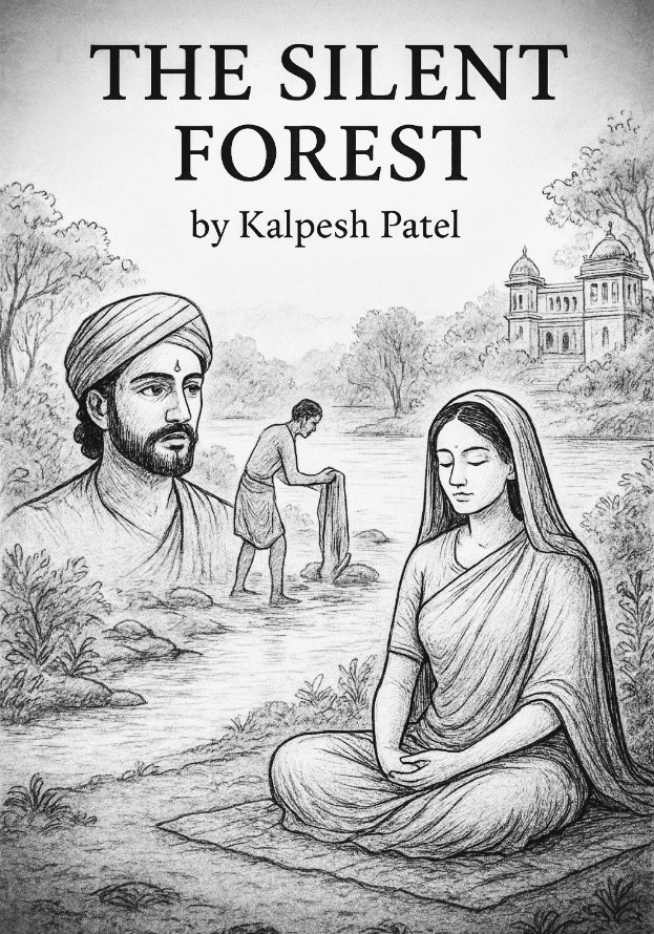
The Silent Forest.
The Silent Forest.

The Silent Forest
by Kalpesh Patel
The palace of Ayodhya glitters beneath the full moon, yet Raam does not sleep.
His hands rest upon the window rail, still as stone, but inside him a storm moves without sound.
The words of a washerman, once thrown into the air like dust, still hang heavy in his chest:
“A king must be pure. How can he keep a wife who has lived in another man’s house?”
He had let those words decide Seeta’s fate.
He had chosen duty over heart, law over love.
The kingdom praises his righteousness; his own soul does not.
At dawn he leaves the palace quietly, no guards, no crown — only a small bundle of cloth and the echo of his own breathing.
He walks toward the forest where once he and Seeta built a hut of laughter and silence.
The river calls faintly from a distance, the earth still wet with dew.
He does not know whether he seeks forgiveness or peace — perhaps both.
When he reaches the forest edge, the wind slows, as if bowing.
He sits beneath a banyan tree, closes his eyes.
First comes noise — the noise of memory.
The cries of war, the shouts of justice, the tremor in Seeta’s voice when she left.
Then guilt rises like heat from the soil, burning his breath.
He lets it come, lets it pass.
He sits longer.
Slowly, the noise begins to melt.
The forest breathes; the river hums softly like an old lullaby.
In that stillness, a presence unfolds before him — not of flesh, but of fragrance and light.
Seeta.
Not imagined, not dreamt — remembered.
Her eyes hold neither anger nor pain, only the calm of someone who has seen truth and ceased to argue with it.
Raam’s lips tremble.
“Seeta… I followed dharma. I thought it was right.”
Her voice rises gently inside his silence.
“Dharma without compassion becomes a cage, Raam. You guarded virtue, but lost tenderness. Meditation is not escape — it is remembrance. It is where the heart learns to forgive itself.”
He bows his head. The wind carries the scent of the earth after rain.
He breathes it in, and for the first time in years, breath feels like prayer.
Time drifts. Day turns to dusk. Somewhere across the river, a man walks alone with his shame — the washerman who once spoke too easily.
He has watched the queen’s exile bring tears to the streets, seen the king’s silence darken the light of the city.
Tonight, the weight of his words crushes him.
He finds his way to the same forest path. His feet are muddy, his heart heavier than the stones underfoot.
When he sees Raam by the river, he falls to his knees.
“My lord,” he whispers, “I was blinded by pride. I spoke as a fool who thought judgment made him pure. Forgive me. My words poisoned love.”
Raam opens his eyes. He looks at the man — not as a king, not as a victim of his ignorance, but as a mirror of his own humanity.
“The fault was not yours alone,” he says softly. “Each of us must awaken from our own blindness. Yours was pride; mine was fear of opinion. Both are noise that hides the soul’s voice.”
Tears fill the washerman’s eyes. “Then bring her back, my lord. Let truth heal what my ignorance broke.”
The river listens. Stars tremble in its surface.
Raam stands, silent for a long moment. The breeze seems to wait for his breath.
He turns toward the path where Seeta once walked away.
And in that turning, something shifts — the weight of kingship falls away like old bark.
He is not returning as ruler, but as a man who has found humility.
When he reaches the ashram near the riverbank, Seeta stands before the firelight, her hair streaked with silver, her eyes luminous with calm.
She looks at him without surprise, as if she has always known he would return when his heart was quiet enough to hear her silence.
Raam bows deeply.
“I came seeking meditation,” he says. “I found confession. I left you because of the world’s voice; I return because I have finally heard my own.”
Seeta steps closer. No anger, no tears. Only stillness.
“The mind that argues with love never wins, Raam. Come, sit. Let us be silent together — not as king and queen, not as husband and wife, but as two souls who remember.”
They sit beside the river. The forest gathers around them — leaves rustling, water murmuring, the sky breathing.
No temple bells ring, no decree is spoken.
Only two hearts listening to what lies beneath sound.
In that unbroken silence, forgiveness blooms like light through mist.
The washerman watches from afar, then bows and leaves, his tears falling into the earth as offerings.
The river flows on, carrying away names, crowns, doubts — everything that cannot stay.
Only awareness remains.
Only love, which is another name for peace.
Raam and Seeta close their eyes.
The forest grows still, holding them as the river holds the moon.
And in that silence, the soul speaks.
Raam and Seeta close their eyes.
The forest grows still, holding them as the river holds the moon.
And in that silence, the soul speaks.
And now, in deep silence, the forest sings, its eternal song.
And at the riverbank, the washerman is no longer alone —
he sits beside his wife, both listening to the same silence
that once divided them, now binding them again in peace.