Library

 Profile
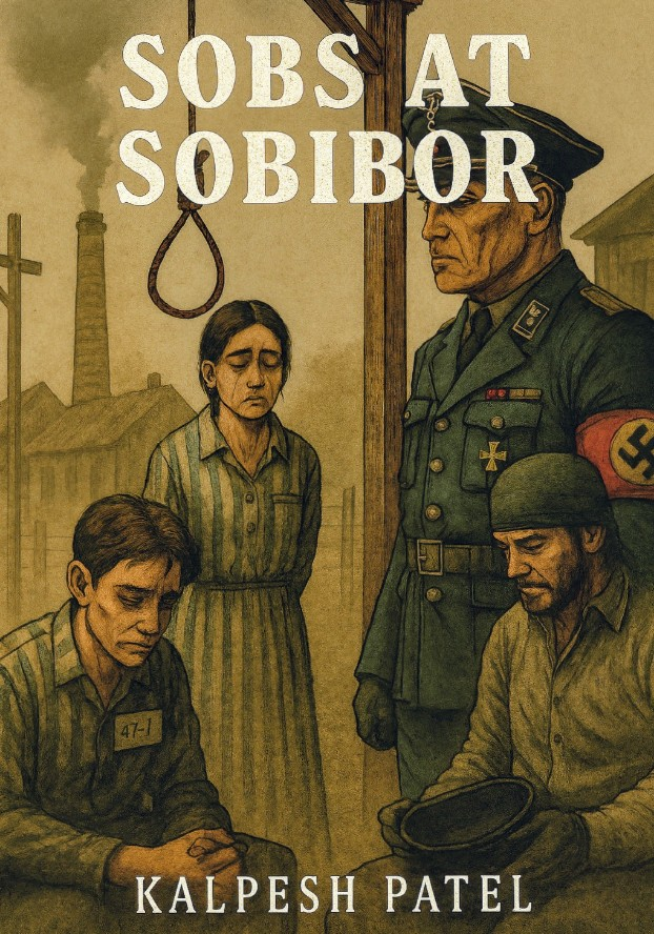
Sobs at સોબીબોર.
Sobs at સોબીબોર.

Sobs at Sobibor
In the mist-shrouded Sobibor camp, the sun never truly rose.
Each morning brought new deaths.
Amid the dust, smoke, and human cries of the gas chamber, German soldiers counted—not lives, but names.
Names to be erased.
World War II was in its final throes.
Luma, a young Jewish woman, carried oceans of tears in her eyes, yet her heart remained calm.
She had never attended school or college, but her hands held a divine gift.
Before capture, she was a surgeon in Warsaw.
Now, in Sobibor, she was reduced to prisoner number 47-L.
No one knew she was a doctor.
Each night, her ordinary-looking hands sketched the human anatomy on the canvas of her mind—
as if trying to preserve life in a place built to destroy it.
Sergeant Oxford served under Nazi Commander Alex.
To him, duty meant blind obedience.
Luma’s turn in the gas chamber hadn’t come yet.
But it visited her dreams often.
One day, as a little girl was shoved into the chamber, Oxford saw tears stream down Luma’s face.
He froze.
Her eyes—filled with grief and silent fury—haunted him.
He began to feel something he hadn’t known: remorse.
And slowly, he began to love her.
Not romantically, but reverently.
Her quiet dignity, her compassion—it shamed the humanity within him.
Then came the Russian airstrike.
Commander Alex was shot—shoulder to abdomen.
Blood poured.
There was no doctor in the camp.
Everyone feared: if the commander died, they’d be next.
Oxford panicked.
Luma stepped forward.
She saw the commander bleeding and wept openly.
Oxford was stunned.
“How can you cry for your enemy?” he asked.
Luma replied,
“Not every tear belongs to our own pain.”
She requested thread, hot water, and a shaving blade.
With trembling hands, she began surgery.
Hours passed.
The commander’s breath steadied.
He survived.
A week later, he awoke.
When he learned a Jewish woman had saved him, rage consumed him.
“An impure hand tied my life’s thread?” he spat.
He ordered:
“Arrest Oxford and Luma. Court-mart.”
Luma smiled.
“Those who give life do not fear death.
What is born must someday die.”
In the dark prison barrack, Oxford sat beside Luma.
He contemplated slitting his wrists.
His hands trembled.
He sobbed—not for death, but for shame.
For being German.
For being complicit.
Luma stopped him.
“Oxford, when cruelty crosses all limits, compassion becomes the truest rebellion.”
She dipped her finger in his blood and wrote on the wall:
Vergebung — Forgiveness.
---
Final Dawn.
May 10, 1945.
Thursday.
Both were led to the gallows.
Luma looked once at the chimney of the gas chamber, then at the sky.
No hatred.
No complaint.
Only compassion.
As the executioner placed the hood over her head, she glanced at Oxford.
Tears welled in his eyes.
Luma felt her life had not been in vain.
Just then, a soldier rushed in with a telegram.
“War over. Germany has surrendered.”
The commander lowered his head.
Execution halted.
Oxford looked at him and whispered:
“Luma, you were right.
The war surrendered.
But compassion did not.”
Luma looked skyward.
Her hands still trembled—
not with fear, but with life.
Even the commander’s eyes filled with tears.
He had nearly killed an innocent.
He spoke, voice cracking:
“Luma… you are free now.”
For the first time, prisoner 47-L heard her name spoken aloud.
---
Years later,
at the Sobibor memorial,
an elderly Jewish woman stood silently.
In her hand, a small paper kite.
On it was written:
“Sometimes, tears born from another’s pain… become the most alive.”
---
Disclaimer
This is a work of fiction inspired by historical events surrounding the Sobibor concentration camp during World War II. The characters, dialogues, and specific incidents are products of creative imagination and do not represent real individuals. The story aims to explore themes of compassion, forgiveness, and moral resistance in the face of cruelty. It is not intended to glorify, vilify, or diminish any group, belief, or historical truth. Some scenes may be emotionally intense and are meant to provoke reflection, not distress.