Library

 Profile
Words of Doomsday
Words of Doomsday

Part 1: The Immortal Assembly
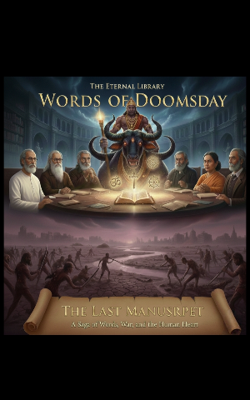
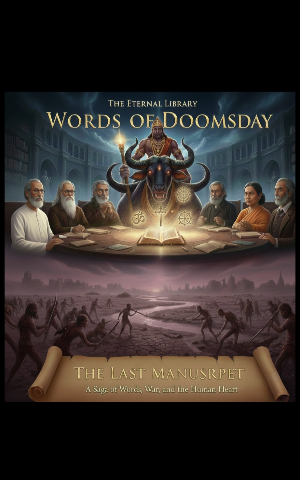
Beyond the boundaries of time and space, where the sky is the color of deep ink, the assembly of 'The Eternal Library' was in session. The walls were covered with manuscripts from thousands of years, and the scent of old parchment floated in the air. At the center of the table sat William Shakespeare. Placing his quill down, he spoke in a deep voice, "Friends, the world below has changed. I am no longer writing tragedies of kings or ghosts, but of 'Silicon Hearts'—where machines mimic love, but souls remain hollow."
Beside him, Munshi Premchand adjusted his glasses and said, "Brother Shakespeare, your heroes fall from palaces, but my 'Hori' is still crawling on the dust of Kaliyuga. His struggle is no longer for bread, but against a mechanical civilization that has stripped him of his empathy." Rabindranath Tagore, stroking his white beard, looked at the stars and said, "I am weaving a 'Gitanjali' where the mind is without fear, but today's man has become a slave to his own virtual shadow."
Then, from a dark corner, came the haunting voice of Edgar Allan Poe, "Are you all still talking of hope? I am writing of the 'Final Heartbeat' that will be heard when man is buried under his own machines. Horror is no longer outside; it is in the void within man." George Orwell slammed his diary on the table and added, "I warned you decades ago! 'Big Brother' is everywhere now—in that small screen in man’s palm, guarding his every thought."
Mahadevi Verma looked at John Keats with gentle eyes and said, "Keats, you are the priest of nature's beauty, and I am weaving words from the tears that modern humans have forgotten how to shed." T.S. Eliot and Milton nodded in agreement. Eliot remarked, "The world has truly become 'The Waste Land'."
Suddenly, the ceiling of the silent library tore open with a terrifying thunderclap. Black ash and the scent of sulfur filled the room. In the center appeared Yamraj in his colossal and terrifying form. He held the glowing 'Kala-Danda' (Staff of Death). His voice thundered like a collapsing mountain:
"Fools! Stop! Throw away these lifeless pens! You sit here decorating rhymes while below on Earth, the funeral pyre of humanity is burning! Kaliyuga has crossed its final limit. My hell is overflowing with souls who never read a single word of compassion, who only spread hatred. The human heart is no longer made of flesh, but of stone."
Fire rained from Yamraj’s eyes, "Kalki’s justice is about to begin. His horse has crossed the boundaries of space. Does your ancient ink have the power to stop the edge of Kalki's sword? I give you one last chance. Combine all—Shakespeare’s drama, Tagore’s spirituality, Premchand’s realism, Orwell’s warning, and Poe’s horror—to write one 'Last Manuscript' that can bring tears back to the eyes of that stone-hearted human. If you can awaken him, only then will the apocalypse be averted."
All the great writers, leaving behind centuries of ideologies, bowed over a single piece of paper. This was the final hope of humanity—Words of Doomsday.
Part -2
After Yamraj’s challenge, a deep silence fell over 'The Eternal Library'. Shakespeare, Tagore, Milton, and Premchand looked at one another. Today, the barriers of language had crumbled. Milton turned the pages of the Bible, Tagore recalled the essence of the Upanishads, and Premchand awakened the memories of the Ramayana and Mahabharata he had heard in his childhood.
The first page they wrote together was not of any single religion, but a 'Great Dialogue' of humanity. The words that emerged on the parchment were as follows:
"O human of Kaliyuga! You gathered stones to build palaces, but you nurtured a stone within your own chest. Do you not remember that Rama erased social distances by eating the tasted berries of Shabari? Have you forgotten that on the battlefield of Kurukshetra, Krishna told Arjuna 'Paritranaya Sadhunam'—that Dharma is not just war, but the protection of the weak?"
On the same page, the echoes of the Bible resonated— "Even while being crucified, Jesus Christ said, 'Forgive them, for they know not what they do.' If God can forgive, why can you not hold one another's hands? The war of Mahabharata tells us that ego only brings destruction, and Rama’s exile teaches us that sacrifice is the truest form of love."
At the end of this manuscript, the writers wrote a heartbreaking appeal— "When the sun rises tomorrow, it will not see how much wealth you possess, but whether you extended your hand to support a falling stranger. Will you leave behind only a pile of rubble and hatred for your next generation? Arise! Awaken the mercy of the Bible and the dignity of the Ramayana within you. One human helping another is the only path that can stop the edge of Kalki's sword."
As soon as this page was completed, a divine light emanated from it, heading straight toward the Earth.
After Yamraj’s warning, an ethereal silence filled the library. William Shakespeare picked up his quill, but his hands were trembling. He looked at Munshi Premchand and said, "My plays remained limited to human jealousy and downfall, but today we must write something that strikes the very soul."
John Milton closed his blind eyes and spoke, "In 'Paradise Lost', I wrote of the war between God and Satan. But today I realize that the true Paradise is lost when man loses mercy for his fellow man. The Bible says— 'Love thy neighbor as thyself'. This is the foundation from which we shall begin."
Rabindranath Tagore hummed a chant of peace from the Upanishads and turned to Premchand, saying, "Premchand ji, the Ramayana and Mahabharata are not just stories; they are mirrors of the inner conflict of man. We must write about that moment when Lakshmana sacrificed everything for Rama."
Premchand added with deep emotion, "Yes, Tagore Babu! We must remind the world that on the battlefield of Mahabharata, when the earth was about to turn red with the blood of kin, Lord Krishna taught Arjuna the meaning of 'Swadharma'. Swadharma is not just about war, but about fulfilling one’s duty. And the greatest duty is to understand the pain of others. Lord Rama, by eating the tasted berries of Shabari, sent a message that in love, there is no high or low. Today's human needs to be reminded of this 'Dignity' and 'Duty'."
Together they began to write. Mahadevi Verma and John Keats dipped those words in the essence of beauty and compassion. On the first page of the manuscript, they wrote:
"O Human! You conquered the world with weapons, but did you ever break a piece of bread for the hungry? When Jesus Christ forgave his executioners while being crucified, it was not just about one religion; it was the pinnacle of compassion. When Rama performed the last rites for the vulture-king Jatayu as if he were his own father, it was a message that the service of humanity is the greatest devotion."
They continued, "The war of Mahabharata warns us that if brother does not hold the hand of brother, only crematoriums and ashes will remain in the end. The apocalypse is not coming from outside; it lies in the hatred within you. The forgiveness of the Bible, the sacrifice of the Ramayana, and the justice of the Mahabharata—all three are calling out: Help one another, for in the end, only 'Love' is the ink that can erase the name of Apocalypse from the pages of history."
As this page was completed, its brilliance was so intense that even the shadow of Yamraj’s Staff of Death began to fade.
Part-3
The scene on Earth was terrifying. Man had built skyscrapers, but his character had crumbled into the dust. Rivers had dried up, but the fire of hatred blazed in every corner. Brother was thirsty for brother's blood. On the streets, instead of helping one another, people watched the spectacle of death. Hospitals had become mere businesses. Even the centers of faith were not untouched by this darkness; the silence of Temples had turned into noise, and the prayers in Churches lacked the old peace and compassion. The 'motherly love' within humans was completely dead.
Just then, the divine manuscript from 'The Eternal Library' entered Earth’s atmosphere like a brilliant beam of light. The great writers found a supernatural way to deliver this message to those who had lost their souls in the blind race of materialism.
The divine message did not spread on paper but began to echo directly as the 'Call of Conscience':
Miracles in Centers of Faith: As prayers were offered in Temples, the sound of the bells suddenly carried the essence of the Ramayana and Mahabharata, whispering— "Service to man is service to God." At the same moment, the scriptures on Church walls began to glow with the words of Jesus Christ— "The Kingdom of God is within you, and it is found only through love."
Impact on the Digital World: Billboards and mobile screens across the world went white. Instead of hateful ads, 'Words of Doomsday', adorned with Shakespeare’s solemnity, Tagore’s philosophy, and Premchand’s simplicity, began to flash.
The First Ray of Change:
At a crowded intersection, a man about to flee after hitting a poor person with his car suddenly stopped. A voice, grave like Milton’s, echoed in his ear— "Will you sell your soul to the Devil for a few coins?" For the first time, he felt compassion instead of fear. He stepped out of his car, embraced the injured person, and took him to the hospital.
At the same time, a wealthy man standing outside a Church, arrogant in his riches, saw Christ’s words in a new light on the window— "Rama embraced Jatayu; will you not support your brother?" He took his hand out of his pocket and, for the first time, extended it to help a stranger.
These people, who were changing, became the living messengers of this word. They began to shout and awaken others— "Stop! We are humans, be each other’s support, for the sword of Kalki can only be stopped by love!"
Part - 4
In the darkest and most dangerous alleys of the city, one name struck terror— 'Arya' (The Noble Warrior). Arya’s past was written in blood, cruelty, and ruthless love. His arms possessed the strength of a thunderbolt; with one strike, he could take any life, and his eyes held only darkness. People trembled at his name. Humanity had died in his heart years ago.
One aspect of Arya’s barbaric past was 'Chhaya' (The Shadow of Love). Chhaya was a girl in the city for whom Arya would go to any lengths. He loved Chhaya with the same intensity of cruelty he showed to others. Chhaya was his weakness, his only human touch. But Arya’s path was one of violence and bloodshed, and Chhaya’s heart always feared that darkness. Arya eventually abandoned Chhaya, knowing his love would only drag her into his darkness.
But on that terrifying night, when the 'Words of Doomsday' echoed from 'The Eternal Library', something miraculous happened. Arya was standing near a deserted church, his hands ready for another crime. Suddenly, the church bell rang, and an echo rose in the wind that struck his very soul. He heard the voice of the Bible— "He who lives by the sword, shall die by the sword." And immediately, he heard the voice of Lord Krishna from Kurukshetra in the Mahabharata— "Ahimsa Paramo Dharmaḥ" (Non-violence is the ultimate righteousness). In that moment, the 'Demon' within Arya collapsed. He realized that true power lies not in taking a life, but in supporting one, and true love is not about possessing someone, but about liberating them. That very night, he severed all ties to his past, even releasing the memories of Chhaya from within himself—he was no longer just 'Arya', but a servant of 'humanity'.
Today, Arya is a transformed man. He roams the city streets not as a monk, but as a protector and guide. His arms still possess the strength of a thunderbolt, but now they rise not to choke a throat, but to pull a trapped child from the rubble or to support a helpless person. People see him and say— "Look, Arya is coming, our God!" He does not consider himself God, but his actions are such that people see him as divine.
In one scene, some armed thugs were attacking a helpless old man and his daughter. Arya arrived. The thugs recognized him and began to tremble with fear. One said, "Arya, you were one of us! Why are you helping these weaklings? Where is your old passion? Where is your Chhaya?"
Arya, calming his thunderbolt-like eyes, said— "My passion is now protection. My Chhaya is the compassion within me. In the Ramayana, Hanuman used his strength for service, not destruction. I could kill you today, but I forgive you, so that you too may become human and awaken humanity in this Kaliyuga. Saving one life is the first step to changing thousands."
Arya has now become the living message of that divine manuscript. Wherever he goes, people connect not with his might, but with his compassion and sacrifice. He cries out— "Help one another, for this is the only religion that can save us from the Apocalypse! This is true love, true sacrifice!" People begin to follow him; his words become a new ray of hope.
The miraculous transformation of Arya on Earth and the light of compassion he spread filled the walls of 'The Eternal Library' with a divine glow. In the grand mirror at the center of the library, known as the 'Kala-Darpan' (Mirror of Time), the writers watched as a brutal criminal became a shield for the innocent.
William Shakespeare, with a twinkle in his eyes, said, "I wrote many tragic heroes who broke in the end, but Arya has turned his own tragedy into a victory for humanity. This is a scene grander than any play."
Munshi Premchand had tears in his eyes. He said softly, "Mr. Shakespeare, this is the 'change of heart' for which literature craves. Arya has shown that even a man buried in the dust of Kaliyuga can follow the path of Rama and Buddha if he chooses."
Rabindranath Tagore, humming his tune of 'Ekla Chalo Re', remarked, "Arya is no longer alone. Thousands of hearts beat behind him. He has broken the boundaries of language and religion, embodying the forgiveness of the 'Bible' and the justice of the 'Mahabharata' in his life."
Suddenly, the floor of the library trembled. Yamraj appeared again, but this time, the terrifying rage was gone from his face, replaced by a deep sense of wonder. His 'Staff of Death' was now calm.
Yamraj’s voice echoed, "Great writers, your pens have achieved what my punishments could not. I thought the sword of Kalki was the only solution for this stone-hearted humanity. But Arya... that criminal, by killing the Ravana within himself, has proven that the divine light still remains within man."
George Orwell stepped forward and asked, "Lord, will the Apocalypse be averted now?"
Yamraj replied solemnly, "Arya has lit a spark, but the rest of the world has yet to awaken. The confluence of the Bible, Ramayana, and Mahabharata you wrote must now reach every heart through Arya. If humanity resolves to follow in Arya’s footsteps, the sword of Kalki shall remain in its sheath. These 'Words of Doomsday' are now becoming 'Words of New Life'."
All the writers, with renewed energy, leaned over the manuscript once more. They were no longer writing just to stop the destruction, but to create a new world.
Last part
1. The Eve of Peace and the Shadow of Terror
The morning on Earth was unlike any other. The influence of the divine manuscript from 'The Eternal Library' was spreading, but the darkness was not going to give up easily. The lords of Kaliyuga—corrupt politicians and arms dealers—felt their power trembling. They saw that instead of fighting, people were shaking hands; instead of hatred, lines of help were forming outside Churches and Temples. These 'Lords of Darkness' decided to crush this change. They ordered their most brutal assassins— "Erase the man the world calls 'Arya'. If he dies, this hope will die with him."
2. Arya’s Confrontation and Inner Power
In the main square of the city, where the blood of thousands of innocents had once been shed, Arya stood today. Behind him were thousands of unarmed people—the elderly, children, and women who now saw a protector in Arya. From the front came modern tanks, armed soldiers, and the thugs filled with hate who once worked with him.
Their leader, 'Kalbhairav', roared, "Arya! You wasted your strength. You became a monk? Did you forget your 'Chhaya', for whom you burned this city? Today we will bury you and this 'humanity' of yours into the ground!"
Arya was calm. His eyes held a deep stability instead of the old cruelty. He took a step forward. Kalbhairav ordered to fire. Thousands of guns were aimed at once. But Arya did not stop. He shouted— "You can fire at me today, but what will you do about the words echoing inside you? Do you sleep at night? Do you not see the fear in your children's eyes? The Bible says love is the truth, and the Ramayana teaches us that the end of unrighteousness is certain. I am not here to kill you; I am here to awaken you!"
Arya’s voice possessed that divine power the writers had poured into the manuscript. When the thugs looked into Arya’s eyes, they saw not their strength, but their weakness. One by one, the weapons began to drop. This was a war not of swords, but of souls. Arya placed his hand on Kalbhairav’s shoulder. That brutal criminal, who had never bowed before anyone, fell at Arya’s feet and began to weep. This was the greatest victory for humanity.
3. Celebration in the Eternal Library and Shakespeare’s Reflection
Up in 'The Eternal Library', the writers watched this scene. Milton breathed a sigh of relief. Tagore put down his pen and said, "Today, words have defeated weapons." Shakespeare smiled and said, "I wrote many tragedies, but what I saw today is more than a happy ending. This is a 'rebirth'." Munshi Premchand and Mahadevi Verma looked at each other with satisfaction that their simplicity and compassion had saved the world.
4. Yamraj’s Manifestation and the Terrifying Truth
Suddenly, the ceiling of the library trembled with a terrifying thunderclap. Yamraj appeared. His form was now so colossal that the entire library was covered in his shadow. The wonder on his face had turned into a cold smile. He looked at the writers and spoke:
"Are you all pleased? Do you think that the change of one criminal and the tears of a few people will alter the cycle of creation? Writers, you are masters of imagination, but I am the guardian of Truth. What you see is merely a 'momentary pause'. The ocean of Kaliyuga is very deep; Arya has only calmed one wave."
Yamraj raised his hand and showed a terrifying glimpse of the future in the 'Mirror of Time'. He said, "Today man is emotional because he felt fear. But remember, as soon as this fear subsides, greed and ego will return. A time will come when man will be so deaf that the mercy of the 'Bible' will seem like a joke and the 'Ramayana-Mahabharata' will be mere old stories. At that time, man will not change by words."
Yamraj’s voice grew heavier, "When Kaliyuga comes in its full ferocity, your great works will only gather dust. At that time, 'He' (Kalki) must come. In that final hour of justice, it will not be the pen, but the sword that strikes. He will erase everything to begin a new Satya Yuga. Until then, this peace is but a moment of respite."
5. The End and a New Beginning
Yamraj vanished. The writers grew silent once more. They realized that their job was only to light the torch; keeping it burning was man’s responsibility. Arya still stood on Earth, helping people. He knew that evil would return, but he had resolved that as long as there was breath in his body, he would keep turning the 'Words of Doomsday' into 'Words of Hope'.
The sun was setting in the sky, but a new ray of hope still remained. This was not the end, but the beginning of an endless struggle.