Library

 Profile
The Man Who Forgot How to Stop
The Man Who Forgot How to Stop

Part 1: The Boy Who Cooked His Own Survival
The aluminum prestige pressure cooker was taller than his torso when he stood on the cold kitchen floor. At eight years old, Arjun dragged a heavy wooden stool to the counter, his small hands balancing a ladle in a pot of boiling rice. In the next room, the rhythmic, aggressive clack-clack-clack of his mother’s calculator punctuated the humid air. Her voice cut through the steam, sharp and warning: "Don't burn it, Arjun. I have auditor work to finish. I don't have time for your mistakes."
He never burned it. He learned early that in this house, mistakes weren't just errors—they were expensive. They cost peace. They cost love.
His father was a tropical storm that passed through the house in unpredictable, violent bursts. He left behind slammed doors, shattered glass, and a heavy, suffocating silence. Arjun became a master meteorologist of human emotion. He learned to read the slight tightening of his father’s jaw, the subtle raise of a hand, the exact pitch of a footstep on the stairs. He learned the art of becoming invisible yet indispensable.
When his sister cried about the heat or her school travels, she was comforted. When his mother stressed over deadlines, she was given space. But Arjun had a stove, a washing bucket, and a childhood that ended before he ever learned to ride a bicycle.
"You're the man of the house when your father is like this," his mother would say, handing him the grocery list without looking up. "You're strong. You can manage."
So he did. He swallowed his own needs so quietly that eventually, he forgot he had them. For decades, he managed.
Part 2: The Breadwinner Who Forgot He Was Human
By thirty, Arjun’s spine felt less like bone and more like an iron pillar holding up a collapsing roof. He had carried his family through every financial crisis, every health scare, every broken appliance, and every emotional deficit. He climbed the corporate ladder in Chennai’s grueling IT sector, moving from software troubleshooting to cloud computing architecture. He became the project manager who never logged off.
He was the anchor. The one who stayed while his sister married and moved away. The one who absorbed the debts. The one who never said no.
Yet, the goalposts of approval were always moving. "Look at Sharma’s son," his mother would remark over morning filter coffee, her eyes glued to the newspaper. "He just bought his parents a three-bhk apartment in Besant Nagar. Why can’t you manage that with your IT salary?" If he asked his sister to handle even a single bank errand for their mother, her voice would erupt through the phone: "I have a family of my own to look after, Arjun! You're right there, why are you being so selfish?"
Arjun didn't argue. Complaining was a luxury meant for people who had a safety net. He had a voice inside his head—honed by nineteen years of conditioning—that whispered: You are only worthy of space on this earth if you are useful.
He worked through migraines that made the glowing monitor look like a blinding sun. He worked through a bone-deep exhaustion that coffee could no longer touch. He worked through the terrifying sensation that his internal gears were grinding into dust.
And then, the machine broke.
Part 3: The Year the World Stopped
Arjun was forty-three when his body filed for bankruptcy.
It didn't happen all at once; it happened in terrifying, silent thefts. First, it took his words. During a high-stakes client presentation, he stared at a familiar spreadsheet and the numbers suddenly swam like tadpoles in dark water. He froze, his tongue heavy, unable to find the English or Tamil word for "revenue." Then, the physical gravity changed. Walking from the bedroom to the bathroom felt like wading through wet cement. He would wake up after nine hours of sleep feeling as though he had been beaten with iron rods.
He consulted four different specialists. Each encounter felt like an interrogation where he was the suspect.
"Your blood work is pristine, Mr. Arjun," the neurologist said, barely looking up from his tablet. "Your vitamin D is slightly low, but this is clearly clinical depression and corporate burnout. You need to push through it. Get some fresh air. Start walking three kilometers every morning. If you stay in bed, you let the illness win."
But the advice was poison.
The morning he forced himself to walk around the neighborhood park, he felt a strange, hollow ache in his muscles. By evening, the crash hit him like a physical truck. A roaring fever without a infection. Swollen lymph nodes. A headache that felt like a spike driven through his temples. Ten minutes of light chores—merely sweeping the hallway—sent him into a dark room for forty-eight hours, unable to tolerate the sound of a ceiling fan or the light filtering through the curtains.
The doctors prescribed selective serotonin reuptake inhibitors (SSRIs). They suggested cognitive behavioral therapy. They smiled condescendingly, treating his physical agony as a psychological flaw. They looked at a man who had worked himself to the bone and diagnosed him with a lack of will.
Part 4: The Invisible Cage
In the dim light of his smartphone, his screen brightness turned down to the absolute minimum to protect his aching eyes, Arjun found his diagnosis online.
Myalgic Encephalomyelitis / Chronic Fatigue Syndrome (ME/CFS).
He read the words and felt a cold shiver of validation and horror. There it was, spelled out in clinical terms: Post-Exertional Malaise (PEM). The cellular inability to produce energy. The delayed crash. The mitochondrial failure. He read about the millions of people living in dark rooms, dismissed as lazy or hysterical by a medical community that equated "undiagnosed" with "imaginary."
He wasn't crazy. He wasn't malingering. He was profoundly, physically broken at a cellular level. But his realization came with a dark truth: there was no cure, no approved treatment, and no insurance policy in the country that recognized the quiet war occurring inside his cells.
Part 5: The Family That Wouldn't Stay
The house did not stop demanding its toll just because the breadwinner had fallen.
"Arjun," his mother said, standing at the foot of his bed, her voice dripping with habitual grievance. "Take the pulp out of the coconut. I need it for the chutney. The mixer-grinder is right there."
He turned his head slowly, his eyes glazed with brain fog. "Amma... I told you yesterday. My hands are trembling. If I use the scraper, I won't be able to sit up tomorrow."
She sighed, a heavy, theatrical sound, and muttered as she walked away, "Everything is an excuse these days. In our time, we worked through typhoid."
An hour later, his sister's voice blasted through his phone speaker, sharp and demanding. "Arjun! The bank made an error on the mutual fund dividend. It’s short by ₹2,000. You need to call the manager right now and sort this out."
"I can't read the screen today, Radha," he whispered, his throat raw. "The letters are moving."
"Oh, so now you can't even make a phone call?" she shouted. "We are only asking you for small things because you're sitting idle at home all day! You aren't even trying to get better!"
They did not see a human being in the throes of a multisystemic collapse; they saw a utility bill that had suddenly defaulted. They treated him like a refrigerator that had stopped cooling—annoyed by the inconvenience, completely indifferent to the machine itself.
Part 6: The Truce
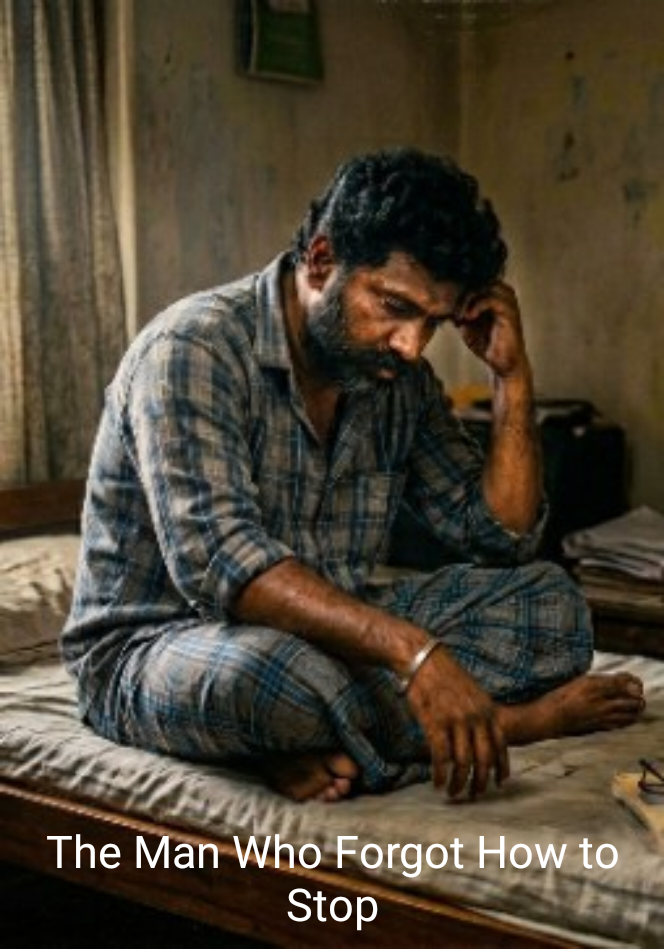
The next few months dissolved into a horrifying blur. Arjun could no longer read his beloved books; thirty seconds of concentration triggered a blinding pressure behind his eyes. He tried to watch a simple television show, but the fast cuts and audio tracks felt like an assault on his nervous system.
He lay in the narrow bed of his youth, listening to the world spin outside his window—the honking of cars, the vegetable vendors shouting on the street, the distant laughter of neighbors. He felt like a ghost haunting his own life.
One Tuesday night, as the guilt began its usual midnight rotation—How will you pay the maintenance fee? What if you never work again? Look at what a failure you are—Arjun looked at his trembling hands in the dark.
He asked himself a question that felt like treason: What if I just stop trying to fix this?
Not giving up on life. But stopping the war against his own biology. Stopping the desperate search for a cure that didn't exist. Stopping the exhausting performance of trying to appear "okay" for a family that only valued his output.
Every fiber of his nineteen years of programming screamed against it. If you stop, you are nothing.
But his cells were emptier than they had ever been. He had no more fuel to burn.
He looked into the darkness of his room and whispered into the quiet air: "I am done. I am done trying to force this body to be a machine. I am just going to lie here, and I am going to breathe."
It wasn't an act of defeat. It was an act of radical survival. It was a peace treaty signed in the dark between his mind and his broken mitochondria: I will stop whipping you. I will let you rest. I will no longer punish you for being sick.
Epilogue: The Victory of Standing Still
Arjun still spends twenty-two hours a day in his room. He still loses his train of thought mid-sentence, still feels the terrifying heavy-lead crash if he pushes past his fragile boundaries, and still hears the bitter remarks of a family that eventually grew tired of his illness and drifted away into their own lives.
But the atmosphere inside his room has completely changed. The toxic fog of guilt has cleared, leaving behind a stark, beautiful stillness.
He no longer checks job portals with a racing heart. When his mother demands an errand he cannot perform, he calmly says, "No," and closes his eyes, letting her anger wash over him like rain on glass. He drinks his water slowly, savoring the cool contrast against his throat. He watches the shadows of the neem tree shift across his wardrobe, finding a strange, quiet poetry in the passage of time.
He is not healed. The medical books say he may never recover his old life. But Arjun has achieved a much rarer victory. He has unlearned the lie that his human worth is tied to his economic productivity.
He is enough.
He is enough when he cannot hold a conversation. He is enough when the bills go unpaid. He is enough when he is entirely empty.
The bravest thing Arjun ever did was not climbing the mountain or rescuing his family. The bravest thing he ever did was choosing to lay down his arms, step off the battlefield, and let the world spin on without him—finally learning, at forty-four years old, how to stop.