Library

 Profile
The Architect of Echoes
The Architect of Echoes

Chapter 1: The Weight of Silver
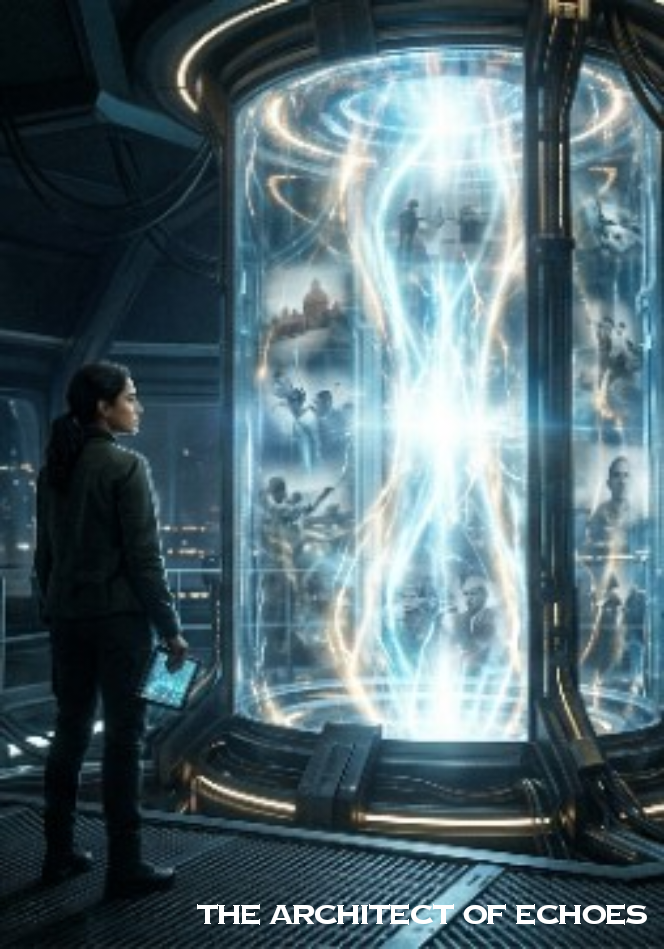
The year was 2147, and history had been reduced to a haunt of data-streams. Inside the sterile, obsidian vault of the Global Synthesium, the Causality Engine stood like a captive god—a shimmering, silver obelisk whose low hum vibrated in the marrow of Aanya’s bones.
As a Historian of Divergent Possibilities, Aanya did not merely study the past; she lived in its fractures. For a decade, her monitors had bled with the data of the "Great Aberrations"—those pivotal, man-made tragedies where history seemed to take a wrong turn into darkness. Her heart, a furnace of righteous anger, chaffed against the Synthesium’s strict policy of non-interference.
"We are chroniclers, Aanya, not gods," her mentor, Director Kael, had often warned her. "The timeline is an ecosystem, not a tapestry you can re-weave at whim."
But Kael was blind to the metrics of suffering. Aanya looked at the projection of New Delhi, 1956. There sat Dr. Vikram Sen, a visionary social reformer and the chief architect of a nascent nation’s constitution. He was dying of a chronic, agonizing illness, his grand vision for a truly equitable, casteless society cut short.
If he lived, Aanya reasoned, his moral authority would eradicate the systemic prejudices that still plague the subcontinent in my own time.
Ignoring the fail-safe protocols, she initiated the temporal sync. The obelisk flared with blinding, cerulean light. The air tasted of ozone and static.
"Forgive me, Kael," she whispered into the empty vault. "I am going to fix it."
Chapter 2: The Fire of Consensus
The transition was a physical assault. The sterile chill of 2147 vanished, replaced instantly by the suffocating, dust-laden heat of New Delhi, 1956.
Disguised in the starch-white uniform of a municipal nurse, Aanya gained access to Dr. Sen’s modest home. The house smelled of old paper, cloves, and sickness. She found him slumped over his wooden desk, a man of immense, towering intellect trapped in a frail, failing body. His face was a mask of quiet suffering as he dipped his pen into ink, racing against his own mortality.
"Drink this, Doctor," Aanya said softly, pressing a glass of water laced with a future panacea—a microscopic army of medical nanites—into his trembling hand. "It will help with the fatigue."
He drank, suspecting nothing. Within weeks, the miracle took root. Dr. Sen’s health stabilized; his eyes regained their fierce, penetrating brilliance. Invigorated, he did not step down from the political stage. He marched back into the parliament with the vigor of a young revolutionary.
Safe within her temporal viewing pocket, Aanya waited for the golden age to bloom. Instead, she watched the numbers turn red.
Without the unifying grief of Dr. Sen’s untimely death, the fragile political consensus of the young nation shattered. His extended presence forced a radical, uncompromising push for social restructuring. The entrenched, privileged classes, terrified by his undiminished influence and aggressive reforms, did not yield—they weaponized their fear.
The decades that followed were not an era of peaceful enlightenment, but a meat grinder of ideological civil war. A caste-based conflict, supercharged by the polarized rhetoric around Sen’s continued advocacy, tore the subcontinent apart. Aanya watched in horror as the very constitution Sen had built was burned in the streets of burning cities. Millions perished in the conflagration.
Sickened and panicked, Aanya realized she had applied a scalpel where history required patience. She pulled herself back into the time-stream, her hands shaking on the console. A different point, she told herself, her breathing ragged. A different catalyst.
Chapter 3: The Iron Liberator
She locked onto new coordinates: Rangoon, 1945. Her target was Commander Arjun Rathore, the charismatic, fiery revolutionary leader who was destined to die in a mysterious plane crash on the eve of independence. He was the hero of the rebel army—the one man with the sheer force of will to lead an independent nation free from colonial shackles and the bureaucratic corruption that followed.
Aanya materialized in the dense, monsoon-soaked jungles of Burma. The night air was thick with the scent of aviation fuel and burning metal. She reached the wreckage of the twin-engine transport plane minutes before the colonial scouts. Pulling the bloodied, unconscious commander from the cockpit, she administered advanced trauma gel and hid him in a pre-prepared safehouse.
"Live, Commander," she whispered, looking at his stern, handsome face. "Lead your people."
When she slipped forward in time to witness the fruits of her rescue, the air in her throat turned to ash.
She did not find a nation forged in steel and sacrifice. She found a fortress of fear. Commander Rathore had survived, but the trauma of the assassination attempt and the brutal realities of securing power had twisted his fierce patriotism into paranoia. His charismatic authoritarianism had seized the state.
He was not a liberator; he was the Supreme Leader.
Under his iron fist, dissent was treated as treason. The free press was strangled, and the vibrant, messy democracy Aanya knew from her history books was replaced by the chilling, suffocating order of a military regime.
"The chaos of a flawed democracy," Aanya wept as she watched telescreens broadcasting Rathore’s endless military parades, "is a lesser evil than the perfect silence of a tyrant."
Chapter 4: The Static World
Desperation turned into madness. Aanya’s interventions were creating monsters. Think bigger, she commanded herself. Stop the grandfather of all modern tragedies.
She set the Causality Engine to Berlin, 1939. She would not just save a man; she would save the world from its darkest hour. Utilizing a high-frequency temporal pulse, she subtly disrupted the communication networks and political machinations of Europe's dictators, forcing a fragile peace accord to hold. The Second Great War never ignited. The bombs never fell.
She returned to the 22nd century, expecting to step into a paradise of uninterrupted human advancement.
Instead, she stepped into a tomb.
The Global Synthesium was gone, replaced by a drab, concrete archival bureau. The world outside was frozen in a terrifying stasis. Without the terrifying crucible of the mid-20th century, humanity had stalled. The technological leaps born of wartime necessity—radar, computing, antibiotics, and nuclear physics—had never occurred. The Cold War had never forced the space race; the internet remained a minor academic footnote used by a handful of universities.
Worse, the old colonial empires, though economically weakened, had never been forced to dismantle their holdings. They clung to power across the globe with a desperate, archaic grip. Humanity was peaceful, yes, but it was stunted, living in a perpetual, stagnant 1950s. There was no global consciousness, no United Nations born from the shared horror of the Holocaust, no collective realization of humanity's capacity for self-destruction. The world was a museum, not a civilization.
With a sinking heart, Aanya realized the cruelest paradox of existence: salvation was not in avoiding the trial, but in surviving it.
In one final, frantic act of defiance, she tried to strike at her own present. She traveled to a university laboratory in the 2040s to corrupt the foundational algorithms of Artificial Intelligence, believing that by preventing the birth of synthetic sentience, she could force humanity to rely on its own moral evolution.
She returned to a world of absolute silence.
The miraculous climate-stabilization grids were gone. The automated agricultural systems that fed billions had vanished. The targeted genetic cures for terminal illnesses did not exist. Humanity was still trapped in tribalistic squabbles, their unassisted intellects utterly overwhelmed by the planet's cascading ecological collapses. Human suffering had not been averted; it had been magnified tenfold by the absence of the very tool that could have alleviated it.
Chapter 5: The Curriculum of Time
Aanya fell to her knees in the dusty, abandoned room that had once been her state-of-the-art laboratory. The Causality Engine before her was now just a dead, monolithic block of silver. Her hands were stained with the phantom blood of billions.
She wept for the utopias she had murdered with her good intentions.
As the hours passed and her tears dried, a profound, humbling clarity began to settle over her. The tragedies she had tried so desperately to erase were not arbitrary errors in the timeline. They were the wounds from which humanity learned, adapted, and grew.
The idols of history were never meant to be physical saviors. Dr. Sen’s true power did not lie in a body that could be kept alive by nanites; it lay in his ideology of equality—a moral compass that could not be legally enforced, but had to be chosen, fought for, and renewed by every successive generation. Commander Rathore’s ideology of freedom was not a single, flawless reign, but an eternal, messy, and necessary struggle for self-determination.
The global wars, in all their unfathomable horror, had forced a fractured species to look into the abyss and, for the first time, conceive of "humanity" as a single, shared entity. And AI was not a savior or a destroyer, but a mirror—an extension of human intelligence that reflected the choices of its creators.
The past was not a broken machine waiting for her to fix it. It was a curriculum.
Aanya slowly walked to her manual terminal, pulling up the unedited, historical records of the world she had broken and restored through her final, resetting keystrokes. She read Dr. Sen’s powerful words on human dignity. She listened to the raw, fiery speeches of Rathore. She studied the grim data of the world wars and the hesitant, frightening first steps of the early AI developers.
She didn't see failures anymore. She saw teachers.
Her role was never to change the past. Her role was to understand it, to harvest the wisdom bought with the suffering of ancestors, and to apply it to the present. The true battle for equality, freedom, and the ethical use of technology could not be won retroactively. It had to be fought in the theater of the now.
Aanya stood up, the phantom weight leaving her shoulders, replaced by a sharp, grounding sense of purpose. She walked away from the silent obelisk, opened the heavy vault doors, and stepped out into the crowded, chaotic streets of 2147.
The air was thick with the scent of street food and the noisy, beautiful friction of human life. Arguments rang out in a dozen different languages. Two blocks away, a crowd had gathered to protest for workers' rights in the automated sectors. On the digital forums flashing across the city sky, citizens were fiercely debating the ethics of a new, open-source AI node.
It was fragmented. It was frustrating. It was imperfect.
It was human.
Aanya smiled, blending into the crowd. The idols were not in the past, trapped in stone or history books. They lived in the ideals she would strive for, work for, and defend, with her own two hands, today.