Library

 Profile
The Invisible
The Invisible

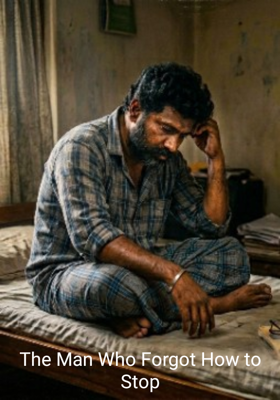
Arjun stared at the glowing rectangle in front of him. The comments section was a battlefield. "Your hook's not working," one person wrote, a short, sharp jab that felt like a surgical strike. Another one, even more cutting, said, "Where's the quality? You're a professional, act like it." They didn't know about the 15-hour days, the chronic fatigue, the depression that felt like a fog in his brain. They didn't see the silent screaming his mind was doing as he tried to find a glimmer of creativity. All they saw was the end result: a video with low engagement. A failure.
For years, his work had been his coping mechanism. It was a way to outrun the demons, to prove his worth in a world that had always made him feel like he had none. The platform was a promise, a place where he could build a community, a chosen family. But it had become just another transactional space.
The message from his manager, terse and emotionless, was the final straw: We need to see better returns on your content. The last few weeks have been a concern. He was being evaluated on a spreadsheet, reduced to a metric. The words, so cold and unfeeling, hit him where his deepest wounds lay—the same place where his childhood bullies had once mocked his speech disability.
A wave of white-hot anger, a symptom of his illness he had learned to hate, surged through him. He typed out a reply, his fingers flying across the keyboard, a furious, unfiltered burst of frustration. He knew it was unprofessional. He knew it was a career mistake. But he was past caring. He sent it.
The moment the email was gone, a wave of shame and regret washed over him. This wasn't him. He wasn't a man who yelled or blamed others. He was the man who always said "sorry," who tried to make peace even when he was on the receiving end of a transaction. He sat for an hour, the shame a living thing in his chest, and then he typed again.
This time, the words were careful, stripped of all blame. "I apologize for my tone," he wrote. "It was unprofessional. I am currently dealing with a severe mental health condition, and my frustration came through. I hope you can understand." He wasn't asking for a break. He wasn't even asking for forgiveness. He just wanted them to see, for a moment, the human behind the content, the person whose invisible wound had just been poked with a stick.
But there was no reply. Not a single word. Not a simple "okay" or "thanks for the honesty." The silence was deafening. He had offered up his deepest pain as an explanation, and the lack of a response said everything. They didn't see it as an apology or a truth. They saw it as an excuse, a "cooked-up story" from a creator who couldn't deliver. They had no time to believe in a narrative that didn't benefit them.
It was in that moment that the final layer of armor fell. They had never seen him as a person. He was a resource, a transactional entity, one of many. The platform was a stage, and he was just an actor with no power, a person who could be used and discarded. He knew then that the apology wasn't for them. It was for him. It was a way of saying, "Even when they can’t see my truth, I will not lose my integrity. I will not become the person they think I am." The pain was still there, but now it was a part of his story, a truth that he no longer needed their validation to hold on to.