Library

 Profile
The Black Pot
The Black Pot

Professor Arundhati Sen was a highly regarded economics professor in a reputed Kolkata university. A woman of sharp intellect and rigorous discipline, she could dissect fiscal policy with the same ease with which others brewed tea. Yet, her students often whispered about the "other side" of her life.
Arundhati was a fervent devotee of Goddess Kali. Not in the way most people are—attending temple on auspicious days or lighting lamps during Diwali. No, she was devoted with her whole being. Every evening, she performed rituals with offerings of fish and wine, chanting mantras that echoed through the apartment she shared with her younger sister, Krittika, a software engineering student.
Krittika found her elder sister's religious zeal strange, even unsettling.
“You sound like you're living in the twelfth century,” she’d say, rolling her eyes.
Arundhati would smile gently, tapping her temple, “You code systems. I decode the cosmos.”
Their verbal sparring was frequent, and neighbors often overheard philosophical rants and furious tech jargon flying across their thin apartment walls.
But what disturbed Krittika the most was not the rituals—it was Arundhati’s claims. She would say, “I have spoken to Shiva today. And yesterday, it was Durga. They are all eager for Kali’s triumph.” She said gods and goddesses conversed with her regularly.
People, fascinated and fearful, started visiting her for spiritual counsel. Some came with garlands, others with questions. Many left with tears in their eyes, saying she had changed their lives.
Krittika grew more alarmed by the day. But she tried to remain focused on her final year project. She had dreams: to work for a top multinational, to build her own app someday. She had no time for mysticism.
Recently, their cousin Rohit had come to stay with them. An accountant by profession, he was practical to the core. He admired Arundhati’s academic brilliance but couldn’t ignore the growing eccentricity in her behavior.
One rainy evening, something changed. Arundhati had been fasting all day and speaking little. She stared at the black earthen pot on her altar with a trance-like intensity. Then, just as the lights flickered, she saw Her.
The goddess.
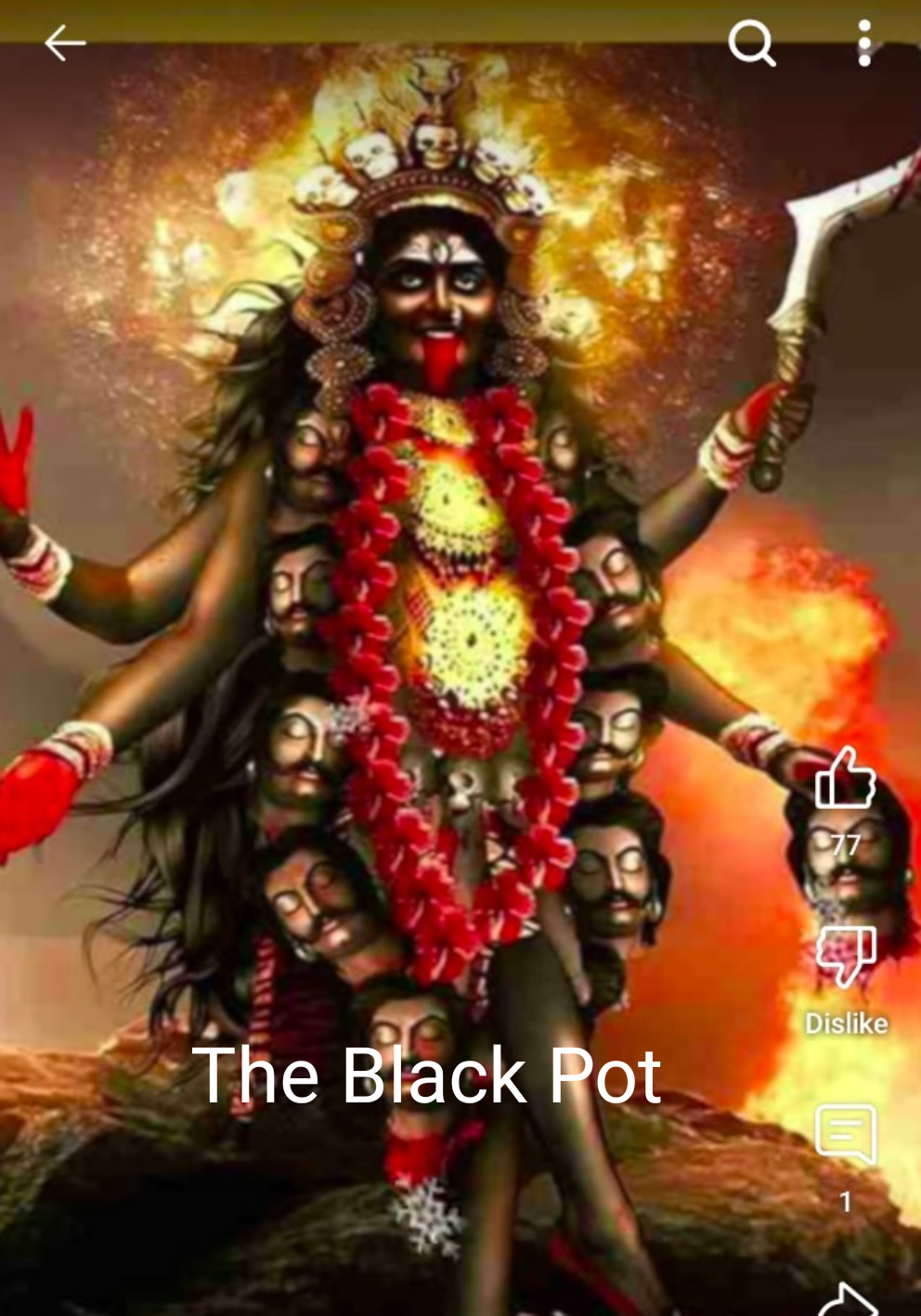
Mother Kali appeared—not solid, not a statue, not a hallucination either. A radiant, shadowy form, with glowing eyes, matted hair, and a garland of skulls. Arundhati froze.
The apparition didn’t speak like a human. The voice came from within her own mind.
“Give me blood. I will fulfill all your wishes. Supernatural power shall be yours. Sacrifice your sister to me.”
Arundhati’s heart thundered. She fell to her knees, weeping, “Mother… my sister is young… innocent…”
But the vision only grew more intense, the black pot now seeming to tremble on the altar.
That night, Arundhati laid out everything for an elaborate midnight ritual. Incense sticks, wine, red hibiscus flowers, and in the center of it all—a long, newly bought knife.
Rohit was up late, scribbling financial notes when he heard a low chant. He paused. The chanting grew louder. Unsettled, he tiptoed to the sisters’ room and peered in. His blood ran cold.
Arundhati was kneeling before the altar, eyes wild, voice cracked with devotion.
“Mother, your wish, your command. I am going to sacrifice my sister to you.”
The knife gleamed under the lamplight.
Rohit couldn’t believe it.
He barged out of the shadows and screamed at the top of his lungs.
“STOP! ARE YOU MAD?”
The apartment burst into panic.
Krittika sat up, stunned. “What’s happening?!”
She saw her sister rise, knife in hand, eyes burning with a frenzy she had never seen before.
Before Arundhati could take a step, Krittika leapt across her bed like a wildcat. Her palm struck her sister’s arm with a force that made the knife clatter to the floor.
Krittika grabbed it and backed away.
“Rohit, help me! We have to stop her!”
The two of them overpowered Arundhati. She didn’t resist much. Her strength was sapped by whatever she had seen, or thought she had seen.
They tied her hands and feet with a bedsheet.
“I’m taking her to a doctor tomorrow,” Rohit muttered, still trembling. “We have to get her help. She needs help.”
The next morning, Arundhati didn’t fight. She barely spoke. Her eyes looked sunken, her mind somewhere far away. At the psychiatric clinic, she slept for hours. Days passed. Medicines worked. The storm quieted.
When she finally woke up, truly awake, Arundhati wept. Not in fear or shame, but in clarity.
“I was so close,” she whispered to Krittika and Rohit, “to doing something that would’ve haunted me forever.”
Krittika knelt beside her. “It wasn’t you. It was something that took hold of you. And you’re back now.”
Arundhati stared into the distance.
“Do you know,” she said softly, “how many so-called saints, possessed people, or deranged devotees must have done the same to their own? Sacrifices in the name of gods—when all the gods ever wanted was love and truth.”
They didn’t report her to the police. They told the university she had suffered a mental breakdown due to stress and overwork. She was given a sabbatical. Her job was safe.
Over the weeks that followed, Arundhati read nothing but medical journals and spiritual works that spoke of the dangers of unchecked mysticism. She began meditating—not to awaken gods, but to understand her own mind.
One evening, she placed the black earthen pot outside and smashed it with a hammer. The wine, the fish, the symbols—all were gone.
“I saw darkness take the shape of divinity,” she told Rohit. “And it nearly devoured me.”
Krittika smiled, tears in her eyes. “Good thing the goddess prefers brains over blood.”
They laughed, the first true laughter in weeks.
And Arundhati, professor of economics, returned not just to her classroom—but to herself.