Library

 Profile
RANGA: THE UNLIKELY AVENGER
RANGA: THE UNLIKELY AVENGER

In a world where the word service had long lost its sanctity in government circles, men like Ranganath Behera stood out—like a crack in a flawless mask, revealing the truth beneath.
Motiganj in Balasore was a sleepy town, crawling with emotionless officers, greedy contractors, and the invisible hoi polloi—voiceless, toothless, trampled under the iron boots of bureaucracy. It wasn’t the kind of place where heroes were born. And yet, Ranga, or Ganga as people affectionately called him, became one.
He had once been a monster in the eyes of the law—a killer who had ended four lives. But those who knew the truth whispered a different story.
The people Ranga had murdered weren’t martyrs; they were leeches. A corrupt MLA who siphoned off flood relief funds. Two arrogant IAS officers who had forced slum demolitions to make way for luxury complexes. And a wicked contractor who had enslaved dozens, including a Bengali girl named Mithu, whom Ranga saved from a horrific fate.
Ranga married her. She was fifteen years younger, but she had insisted. “You saved my life. You may have taken four, but I would be the fifth if you hadn’t interfered.” He hesitated, ashamed of his past, but Mithu had looked him straight in the eye and said, “A bad man doesn’t risk his life for someone like me.”
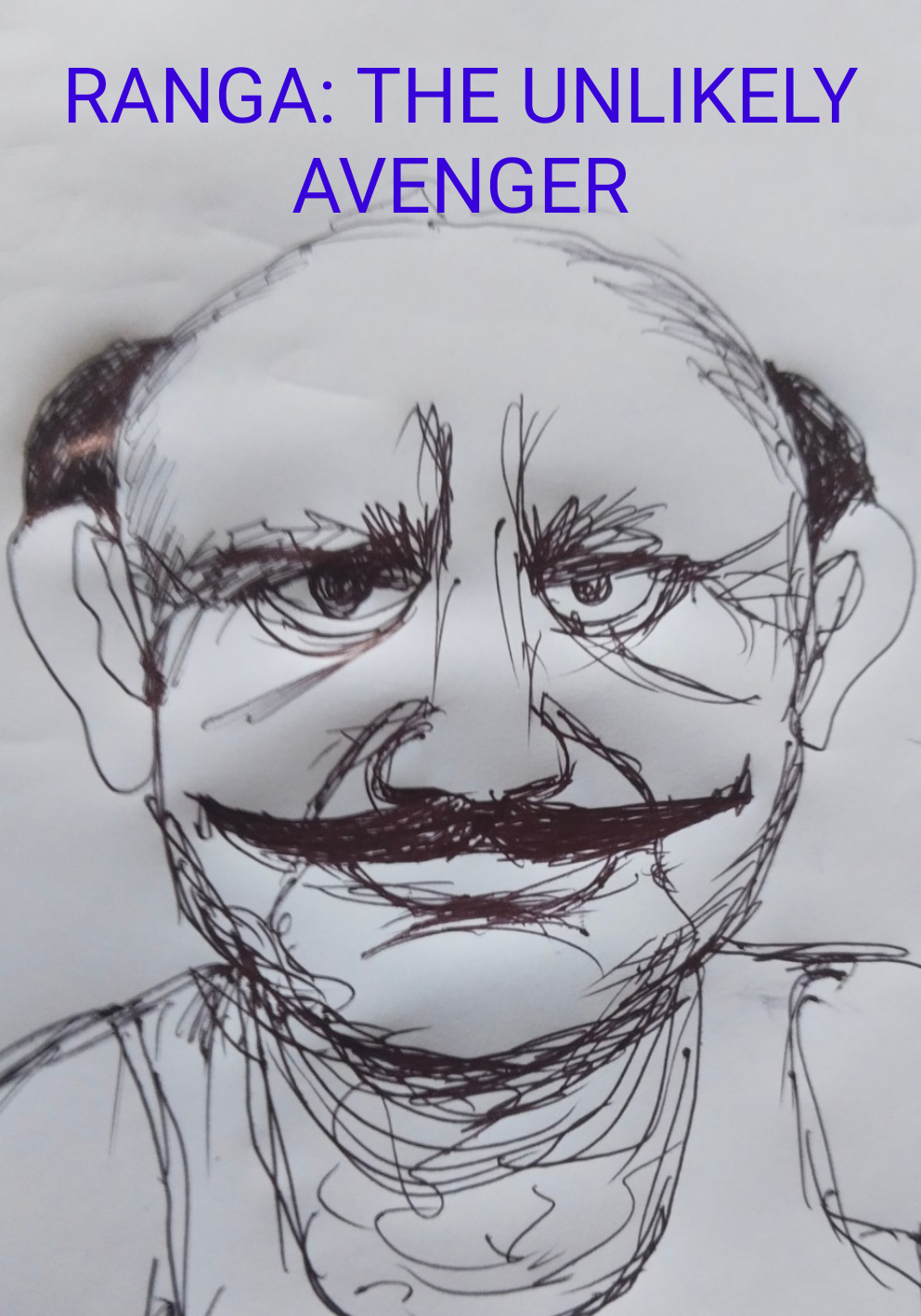
Now, Ranga ran a humble tea-and-bidi stall near the Motiganj bus stand. He wore the same dirty vest and khaki shorts every day, his bald head shining in the sun like polished brass, his handlebar moustache twitching now and then with suppressed fury or joy. He rarely spoke. But his eyes always observed. Watched. Judged.
I was just another name lost in the slum census. From Kendrapara, trying to escape a past full of failure and addiction. I had wasted three years after dropping out in Class 8. I smoked bidis, chewed pan, and roamed with urchins. But now I was in Balasore to prepare for my entrance exams, hoping to rejoin the path I had once abandoned. Ranga's pan was the only indulgence I hadn’t kicked yet—it was addictive, seasoned with cloves, fennel, and what I suspected was a drop of some divine elixir.
Ranga never spoke to me. But my nephew Babu knew everything about him. He had said once, “Ranga is not a good man. But he is the kind of bad man good people need.”
One sultry afternoon, Babu and I were at Ranga's stall. Hari, the local water-supplier, came cycling in, panting with frustration. He sat on the edge of the stool and began venting.
“That devil of a Tehsildar is asking for ten thousand rupees! Just to settle a simple boundary dispute! He says, ‘No bribe, no justice.’ Where do I go? What do I do?”
We expected a shrug from Ranga. Or silence. But something cracked.
Ranga suddenly stood up. His muscles stiffened. His fingers clenched the edge of the tea table. His moustache bristled like the mane of an angry lion.He spoke Hindi when he got infuriated. “Gunda ho gaya hai sarkar. Choron ka raaj hai,” he growled.
Then, with alarming speed, he shut his stall. Slapped the lid down on the steaming tea. Locked up the pan box. He turned to Hari and barked, “Chadh ja. Cycle pe.”
Hari, shocked and confused, climbed onto the carrier of Ranga’s rusted cycle. And with terrifying force, Ranga began pedalling toward the Tehsildar’s office.
The market buzzed alive. Babu and I looked at each other and ran behind, as did nearly thirty people. Shopkeepers, slum kids, rickshaw-wallahs, women with their dupattas flying in the wind. The sight of Ranga cycling like a missile through the narrow lanes of Motiganj was enough to bring everyone out.
At the Tehsildar’s office, the old peon tried to block the gate. Ranga, without breaking speed, slammed a kick straight into the man’s chest. The peon flew back, crashing into a bench.
Ranga stormed in like a cyclone. Before the Tehsildar could look up, a powerful kick landed on his chest. Papers flew. Files scattered. The officer fell off his chair, gasping.
A second kick, more furious than the first, made him curl up, pleading.
“Forgive me! Please! I’ll give the money back. No need for police! Please!”
“Police?” Ranga spat. “Call them. I’ll wait. Tell them how you took money to deny a poor man his land.”
Within minutes, Hari's case was resolved. The documents were signed, the file stamped, and the money returned. All done while a hundred townspeople stood outside, shouting, “Long live Ranga Bhai!”
Fifteen days later, the Tehsildar applied for a transfer and vanished from Balasore. Rumours spread. People began to come to Ranga with their problems. He would listen, but rarely act. “Bas ek hi bar phir se chalu karoon, toh chaar log aur girein. Is baar jail nahi—phasi hoga,” he said to Mithu once.
He had changed. He didn't want to be the avenger anymore. But injustice had a way of seeking him out, like iron filings to a magnet.
Still, Ranga now preferred peace. He sold his pan and tea. Took his son for tuition. Loved Mithu with a quiet tenderness. At night, he whispered prayers—perhaps not to any god, but to the ghosts of those four lives, asking for forgiveness.
As I stood near his stall one evening, watching him mix lime and catechu on a betel leaf, I realized I had passed my entrance exam. I would take my matriculation soon. Maybe I would become someone useful someday.
But men like Ranga—they were already useful. More than all the officers and politicians combined. A criminal, yes. But also a prophet of justice in a world gone silent.
The tea steamed. The town slept. But somewhere, the legend of Ranga grew—like a banyan tree with roots tangled in both crime and compassion.