Library

 Profile
Peace
Peace

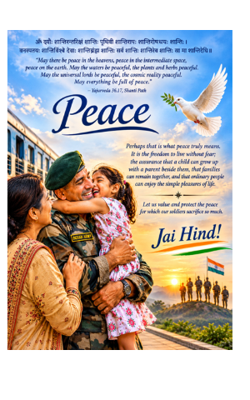
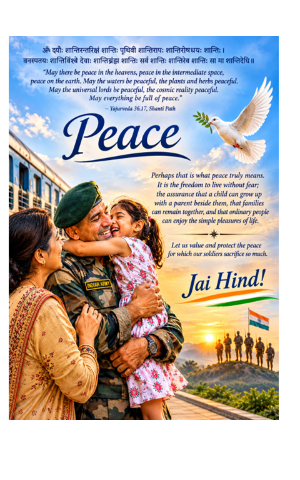
ॐ द्यौः शान्तिरन्तरिक्षं शान्तिः पृथिवी शान्तिरापः शान्तिरोषधयः शान्तिः।
वनस्पतयः शान्तिर्विश्वे देवाः शान्तिर्ब्रह्म शान्तिः सर्वं शान्तिः शान्तिरेव शान्तिः सा मा शान्तिरेधि॥
“May there be peace in the heavens, peace in the intermediate space, and peace on the earth. May the waters be peaceful, and the plants and medicinal herbs peaceful. May the trees and forest lords be peaceful, the universal deities peaceful, and the cosmic reality (Brahman) peaceful. May everything be filled with peace. May that very peace come unto me.”
— Yajurveda 36.17, Shanti Path
It was sometime in the early 1990s, around December, when winter was beginning to set in across North India. I had been asked to undertake some official work in Hyderabad. In those days, we were permitted to travel by train; air travel was reserved for very senior officials. Our colleague, Mr Qasim, had arranged AC two-tier tickets for me from Kanpur to Delhi and then from Delhi to Hyderabad, as he had been unable to get a reservation from Jhansi. This added almost a day to my journey. I enjoyed travelling by train because it gave me more time to read.
I boarded the Hyderabad-bound train in Delhi and was allotted a side-lower berth near the exit. The upper berth above it was vacant. The train had left in the early evening and was gathering speed. The coach was nearly full, though a few berths were yet to be occupied at the stations ahead. Fortunately, as it was an evening train heading out of the city, there were no local commuters. I had brought a packed dinner from home, which I finished before settling down with a book.
From somewhere inside the coach came a steady stream of loud laughter and conversation—a cacophony often associated with exuberant youth. I assumed it was a group of youngsters travelling together. The noise was annoying at first, but gradually it became a kind of background hum.
At around eight in the evening, a man who appeared to be about my age, with a neatly built frame and a typically military haircut, came and stood beside me. He asked if he could sit. I was reading, but readily agreed. He introduced himself as Major Mishra, a serving officer in the Indian Army. I introduced myself, and we soon felt at ease with each other.
He told me that his berth was surrounded by a group of youngsters who were making a great deal of noise. They were, he said, candidates selected for the Indian Police Service and travelling to an academy in Hyderabad for training. He was annoyed that people preparing to become government administrators seemed to have so little regard for the comfort of fellow passengers. They appeared to be drinking and playing music loudly. He could have confronted them, he said, but he was looking for peace and did not want an argument.
I thought he might prefer to be left alone. I offered him my lower berth so that he could sleep, saying that I could move to the upper berth until its occupant arrived. But sleep, he said, was the last thing on his mind. He wanted to experience every moment of his leave. Meanwhile, the TTE came by. We requested that Major Mishra's berth be changed to the vacant upper berth, and the TTE kindly agreed. Major Mishra collected his baggage from his earlier berth and settled beside me.
He began to talk, and I listened. At times I caught a glimpse of happiness in his eyes; at others, I saw deep sorrow, sadness and even anger. By the time we reached Hyderabad the following day, neither of us had slept properly. It was not that he kept me awake unwillingly. I was absorbed in his account, and in his determination to spend the journey alert and awake rather than sleeping away precious hours.
He told me that this was his first leave in two years. Although Army personnel were entitled to leave every year, the tense situation in the area where he was posted had prevented him from taking it. Now he wanted to spend his time meaningfully with his family in Hyderabad. He had a six-year-old daughter who was already attending school, but he had not seen her since his previous visit. His memories of her were limited to telephone conversations and a few photographs sent by his wife. He could have brought his family to the place where he was serving, but had chosen not to, given the dangers surrounding him. In those days, mobile phones and video calls were not part of everyday life.
Many people of my generation, particularly those born in the 1960s, will remember the difficulty of calling home from a public call office, or PCO. Calls were expensive, and if one wanted to speak for longer, it was better to call late at night to take advantage of discounted rates. There were often queues, unless one had a telephone connection at home. For Major Mishra, however, making a call was not the main difficulty; finding the time to make one was. Army personnel were on duty at odd hours, virtually around the clock. He said he thanked God for being alive. He had seen many of his friends killed in terrorist attacks, some right before his eyes.
He recounted one incident in which his unit had gone to deliver food to a house. A person wearing a burqa approached and opened fire, killing two of his colleagues instantly. Major Mishra had been sitting beside the driver in the vehicle, ready to move on to the next house. He explained that they were not permitted to search houses for concealed terrorists and were not supposed to fire first; they were allowed to act only in self-defence. They lived with the constant uncertainty of not knowing who was an ordinary civilian and who might be a terrorist.
On another occasion, while they were on patrol, a boy of about ten approached them, apparently playing with a ball. He hurled it towards them. It turned out to be a grenade, which exploded a few feet behind their vehicle. They were fortunate to escape unharmed. By the time they looked around, the boy had disappeared into one of the houses.
Major Mishra said that soldiers were constant targets because they moved in uniform and in identifiable vehicles. Even some people serving at lower levels in the Army on contract, he felt, could at times appear suspicious. In short, he said, it was extraordinarily difficult to know who might turn out to be a terrorist at any given moment.
He was forthright in blaming the political system. In his view, there was little political will to resolve the problem because the continuing unrest suited those in power. The people, he felt, did not realise that the principal beneficiaries of the situation were the political establishment and the terrorists, while ordinary citizens bore the consequences: unemployment, illiteracy and a life brought almost to a standstill, with little growth or progress. Frequent school closures contributed to illiteracy, while illiteracy and unemployment created conditions in which terrorism could flourish. He believed that, with political will and a free hand for the Army, the terrorists could be identified and rooted out, although the difficult terrain and the involvement of local people would make the task time-consuming. Most local people, he said, did not support the terrorists but feared that they and their families would be targeted if they opposed them.
He also spoke about the cost of maintaining a substantial Army presence and conducting operations to support local people by providing food and essential supplies. In his assessment, a large part of the taxpayer's money was being spent in this way. Economic activity in the region was limited, apart from some horticulture and the use of other natural resources. Tourism was at a low ebb, there were few industries, and employment opportunities were scarce.
At some point between four and four-thirty in the morning, without either of us realising it, we dozed off while sitting on the berth, our legs stretched out and crossing one another. Major Mishra had not moved to his own berth. A sudden jolt woke us. The train had come to an abrupt halt after someone pulled the emergency chain. It was around seven in the morning, and we had stopped at a station where the train was not scheduled to halt. Tea and coffee vendors climbed aboard, calling out their familiar cry: “Garam garam chai!”
We both had tea from the onboard catering service. The food on trains was good in those days. As ours was a premium train—I think it was the then Andhra Express—the pantry service was quite efficient. The staff would take orders for breakfast, lunch, dinner, tea and snacks, and collect payment at a station before the passenger's destination. It was convenient to pay the total amount at once rather than make several small payments during a journey of nearly twenty-four hours.
Throughout the journey, Major Mishra continued to share his experiences. He said he intended to spend the next thirty days as though each day might be his last. At times, the conversation turned philosophical. When, he wondered, do we truly live in peace? Would we be at peace if we all spoke the same language, belonged to the same religion, or simply followed what others told us to do? Would an equal distribution of wealth bring peace? There seemed to be no single answer. People fought even when they belonged to the same religion or spoke the same language.
His questions brought to mind a Jain teaching on empathy: “In happiness and suffering, in joy and grief, we should regard all creatures as we regard our own self, and should therefore refrain from inflicting upon others such injury as would appear undesirable to us if inflicted upon ourselves.” If only we could understand and practise this principle, perhaps we could move closer to peace and harmony—not only among human beings, but also with the wider ecosystem.
I had been a quiet listener to his accounts of dangerous encounters. I had once thought that living in Kanpur was dangerous, but after listening to him I felt relieved to live in a relatively peaceful and safe environment. I wondered about the lives of soldiers like him and their families, who lived with constant uncertainty while the soldiers continued to perform their duties, often with a smile. Some of the incidents he described were horrifying. I wondered how they managed to sleep with such memories. Perhaps that was part of what military training demanded of them: the ability to function in circumstances that most of us would find unbearable. He also told me that some of his colleagues had suffered serious psychological difficulties and had been discharged from service.
It was evening by the time the train reached Secunderabad station. His wife, daughter and orderly were waiting for him. We let the hurried crowd—and the noisy trainees—get off first. As we stepped down, he embraced his wife and child for a long time before introducing them to me. He described me as a patient listener and invited me to his home. I thanked him, wished his family well and said, “My dear Major, because of people like you, the rest of us can breathe in peace and enjoy our freedom. Make the most of your leave. Jai Hind.”
I watched him walk away, his child in his arms and his wife beside him. Perhaps that is what peace truly means. It is not merely the absence of war or conflict. It is the freedom to live without fear; the assurance that a child can grow up with a parent beside them, that families can remain together, and that ordinary people can enjoy the simple pleasures of everyday life. For Major Mishra, those thirty days with his family were not just a period of leave; they were a brief return to the very peace that he and his fellow soldiers worked so hard to protect for the rest of us.
Even today, I think of Major Mishra and of the many people like him who give their best in the service of the nation so that ordinary citizens can live in peace. Our growth, progress and prosperity are made possible, in no small measure, by their dedication and sacrifice. We owe them our peace and happiness. We owe them our laughter and our giggles.
Jai Hind.