Library

 Profile
Choice
Choice

“वक्त से पहले और किस्मत से ज्यादा किसी को कुछ नहीं मिलता”
As we grow older, life presents us with choices—some small and inconsequential, some difficult, and some that can change the course of our lives.
But how much of a choice is really ours?
Do we make our own decisions, or does time make them for us? Are we exercising our free will, or are we simply responding to circumstances that leave us with little choice? Are we sometimes captives of circumstances that force us to choose one path over another?
Many times, we hear people say, “I put in so much effort to achieve this,” or, “I sacrificed so much to attain this.” But is our effort alone responsible for the results we achieve?
Someone else may say, “Times were like that. What could I do?”
Another may say, “Without his help, I could never have achieved this.”
So, what really determines the outcome of our lives? Is it our effort? Is it time? Is it our surroundings? Is it luck or fate? Or is it some combination of all these things?
I could have chosen “Volition” as the title of this essay. But I chose “Choice.”
Why?
I have no answer. It just happened.
Does that itself mean that I do not have complete control over my choices?
Perhaps.
We may say many things about our lives, but sometimes it appears that what has to happen, happens.
The Five Elements
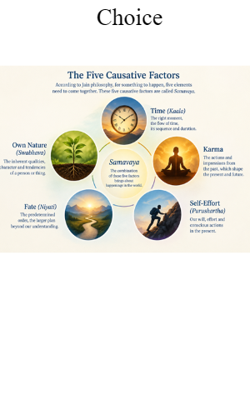
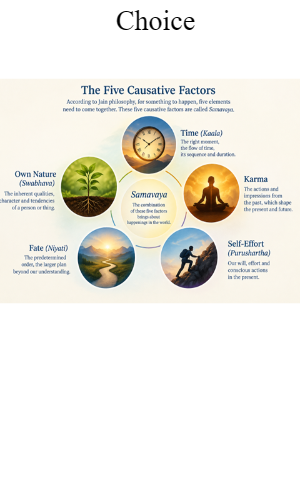
In Jain philosophy, it is believed that for something to happen, five elements need to come together. These are Time (Kaala), Own Nature (Swabhava), Karma, Fate (Niyati), and Self-Effort (Purushartha).
These five causative factors are referred to as Samavaya and are considered responsible for happenings in the world.
While Jain philosophy places considerable importance on Purushartha, or self-effort, it also recognises that effort alone may not be sufficient. The other factors must also come together for an outcome to occur.
I have often wondered about this.
Over the years, I have come across a few incidents that have stayed with me. There have been many such experiences, but these few are particularly distinct in my memory.
Perhaps they offer some clues.
Or perhaps they only create more questions.
Fate
I had secured admission to an engineering course and had joined college. After a brief struggle and some personal discussions with the Principal, I was able to secure admission to the college hostel.
I was shy then, as I probably still am. I made very few friends, and it took me some time to open up to people.
As we started attending classes, there were a few faces we regularly encountered—in the classroom, in the hostel, or at a nearby eatery.
Three of us shared a room. One was studying Electrical Engineering, another Civil Engineering, while I had opted for Mechanical Engineering. Many Electrical Engineering students used to visit my roommate, and through him I gradually got to know some of them.
One of them was Mr. Raimane.
I found him very disciplined and well-groomed. Later, I learned that he came from a very poor family. He was the eldest son and had younger siblings to support.
Through his own effort—his Purushartha—he had managed to secure admission to engineering. He belonged to a less privileged section of society, which had also helped him secure free admission to the hostel and college.
He was jovial, hardworking and, as I mentioned earlier, very disciplined.
Time passed. We completed our first internal examinations and were all happy with the good marks we had obtained.
One evening, Mr. Raimane came to our room with a smile and said,
“Goodbye, dear friends.”
We could not understand what he meant.
Then he explained that he had received a job offer from a nationalised bank and was leaving the engineering course to take up the job.
We were all taken aback.
He was a bright student and appeared to have a promising career ahead of him as an engineer.
But then he explained his situation.
“My family needs support immediately. If I continue engineering, it will be another five years before I graduate and start earning. In the interest of my family, I have decided to take the job. Thank you for the good times we had.”
He left the next day.
At that time, I thought of it simply as fate.
His Purushartha had helped him secure admission to engineering, but circumstances had taken him away from the path he had initially chosen.
Years later, I came to know that he had completed his graduation through correspondence, appeared for banking examinations and did well. He eventually built a good life for himself.
Perhaps that, too, was his Purushartha.
And perhaps what looked like a setback at one point in his life was only a change of direction.
Fate and Time
I was in the sixth semester of my engineering course. In those days, we had a five-year degree programme with ten semesters.
Our final examinations were in progress. One more examination was scheduled for the following day.
I was staying in the college hostel. One morning, I was up by about 7 a.m. and was getting ready to go for breakfast when I heard a knock on the door.
I opened it.
Our senior, Mr. Pashupatimath, was standing outside. He looked worried.
He asked me whether I had seen Parashetty, his classmate.
Sometimes, we used to have breakfast together.
I told him that I had not seen him and that I was just getting ready.
He said, “If you see him, ask him to talk to me.”
I wished him good luck for his examination.
It was, after all, the last examination of their long student life.
Parashetty was a brilliant student. He had secured first rank in every semester.
He was disciplined, studious and creative.
During my three years in the hostel, I had spent several hours with him. He kept his room exceptionally clean and organised. His books, study material, clothes—everything had its place.
Our conversations were mostly about academic subjects. I never asked him much about his personal life, and he never volunteered much information about his family.
But there was one thing he mentioned several times.
His dream was to study at MIT—the Massachusetts Institute of Technology, USA.
He appeared almost obsessed with the dream.
I had seen carvings he made out of chalk and large candles on the window sill, and I admired the dexterity with which he worked. He also spent considerable time sketching.
He showed me some of his pencil sketches, mostly made on engineering drawing sheets.
They were good.
But somehow, I sensed a sadness in them.
I once asked him why I felt that his sketches carried some kind of sadness.
He simply smiled.
The next morning, I had an examination of my own. After breakfast, I returned to my room and started studying.
The examination was scheduled from 9:30 a.m. to 12:30 p.m.
Around noon, there was a commotion outside.
I came out to find a crowd gathering near Parashetty's room.
He had not appeared for the examination.
His room was locked.
Almost all his classmates were there. Somehow, the news had also reached the Warden and the Principal, who came rushing to the hostel.
With their permission, the students forced open the door.
The room was empty.
And, as always, it was absolutely neat and clean.
Someone noticed two sheets of paper lying on the table, held down by paperweights.
The Warden picked them up.
His face turned pale.
Parashetty had apparently left two letters—one addressed to his friends and the other to his parents.
The handwriting was unmistakably his.
He had beautiful, impeccable handwriting.
Both letters appeared to have been written calmly and deliberately.
He said that he was sorry. He believed that he had not performed well in his final examination and was therefore likely to lose his university rank. He feared that, as a result, he would not get admission to MIT.
MIT was his only dream.
And because he believed that dream had now become impossible, he had decided to end his life.
The last words in the letter to his friends were:
“I am on my way to MIT.”
In the letter to his parents, he sought their forgiveness. He said that he had failed himself and them and that, in another life, he would fulfil their desire.
He had written:
“Please forgive me. I failed myself and you. I am on my way to MIT.”
At that time, achieving a high university rank, together with an institutional recommendation, could make admission to prestigious foreign institutions such as MIT easier.
But whether his dream was truly lost, we will never know.
Some students then reported seeing a large crowd behind the hostel, near the railway track.
The railway line was only about half a kilometre from the back of the hostel. It was a large, open grassy field overlooking a hill known as Nripatunga Betta.
What had happened there was horrifying.
Parashetty had taken his own life on the railway track.
The image of his otherwise serene face has remained with me for decades.
His parents must have endured an unimaginable loss.
After the examinations, his friends dispersed—in search of jobs, higher education and their own futures. Life moved on, as it inevitably does.
But for his parents, life could never have been the same.
I do not believe we can easily judge what was happening inside Parashetty's mind that morning.
What seemed like an irreversible failure to him may not have been irreversible at all.
Perhaps his perception of his future had narrowed to a single point.
Perhaps circumstances, time, ambition and his own nature had all converged in that moment.
It also reminded me of Anton Chekhov's “The Bet.” I wondered whether Parashetty, too, had become so consumed by a single idea that everything else in life had lost its value.
Was it fate?
Was it time?
Was it his own nature?
Or was it simply a choice made at a moment when he could see no other choice?
I still do not know.
Karma
Karma is one of the most debated subjects.
It is often said that the Purushartha of the past becomes our present Karma, while our present Purushartha becomes our future Karma.
Of the five elements, Purushartha appears to be the one that is most directly within our control.
If we do good today, we accumulate good Karma for the future. If we do bad, we accumulate bad Karma.
But this raises a fundamental question.
Where do we begin?
If a person is born into poverty, we sometimes say it is because of his past Karma.
But where did that past Karma originate?
If he had done something wrong in an even earlier life, where did that action come from?
If we start with nothing, what determines whether the first action is good or bad?
And why do human beings sometimes choose good and sometimes choose evil?
To me, Karma also appears to serve as an ethical framework—a way of encouraging people to distinguish between right and wrong and to take responsibility for their actions.
Yet even with such a framework, we continue to see terrible things happen.
And that leaves me with another question.
What happens when something terrible happens to someone who appears to have done nothing wrong?
I experienced one such incident through my elder son.
He was about nine years old and was studying in school. Since we lived in a township, many children of his age lived nearby. They went to the same school, played together and often visited each other's homes.
One such boy was Sudipto.
I cannot recall his surname, and I do not want to ask my son about it even today. I would not want to reopen those feelings.
Sudipto was a brilliant and smart child.
His parents were God-fearing people from Bengal. They lived in a rented house near our township.
My son liked him immensely.
There was hardly a day when my son did not mention him at home.
They played together.
They laughed together.
They were simply children enjoying each other's company.
I was away on an official tour for about a week.
When I returned, my son told me that he had not seen Sudipto for some time and that he was no longer coming to school.
He said that his teacher had told the class that Sudipto would not be coming back.
The following day, I learned that the boy had died from severe burn injuries.
I was devastated.
My wife and I went to meet his grieving parents and tried to console them.
But is it really possible to console parents who have lost a beloved child?
Their eyes said everything about the pain they were going through.
Later, we learnt what had happened.
There was a marriage celebration taking place nearby. The halwai—the chef preparing sweets—was making jalebi. Oil was being heated in a large kadai ( Cauldron) on the ground floor, in an open area next to the house.
Sudipto was playing with some neighbouring children on the terrace.
The terrace had no protective wall or railing along its edge.
While playing, he accidentally fell from the terrace into the kadai.
The injuries were catastrophic.
Despite efforts to save him, he eventually succumbed.
The owner of the house subsequently built a protective wall around the terrace.
But it was too late.
And the question that stayed with me was this:
Whose Karma was it?
Was it the Karma of the parents?
Was it the Karma of the child?
Was it the Karma of the house owner?
What had the parents or that innocent child done after their birth—or before it—to deserve such a tragedy?
As time passed, the family had another child and perhaps found some solace in him.
Whenever we met them at school, I could see their eyes fill with tears when they saw my son.
Yet they would still smile.
That image has stayed with me.
What Karma can such a tragedy be attributed to?
I have no answer.
Purushartha
I was working with a PSU in Kanpur when I became friends with one of my batchmates who had joined the organisation around the same time.
Our families became friends, and we enjoyed each other's company.
He was intelligent, dedicated and hardworking.
He had joined an external doctoral programme at IIT Kanpur.
He would ride his scooter about 25 kilometres each way, almost three times a week, to attend classes and then report for his duties in the second shift.
Being a production unit, our organisation operated in two shifts—6:30 a.m. to 2:30 p.m. and 2:30 p.m. to 10:30 p.m.
I was fortunate to work in the Design Department and had a general shift from 7:30 a.m. to 4:30 p.m.
He worked in the NC Manufacturing Cell, which was considered one of the more privileged departments in those days.
He completed his coursework and began working on his thesis.
Somewhere along the way, he had a disagreement with his senior officer, and things began to deteriorate.
He was initially transferred from the much sought-after NC Machining Department to the Sheet Metal Shop, which was considered one of the more difficult and demanding areas.
He was pursuing doctoral research in advanced machining.
He was not perturbed.
He continued doing his work in the Sheet Metal Shop while pursuing his research.
He was then told to abandon his PhD programme.
He simply smiled in the face of the adversity.
One day, he was transferred to another division about a hundred kilometres away.
Someone seemed unhappy with his progress.
He continued his thesis work.
Every Friday evening, he would drive to Kanpur, work with his professor on Saturday and Sunday, and return to his division early Monday morning.
Even that did not work.
He was transferred again, this time to a division that was much farther away and poorly connected to Kanpur.
Travelling to Kanpur every weekend was no longer practical.
His guide knew the difficulties he was facing and offered him a research position so that he could leave his current job and concentrate on his thesis.
But my friend did not want to leave his job.
The organisation had given him an entry into advanced machining and, more importantly, into the prestigious aircraft manufacturing field.
He was an example of perseverance personified.
I always admired him.
What I could never understand was where he found the energy.
He had two small children.
Even after a tiring day, if his children wanted to play with him, he would take them out—even late at night.
I have seen him endure the daily grind of getting up early, riding to IIT for his coursework, returning to the office around noon after covering nearly 50 kilometres, dealing with unruly traffic, finishing his work and coming home around 10:40 at night.
And then, instead of simply going to bed, he would take his children out for a scoop of ice cream.
He would still be smiling.
Eventually, he realised that he had to make a choice between his job and his research.
The adversities had won.
With a heavy heart, he resigned.
His guide again came to his assistance and offered him a Research Assistant position, providing him with financial support while he completed his work.
He moved his family closer to the institute and concentrated fully on his research and thesis.
He completed his doctorate.
Today, he heads a laboratory in one of the country's prestigious institutions.
Looking back, his journey seems almost extraordinary.
Circumstances repeatedly pushed him backwards.
Yet he kept moving forward.
Perhaps this is where Purushartha reveals its true strength.
We may not always be able to choose the circumstances into which we are placed.
We may not be able to control time.
We may not understand fate.
We may not even know whether Karma is shaping our lives in ways that are invisible to us.
But we can still make an effort.
We can still persevere.
We can still choose how we respond.
Choice
After all these years, I still wonder what really determines the course of a person's life.
Raimane had the ability and the desire to become an engineer, but circumstances forced him to choose a different path.
Parashetty had an extraordinary academic record and a powerful dream, yet one examination seemed, to him, to bring that dream to an end.
Sudipto was an innocent child whose life ended through an accident that no one could have intended.
My colleague faced repeated obstacles that could easily have broken his determination, yet his perseverance eventually took him to a doctorate and a position of distinction.
Four lives.
Four very different circumstances.
And perhaps four different combinations of Time, Nature, Karma, Fate and Purushartha.
So, do we really choose?
I think we do.
But perhaps we do not choose in isolation.
Our choices are influenced by the time in which we live, the circumstances surrounding us, our own nature, the people we encounter, opportunities that come our way, opportunities that disappear, and forces that we may never fully understand.
Perhaps Choice is not about having complete control over our lives.
Perhaps it is about making the best choice possible with whatever has been placed before us.
And perhaps Purushartha is not the power to control everything that happens to us.
Perhaps it is the courage to respond to what happens to us.
I began by wondering why I chose the word Choice when I could have chosen Volition.
I still do not have a clear answer.
It just happened.
And perhaps that, in itself, is the point.
Maybe some choices are ours.
Maybe some are shaped by time, circumstances and fate.
And perhaps some are made somewhere in between.
We may never know for certain.
But we continue to choose.
And perhaps that is what makes life a journey.