Library

 Profile

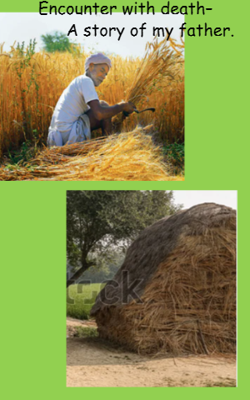
Encounter With Death– A Story Of My Father
Encounter With Death– A Story Of My Father

सर्पदुर्जनरोर्मध्ये वरं सर्पो न दुर्जनः |सर्प दंशती कालेन दुर्जनस्तु पदे पदे ||
Between a villain and a snake , the snake is better for your sake.
The snake may bite you once a while, but the villain bites you every mile.
One afternoon, our apartment residents’ social media group was buzzing with urgent messages about a snake sighted in the basement car park. The building, set on seven acres of lush greenery, had apparently become a battleground between urban anxieties and nature. The snake was small and non-venomous, but the alarmed messages suggested a deep-seated fear of wildlife among city dwellers. The requests ranged from calling snake catchers to spraying repellents, reflecting a desire to erase any trace of nature from their lives.
“Dear RWA, I’ve heard that the security team was searching for a snake near the open gym area this morning. Can you confirm this? If it’s the same snake from the basement, please let us know so we can avoid these areas for a few days. We urge the RWA to call a snake catcher and remove the snake, even if it requires spending extra money for residents’ safety. If they can get into the basement, they might soon access duct areas and possibly enter our apartments. Please address this urgently.”
“RWA, snake repellents should be sprayed everywhere immediately.”
“Dangerous snake roaming in our apartment. Keep all doors closed. Avoid the basement.”
“Snakes are roaming and the RWA is asleep. Wake up before they bite you and deal with these crawlers.”
Amid the apartment’s frenzy over a minor snake sighting, I was reminded of a far more profound and dramatic story from my father’s life. His encounter with a snake, marked by a deep respect for nature and a steadfast belief in non-violence, stood in stark contrast to the urban panic I was witnessing.
When I first heard the story from my foster mother, his elder sister, it seemed almost mythical. My father initially dismissed it with a smile when I inquired, but it wasn’t until I visited our village a year later, while my mother was ill, that he finally shared the full tale with me. His experience, though unbelievable, was a powerful testament to his principles and resilience.
My father’s elder brother had tragically died from a snake bite while returning from the fields. The snake attracted to the Screw pine (Ketaki) plants in the area, was a small but venomous species now rare. Despite being rushed to town for treatment, he succumbed to the venom’s effects. In those days, antivenins were not readily available, and Neem Juice was given in hopes that its bitterness might counteract the venom. This loss haunted my father deeply, especially since he himself had a close encounter with a snake years later.
To understand the gravity of his experience, it helps to know a bit about his background. My father was a small farmer with a few acres of rain-dependent land, situated about three kilometres from our home. His largest plot was nestled between two small hillocks, bordered by relatives’ lands. A stream cut across this land, flowing during the rainy season, with a well nearby providing crucial water for us and neighbouring farmers.
At the hillock ends of the field, the ground was slanted and covered with tall grass and trees, with no crops grown there. There were also a few Indian Jujube (Ber in Hindi, Bore Hannu in Kannada) shrubs. I remember enjoying these fruits as a child. The grass grew very tall, up to three or four feet. I once wandered through this dense grass while my father was cutting it, feeling lost and frightened, shouting for him.
This grass is harvested only when it matures and turns golden. The swath of golden grass looks wonderful. The grass is cut and stacked as hay. After harvesting the grass and the Jowar or Maize crop, depending on which crop is grown, bundles are made from chopped Jowar or Maize Stems and the cut grass. These bundles will be stacked nicely. This in local language is known as Banave. These stacks are covered with mud or a mixture of dung and mud to protect them from rain and from birds making their nest. This hay is used as fodder for the cattle stock, especially during the rainy season. Even today my younger brother harvests the grass by hand with a sickle, eschewing machines.
I remember, my father sitting barefoot, holding the grass bunch with his left hand while cutting with sickle in his right. He would start cutting the grass after the morning dew had settled and finish well before the sun started floating above the shoulders and the sun became too hot. He would have his lunch and rest for a while in a hutment or beneath the tree. He would resume after the sun had gone down the shoulders and become cooler, completing the task before dusk. Neighbours often helped, and the work was shared more cooperatively before machines led to more isolation.
One such morning, my father had set out to cut the grass alone. As he worked, he laid out the grass bundles and progressed through the field. After some time, he got up to pool the grass bundles. After lifting one bundle he went to lift another bundle, as he put his foot down, he felt something beneath his foot and an unexpected pressure around his left leg. He dropped the grass bundle, while still holding a sickle in his right hand. Looking down, he was horrified to see a snake coiled tightly around his leg, its hood positioned dangerously beneath the arch of his foot. He realised he was facing one of the most venomous snakes: a Cobra.
My father understood it was unlikely to bite him due to its hood being beneath his foot. He gained confidence and tried to loosen its grip. The snake was increasing its pressure to weaken its prey. Struggling against the growing heat of the sun and the numbing pain in his leg, he remained calm, applying steady pressure to prevent the snake from tightening its grip.
As he stood, he glanced across the other fields but could see none. He shouted for help, but no one responded. He kept on shouting and whistling in the hope that someone would come and help. He knew, my mother would bring him lunch in about an hour and a half, so he kept his foot still and continued to apply downward pressure.
The soil beneath was loose allowing the snake to breathe and maintain its grip. They both tested each other’s strength and patience. After fifteen or twenty minutes, my father felt weakness in his leg but persevered. He managed to force his right leg onto his left foot, applying pressure until the snake began to loosen its grip
He further applied pressure on his right leg. With the snake’s hold weakening, he unwound it from his leg, with his foot still firmly on the hood, held the snake in his hand and in one go slightly loosened the foot, pulled the snake threw it away and sat in exhaustion. He cried for a while and sat there, blinking and thanking God, until my mother arrived with lunch.
During those tense minutes, my father thought of his young daughters, wife, mother, and younger brother. The memory of losing his elder brother to a snake bite and his current peril made him shiver. He prayed for his family’s safety and found the strength to conceal his fear when my mother arrived
That evening, he struggled to walk due to the weakness in his leg. My mother, noticing his condition, asked what happened. He broke down as he explained. She massaged his leg for the next week until he recovered. My father felt vulnerable crying in front of his wife, and my grandmother, who had lost her son to a snake bite, was deeply troubled by the incident.
I listened with awe as my father recounted the ordeal. I asked innocently why he didn’t use the sickle to free himself. He smiled and said, yes he did think of it and explained his internal conflict.
On one hand, it could have made it easier and freed him, but on the other hand, he would be killing the snake, a notion he struggled with. He saw the snake as a part of the ecosystem that helped control pests and believed in living harmoniously with nature moreover, they don’t attack on their own, they only defend. His daily morning visits to the Jina Temple and the discourses (Pravachanas) he had listened to on the preachings of Mahavir Theerthankar had instilled in him the principle of “Live and let live”. He could not bring himself to kill the snake and chose instead to endure the situation,
I asked if he stopped cutting grass afterwards. He laughed and said no. Despite the pain, he continued working that afternoon. Life goes on, he believed. If it were destined for him to be bitten, it would have happened without giving him a chance to survive.
I asked him, did he had gone in search of the snake. He said “No”. He said animals have strong endurance and survival capabilities. It would have recovered and gone on with its life. All that mattered to him was both he and the snake were alive.
It took me a while to fully appreciate his profound harmony with nature and the environment. His resilience, unwavering principles, and deep connection to the land revealed a profound understanding of life’s challenges and the delicate balance between humans and nature.