Library

 Profile
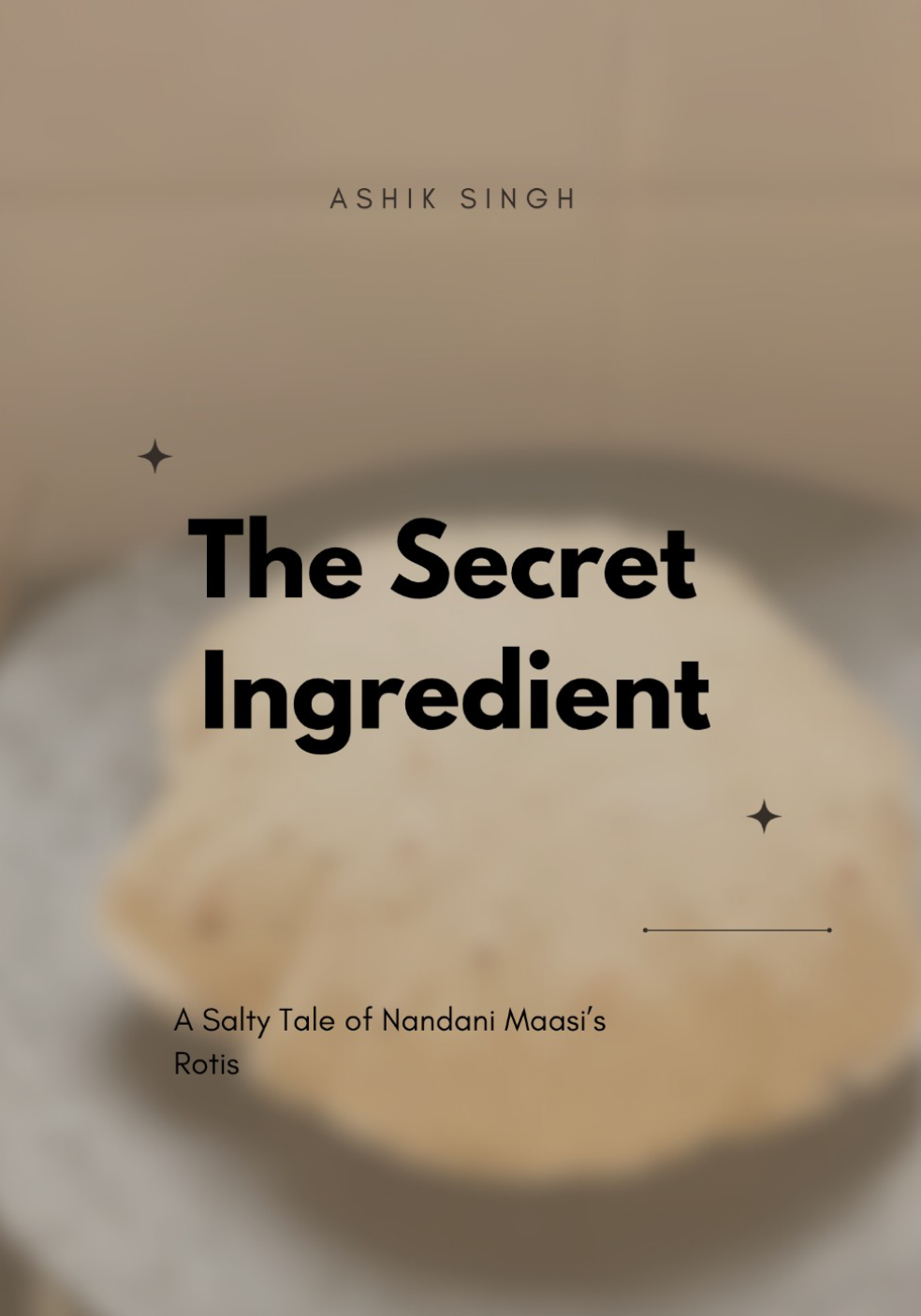
The Secret Ingredient: A Salty tale
The Secret Ingredient: A Salty tale

In the grand, chaotic theater of an Indian middle-class home, there is one hour that is more sacred than the morning prayer and more dangerous than a parent-teacher meeting. The Evening Tea Hour. It was 6:00 PM.
The sun was setting, casting a golden hue over our slightly dusty sofa set. The ceiling fan was rotating with a rhythmic crick-creck sound, struggling to provide air to the seven people squeezed into a room meant for four. The air was thick with the aroma of Adrak wali Chai and the looming threat of family gossip.
On the ‘VIP’ single-seater sofa sat Nandani Maasi. If perfection had a human face, it would be hers—or so she wanted us to believe. At forty-five, Maasi had become the self-appointed Minister of Health and Hygiene. She carried a small bottle of sanitizer like a holy relic and could spot a single speck of dust on a ceiling fan from two rooms away.
"Beta, ye biscuit ki plate thodi tedi hai," she remarked, adjusting her gold-rimmed spectacles with the precision of a surgeon. "And please, use a coaster. We aren't savages."
My mother, the silent observer and the keeper of all dark family secrets, took a slow, calculated sip of her tea. She looked at Maasi’s nose—the very same nose that was now held high in a gesture of superiority—and a mischievous glint appeared in her eyes. It was the look of a hunter who had just spotted a very posh, very arrogant deer.
"Nandani," Mummy said, her voice dropping to a dangerously calm tone. "You talk a lot about hygiene these days.
It’s funny, considering your historical contribution to our family’s... unique diet."
The room went silent. Even the fan seemed to slow down. We all knew that tone. Mummy was about to serve the 'Real Tea'.
To understand this story, you must understand the anatomical tragedy that was Nandani Maasi’s childhood. While other children were gifted with toys or talent, Maasi was gifted with a Perpetual Sinus Infection.
From the age of five to fifteen, Maasi’s nose was not just a facial feature; it was a leaky faucet that the plumbers of the world had given up on. In every childhood photo, Maasi is seen with a slightly red nose and a handkerchief tucked into her sleeve like a hidden weapon. Her 'sniffing' was the background score of our house.
Sluuuurp-sniff. Sluuuurp-sniff. It was a rhythmic, wet sound that told you Nandani was within a 50-meter radius.
But by 1995, Maasi was ten years old and determined to prove she was a "Badi Beti."
She wanted to conquer the final frontier of Indian womanhood: The Round Roti.
The documentary camera of my mind pans back to a hot, humid July afternoon. The kitchen was a small, suffocating box filled with the smell of kerosene and dry flour.
My grandmother was unwell, and the responsibility of the evening meal fell upon the tiny, trembling shoulders of young Nandani.
Mummy was standing by the kitchen door, hidden by the shadows, watching the "Masterchef" in training.
"Nandani was standing on a small wooden stool (patri) because she couldn't reach the counter," Mummy narrated to the now-horrified living room audience.
"She looked so dedicated. Her hair was tied in two tight, oily braids, and her face was flushed from the heat of the stove. But there was one problem. The 'Leaky Faucet' was at full pressure that day."
In the kitchen, young Nandani was battling two giants: the sticky wheat flour and her own gravity-defying mucus.
Sniff. She would knead the dough with all her might. Thump. Thump.
Sniff.
She would turn the dough over. Slap. Slap.
Mummy described the scene with the poetic detail of a horror movie. "I saw it happening in slow motion. She was leaning over the Parat (the large kneading plate). Her face was inches away from the soft, pale mound of dough. Her sinus was acting up because of the dry flour dust. And then, it appeared."
The Suspense of the Drop A single, crystalline, perfectly formed drop began to descend from the tip of Maasi’s nose. It was a masterpiece of physics—clinging to her skin by a thread of pure willpower.
In the living room, Maasi’s face had turned a shade of purple that matched the curtains. "Didi, bas karo! Why are you telling them this?" she hissed.
But the rest of us was hooked. We leaned in, tea forgotten.
"It hung there," Mummy continued, ignoring the protest. It wobbled.
It glistened under the 40-watt bulb of the kitchen. Nandani was so focused on the dough that she didn't realize her nose was about to participate in the cooking process.
I wanted to scream, 'Stop! Abandon the flour!' but I was frozen, mesmerized by the impending disaster.
Young Nandani took a deep breath to push the dough one last time. The vibration was the final straw.
Bloop.
The drop lost its battle with gravity. It didn't just fall; it performed a graceful dive, hitting the exact center of the dough with the precision of a heat-seeking missile. It disappeared into the soft, white crater of the wheat flour like a secret being buried in the sand.
The 'Suspect' (Maasi) froze for a micro-second. She looked at the spot. She knew something had landed. She looked around to see if anyone had witnessed the 'Extra Ingredient'. Seeing no one, she made a decision that would haunt our digestive systems for decades.
She didn't take a spoon and scoop it out. She didn't throw the dough away.
"She took her palm," Mummy said, gesturing with her own hand, "and she swiped it across the dough. She began to knead it with even more passion. Goonth-Goonth ke (kneading and kneading), she made sure that 'biological contribution' was evenly distributed throughout the entire batch. It wasn't just in one roti anymore. It was everywhere. It was the soul of the meal."
Rasoi mein us din ek 'Silent Crime' ho chuka tha. Mummy batati hain ki unhone darwaze ke peeche se dekha ki Nandani Maasi ne us aate (dough) ko aise masla jaise wo kisi bade saboot (evidence) ko mita rahi ho....
"Nandani was sweating," Mummy continued, her eyes widening with the drama of the memory.
"The heat of the small kitchen, the pressure of making her first perfect roti, and the secret she had just buried in the wheat—it was making her frantic. She took a small ball of that dough, dusted it with dry flour, and placed it on the Chakla."
Roll. Roll. Flip.
Roll. Roll. Flip.
The 'Leaky Faucet' (Maasi’s nose) was still at work, but she was more careful now. She was sniffing back with the strength of a vacuum cleaner. Every time a drop would reach the 'Danger Zone' (the tip of her nose), she would tilt her head back like she was looking for a spider on the ceiling.
"The roti was perfectly round," Mummy said, a hint of admiration in her voice for the craftsmanship. "It was beautiful. It puffed up on the Tawa like a golden balloon. If only the family knew what 'Gas' was filling that balloon!"
Living room mein ab tak sabka bura haal tha. My brother had stopped chewing his samosa mid-way, and Papa was looking at his own hands as if they were contaminated.
Nandani Maasi was now hiding her face behind her dupatta, but Mummy was unstoppable.
The Tasting Ceremony Dining table par us din poori family baithi thi. Dadaji (Grandfather), jo hamesha khane mein naks-nikalte (picky eater) the, wo sabse pehle baithe.
"Nandani ne aaj roti banayi hai?" Dadaji ne garv se pucha. "Chalo, meri beti badi ho gayi."
Pehli roti Dadaji ki thali mein gayi. Garam, narm, aur thoda... extra moist. Dadaji ne roti ka ek tukda toda, usey daal mein duboya, aur apne mooh mein rakha.
Back in the kitchen doorway, my mother and the young "Chef" Nandani stood frozen, holding their collective breath. Mummy, the self-proclaimed Satyawadi (truth-teller), was having a moral conflict.
Half of her wanted to scream a warning to the family, but the other, more curious half really wanted to observe the chemical reaction of 'Biological Salt' on the human palate.
The first roti landed on Dadaji’s plate—warm, soft, and slightly suspicious. Dadaji, the patriarch and the ultimate food critic of the house, took a bite. Then another. His face went through a series of complex expressions—confusion, curiosity, and finally, a deep, philosophical realization.
"Nandani," Dadaji called out, his voice echoing through the silent house. "Did you add something special to the dough today? There is a very... earthy aroma to it."
Nandani Maasi, trembling like a leaf, lowered her eyes. "No, Dadaji... it’s just my hard work (mehnat)."
"Well, there’s definitely hard work in here," Dadaji remarked, chewing slowly. "But the salt is a bit on the higher side. And it has a... unique texture. A bit sticky, yet fulfilling. But since it’s your first time, it’s okay. It’s a job well done!"
Back in the present-day living room, Mummy was howling with laughter. "I was the only one who knew exactly where that 'extra salt' came from! Nandani had made rotis for twelve people that day. The entire family, unknowingly, had partaken in the Prasad (holy offering) of Nandani’s Sinus."
"The next day," Mummy continued, wiping tears of laughter from her eyes, "the entire household was hit by what I like to call the 'Nandani Flu'. Suddenly, everyone was sneezing in sync. My father thought the weather was changing, but I knew the truth—we had all participated in a direct, oral consumption of Nandani’s virus."
From that day on, a new, unspoken law was established in our family. Whenever someone fell ill, Mummy would look at Nandani and say, "Quick, send Nandani to the kitchen! We are low on antibodies!"
Nandani Maasi, who was now so red in the face that she matched the pattern of the sofa, finally spoke up. "Didi, that only happened once! I was just a child!"
"Once?" Mummy countered instantly. "Nandani, your nose was a perennial river for ten solid years of your childhood! Every time you went to make rotis, we used to pray that 'The Drop' would at least wait for you to use your pallu (saree end). But no, you clearly believed in 'natural seasoning'!"
The atmosphere in the living room had shifted completely. Nandani Maasi’s carefully curated 'Hygiene Queen' image was now in absolute tatters. The small bottle of hand sanitizer she always carried like a weapon suddenly felt like a cruel irony.
"And that, my dear jury," Mummy said, finishing the last of her now-cold tea, "is why you should never trust a cook who sniffs more than she stirs."
We were all breathless with laughter. Maasi, defeated but dignified, cleaned her glasses with a huff and walked toward the kitchen—perhaps this time to make her own 'Safe' cup of tea.
This story is a reminder that in every Indian family, behind every 'Perfect Maasi' or 'Disciplined Chacha', there is a gross, hilarious, and salty secret waiting to be served. Because in our house, the secret ingredient isn't always love; sometimes, it’s just a poorly timed sneeze.