Library

 Profile
The Dead Man's File
The Dead Man's File

Hello readers, I am a chair—not the kind with plush cushions you’d find in a corporate glass cabin, but a creaky, termite-ridden wooden relic in a sarkari government office.
Specifically, Room 402 of the Vikas Bhawan. For thirty years, I have stood here in this damp, dimly lit room, observing the slow decay of human souls. People think I am inanimate, but I have felt the weight of a thousand secrets—the nervous trembling of a poor man’s thighs and the arrogant, heavy sprawl of a corrupt officer. I am the silent custodian of a darkness that even the walls are too afraid to whisper.
In this world, time doesn't move by the clock; it moves by 'convenience.' Every morning at 10:45 AM, Shukla Ji arrives, his presence announced by the thud of his heavy tiffin and the pungent smell of cheap tobacco.
He doesn't just sit on me; he 'settles' in, his belly spilling over his belt like a bureaucratic disaster. To the outside world, he is a 'Public Servant,' but to me, he is a parasite. My wooden armrests are permanently stained with his greasy thumbprints and the sticky yellow rings of countless cups of cutting-chai. I’ve watched his desk become a graveyard of dreams.
He doesn't read the applications; he waits for them to 'ripen.'
The contrast of this 'ripening' is a sight that makes my wood splinter in silent rage. I remember an afternoon when the room was divided by an invisible wall of status. On one side stood Ganpat, an old farmer whose dhoti had more patches than fabric.
He had been coming every Tuesday for two years, standing before me with folded hands, his eyes fixed on Shukla Ji as if he were a God who could grant him his own pension. Ganpat’s file was at the bottom of a mountain of dust, yellowed and forgotten.
Suddenly, the door swung open. A man in a crisp linen shirt, smelling of expensive cologne and wearing gold rings that could feed Ganpat’s village for a year, walked in. He didn't plead; he didn't even wait in line. He sat on the edge of the desk, leaning in close to Shukla Ji.With a practiced sleight of hand, he slid a thick, heavy envelope under a file.
I heard it clearly—the crisp, dry rustle of brand-new 500-rupee notes. The sound was like music to Shukla Ji’s ears. Within seconds, the magic happened. Shukla Ji didn't ask for a single document or verify a single signature. He picked up his pen, licked his thumb, and with a flamboyant flourish, signed the rich man's file. "Work is done, Seth ji. Don't worry," he smiled, his teeth stained blood-red with paan. The rich man left within five minutes, his 'legitimate' business authorized by the power of the kadak notes.
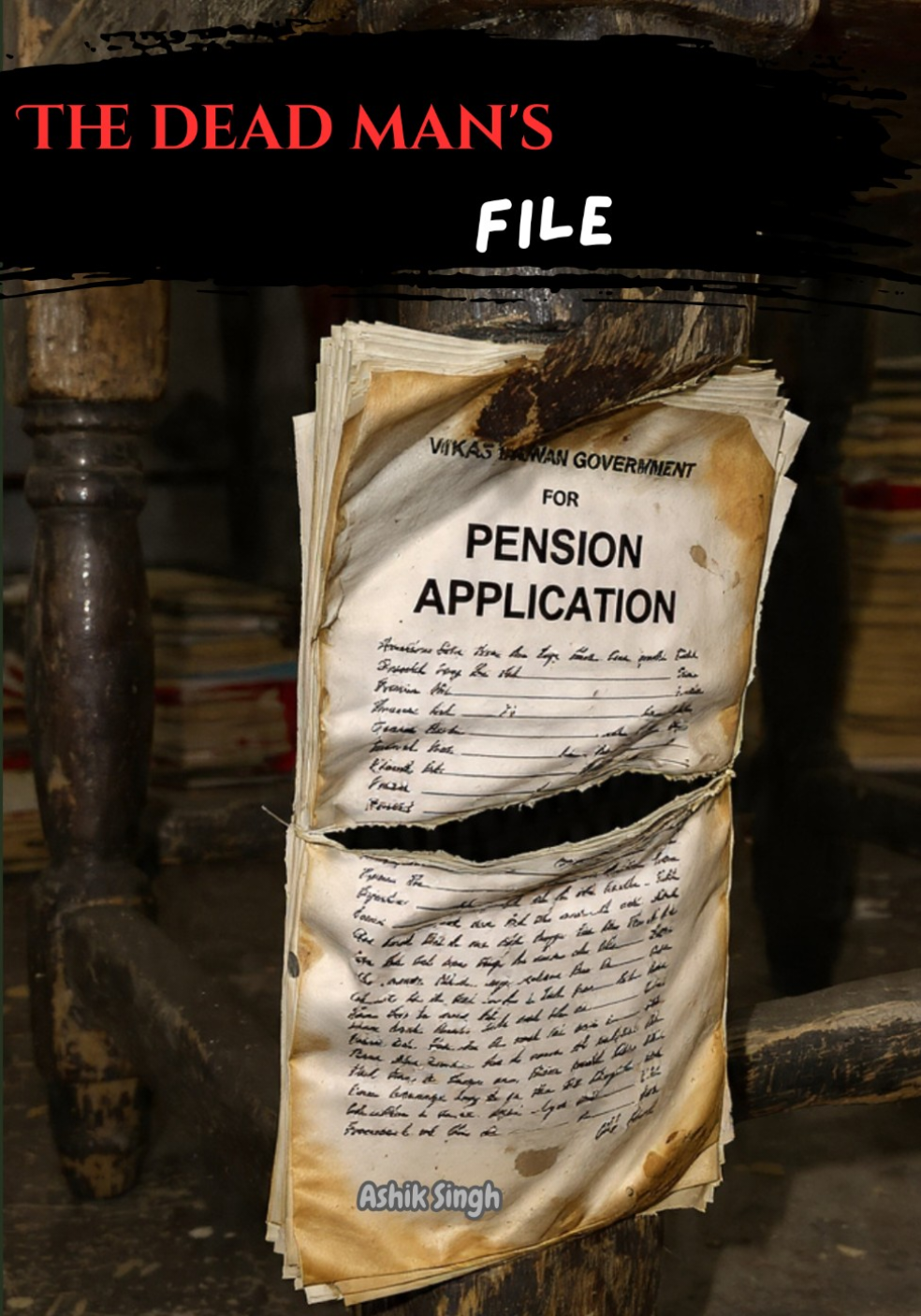
And Ganpat? When he finally gathered the courage to ask about his pension, Shukla Ji didn't even look up. He picked up Ganpat’s thin, tattered file—the only proof of a lifetime of hard labor—and jammed it under my uneven left leg to stop me from wobbling.
A man’s entire life—his medicine, his food, his dignity—was literally crushed under my weight just to provide a stable seat for a thief. I felt Ganpat’s hope shatter into the dusty floor. I wanted to snap. I wanted to break my own legs and send Shukla crashing to the ground. But I am a chair; my only protest is a silent creak that is always drowned out by the mindless drone of the rusty ceiling fan.
...Then, for a brief moment, the air changed. A young officer named Aryan took charge—fresh-faced, sharp-eyed, and carrying the scent of idealism. When he sat on me, for the first time in three decades, I felt 'light.'
He didn't want 'Chai-Paani'; he wanted justice. Within his first week, he noticed me wobbling. He reached down, pulled out the tattered, dust-choked file of Ganpat that had been jammed under my leg for months, and cleaned the grime off it with his own handkerchief. As he read the struggles of a man who only wanted what was rightfully his, I saw a tear skip off Aryan's cheek and land on the dry ink.
With a firm hand, Aryan picked up his pen and signed the approval. The stroke of that pen sounded like a victory cry in this silent graveyard of an office. "Call Ganpat immediately," Aryan ordered the peon, his voice filled with a rare spark of hope. "Tell him his pension is approved. Bring him to my office. I want to hand this to him personally."
There was a heavy, suffocating silence. The peon, an old man who had grown grey watching this corruption, looked down at his tattered slippers and whispered, "Sir... Ganpat passed away three months ago. He died on the bench outside this very room, waiting for his turn. We found his body in the same dhoti he wore for two years."
The pen fell from Aryan’s hand. The silence that followed was louder than any scream.
It was then that I realized the true horror of this 'System.' We don't just kill dreams here; we kill the dreamers. For every file that is signed 'too late,' a Ganpat dies in some corner of this country—unheard, unhelped, and unmourned.
We call it 'Bureaucracy,' but it is a slow-motion execution of the poor. The ink on that paper was fresh, but the blood it was meant to save had already turned to dust....