Library

 Profile
The Pressure Cooker Whistle
The Pressure Cooker Whistle

If you ask anyone in my family what the most reliable clock in our house is, they won’t say the wall clock in the living room or the alarm on their phones. They’ll say: the pressure cooker.
Three whistles for rice. Five for dal. Seven if Ma is angry.
That is not an exaggeration. That is data collected over twenty years.
This story is about a Sunday afternoon that began like every other and ended with the entire neighborhood knowing our business—all because of a cooker, a forgotten phone call, and my father’s stubborn belief that he could fix anything with a screwdriver and optimism.
Sunday was supposed to be peaceful.
Ma woke up early, as always, even though it was her only day off from school. By 8 a.m., she had already swept the house, watered the plants, and mentally prepared a full-course lunch that could easily feed a wedding party.
“Simple khana today,” she announced.
In our house, “simple” means rice, dal, aloo bhaja, fish curry, chutney, and something sweet “just in case.”
I was still half-asleep when the first whistle went off.
One.
That meant rice was on.
Two.
That meant things were under control.
Three.
That meant we had entered the critical phase of cooking where Ma expected absolute silence, obedience, and zero unnecessary movement in the kitchen.
Of course, this is exactly when my father decided to intervene.
Baba has a habit of fixing things that are not broken.
If a chair is slightly wobbly, he will dismantle it completely and then spend two days wondering where the extra screw came from.
That morning, his target was the kitchen exhaust fan.
“It’s making noise,” he declared, standing with hands on hips like a man about to negotiate a peace treaty.
“It’s been making that noise for ten years,” Ma replied, not looking up from chopping onions.
“But now it is different noise.”
There was a pause.
Anyone who has lived with my parents knows that this was the moment where things could go one of two ways: either Ma would ignore him, or Baba would proceed anyway.
He proceeded.
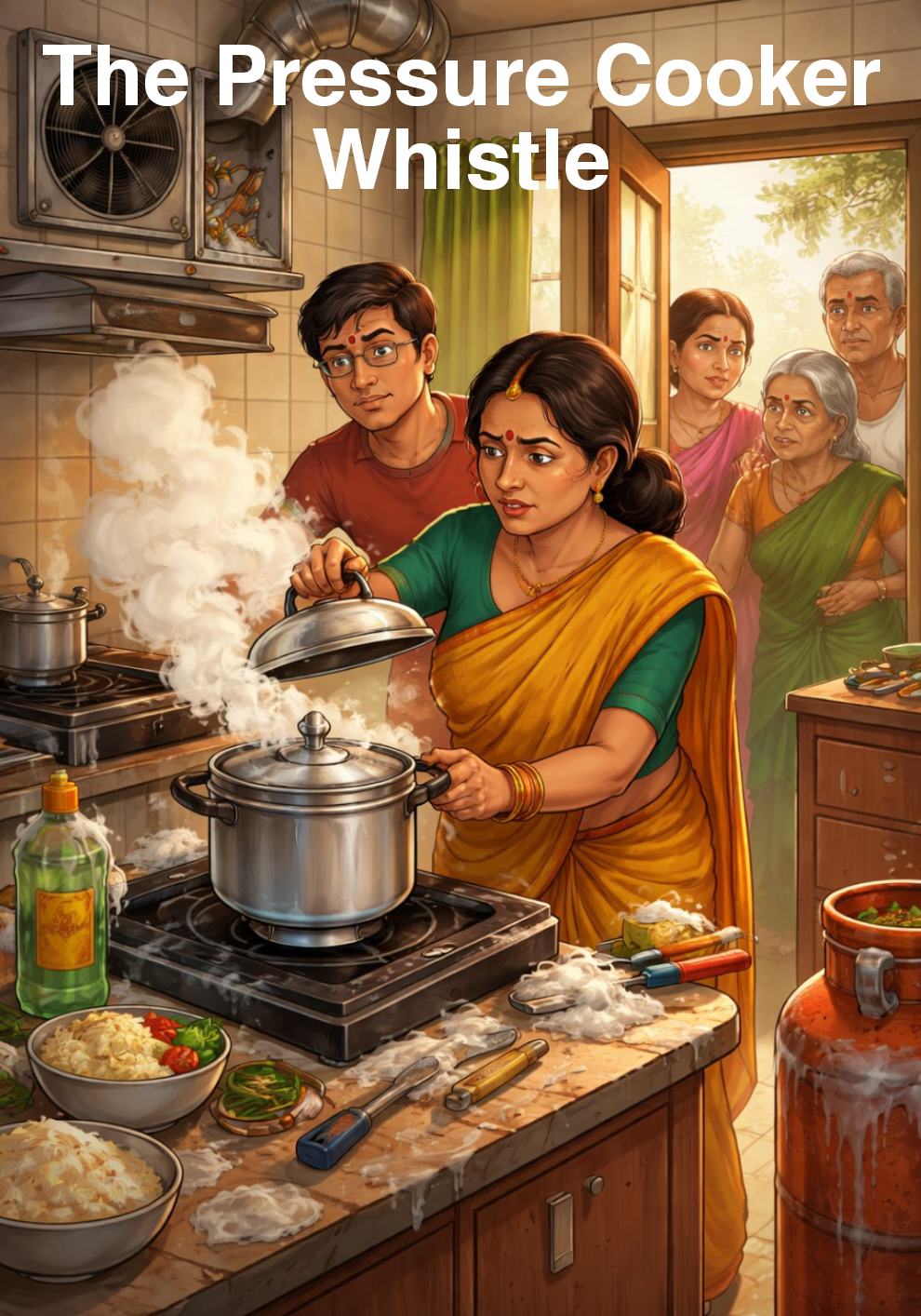
By 10 a.m., the kitchen looked like a workshop.
The exhaust fan was removed. Screws were arranged on the counter like tiny soldiers awaiting orders. Baba stood on a stool, peering into the hollow space in the wall.
“Switch off the main,” he said.
“Why?” Ma asked.
“Safety.”
“Then why didn’t you think of safety before opening it?”
No response.
He waited.
Ma sighed, wiped her hands on her saree, and went to switch off the main power.
This is important.
Because when she turned off the power, she also turned off the phone charger.
And when the phone charger was off, her phone—already at 3% battery—died.
This is also important.
At 10:30 a.m., the pressure cooker began its second round.
Dal.
One whistle.
Two whistles.
Meanwhile, Baba had successfully opened the exhaust fan and was now staring at a collection of wires as if they would confess their purpose under pressure.
“Pass me the screwdriver,” he said.
“It’s already in your hand,” I replied.
“Then pass me the other one.”
We had only one screwdriver.
He nodded thoughtfully, as if this confirmed something profound.
At 11 a.m., the doorbell rang.
It was our neighbor, Mrs. Dutta.
She never just visits. She arrives with news.
“Did you hear?” she said before even stepping inside.
“No,” Ma replied, still focused on cooking.
“The gas supply in the next block had an issue yesterday. Leakage. Very dangerous.”
Ma froze.
“Leakage?”
“Yes, yes. They had to call someone to fix it. These things are not to be taken lightly.”
Baba, from his stool, said, “Our gas is fine.”
Mrs. Dutta looked at the disassembled kitchen and then at Baba balancing precariously.
“Are you sure?”
“Yes.”
“Hmm.”
She didn’t sound convinced.
At 11:15 a.m., the third whistle of the dal cooker went off.
But this time, it sounded… louder.
Or maybe sharper.
Or maybe, as Mrs. Dutta dramatically suggested, suspicious.
Ma turned to Baba.
“Did you check the gas properly?”
“Yes.”
“When?”
“This morning.”
“How?”
“I saw it.”
“That is not checking.”
“It is visual inspection.”
Mrs. Dutta gasped softly.
“Visual inspection is not enough in these cases.”
At 11:20 a.m., Ma decided to call the gas agency.
Her phone was dead.
“Use your phone,” she told Baba.
“My phone is also charging.”
“But the power is off.”
They both looked at each other.
Slowly.
Realization dawned.
Now, if this were any other family, they would calmly switch on the power, charge the phone, and call for help if needed.
We are not that family.
Instead, what followed was a series of decisions that escalated the situation from “possibly nothing” to “mild neighborhood crisis.”
First, Ma turned off the gas cylinder.
Good decision.
Second, Baba decided that the smell in the kitchen was “slightly unusual.”
Debatable.
Third, Mrs. Dutta insisted that unusual smells are always the beginning of something catastrophic.
Unhelpful.
Fourth, I suggested opening the windows.
Ignored.
Fifth, Baba climbed down from the stool, leaving the exhaust fan half-repaired and wires exposed.
Questionable.
At 11:30 a.m., the pressure cooker—forgotten in the chaos—released another whistle.
A long, dramatic one.
Mrs. Dutta jumped.
“That is not normal!”
“It is normal,” Ma said.
“It sounded different.”
“Everything sounds different to you.”
At this point, another neighbor had arrived.
And then another.
Because nothing spreads faster than the possibility of danger combined with curiosity.
Within minutes, our kitchen doorway was crowded with concerned faces offering advice.
“Pour water.”
“Don’t pour water.”
“Call someone.”
“Don’t call, first check.”
“Switch off everything.”
“Already switched off.”
“Then switch on.”
“No, don’t switch on!”
It was less of a discussion and more of a live debate show.
Meanwhile, Baba decided to take matters into his own hands.
He approached the gas cylinder like a man approaching a wild animal.
Carefully.
Slowly.
With unnecessary drama.
“I will check for leakage,” he announced.
“How?” Ma asked.
“With soap water.”
“Where will you get soap water now?”
He paused.
Looked around.
Picked up the dishwashing liquid.
Poured a generous amount directly onto the cylinder.
No water.
Just soap.
Nothing happened.
Of course nothing happened.
Because there was no leak.
But the lack of bubbles did not stop the commentary.
“Maybe it is inside.”
“Maybe it is very small.”
“Maybe it is in the pipe.”
“Maybe it is in the wall.”
“Maybe it is the cooker.”
Ah yes.
The cooker.
The true star of this story.
At 11:45 a.m., Ma finally lost patience.
“Everyone please go,” she said, in a tone that suggested this was not a request.
Reluctantly, the neighbors retreated.
Mrs. Dutta was the last to leave.
“Be careful,” she said, placing a hand dramatically on Ma’s shoulder.
“We are always careful,” Ma replied.
The kitchen was quiet again.
For exactly ten seconds.
Then—
WHISTLE.
Loud.
Sharp.
Unmistakable.
We all turned to the cooker.
Ma walked over, turned off the stove, and lifted it with practiced ease.
Steam hissed out.
Completely normal.
She opened it.
Dal.
Perfectly cooked.
No explosion.
No leakage.
No crisis.
Just lunch.
There was a long silence.
Then Baba said, very softly, “So… no problem?”
Ma looked at him.
Then at the dismantled exhaust fan.
Then at the soap-covered gas cylinder.
Then at the dead phone.
And finally at the perfectly cooked dal.
“No problem,” she said.
“But next Sunday, you are not entering the kitchen.”
We ate lunch at 12:30 p.m.
Everything tasted exactly as it should.
Rice fluffy. Dal smooth. Fish curry rich.
The kind of meal that makes you forget chaos ever existed.
Almost.
By evening, the story had already spread.
Apparently, we had a “gas scare.”
Some versions included “almost explosion.”
One version even had “fire brigade almost called.”
Mrs. Dutta, I suspect, was the primary source.
Baba eventually fixed the exhaust fan.
It still makes the same noise.
But now, every time it starts, Ma says, “Different noise, right?”
And Baba pretends not to hear.
As for the pressure cooker, it continues to be our most reliable clock.
Three whistles for rice.
Five for dal.
And occasionally, one very loud whistle to remind us that sometimes, the drama in a house has nothing to do with danger—and everything to do with the people inside it.
And honestly, I wouldn’t have it any other way.