Library

 Profile
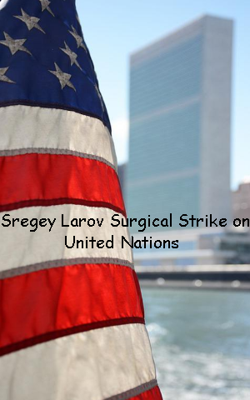
Sregey Larov Surgical Strike on United Nations
Sregey Larov Surgical Strike on United Nations

SERGEY LAVROV SURGICAL STRIKE
The Day the Drum Was Beaten: The Great Kutch UN Accord.
Act I — The Morning Dispatch
The teacup in Ramesh Bhai Patel’s hand did not rattle.
It froze.
It was 7:14 on a quiet Sunday morning in September 2026 in Satellite, Ahmedabad. The morning sun had barely cleared the apartment towers. The fafda was still warm. The jalebi was still respectable.
Then his mobile phone vibrated.
A WhatsApp notification appeared with the gravitas of a nuclear launch code:
“Russian Foreign Minister Sergey Lavrov backs India’s bid for a permanent seat on the UN Security Council.”
Ramesh Bhai swallowed his lukewarm fafda without chewing. He shouts: આપણો ડંકો દુનિયામાં વાગી ગયો.
The drum had been beaten.
History had arrived.
By 7:18, forty-seven society WhatsApp groups, three caste matrimonial forums, two retired-bankers’ groups, and the Lions Club of Ranip 1998 Batch had received the definitive dispatch:
BREAKING: RUSSIA HAS STAMPED THE PAPER. INDIA’S PERMANENT UNSC SEAT CONFIRMED. CERTIFICATE WILL BE COURIERED BY BAN KI-MOON BEFORE EVENING AARTI. FORWARD TO 11 GROUPS FOR GOOD LUCK. JAI VISHWA GURU!
Nobody mentioned that Ban Ki-moon had retired years ago.
Nobody mentioned that Russia could not unilaterally create a new permanent member of the Security Council.
Nobody mentioned the UN Charter.
There was no time.
The algorithmic floodgates had opened.
Gujarati hyper-pragmatism had collided with global statecraft.
By 8:30, the WhatsApp University Think Tank on Strategic Affairs had produced India’s inaugural veto schedule.
A PDF titled: VETO_ACTION_PLAN_2026_FINAL_v2_REAL_FINAL.pdf
was circulating at extraordinary speed.
It contained several urgent recommendations.
First: a retrospective veto against every resolution ever passed against Russia and India since 1979.
Second: immediate cancellation of Canada’s visa quota until Ottawa issued a formal apology to the Patel community of Brampton.
Third: all Pakistani proposals at the UN were to be vetoed every Tuesday and Thursday between 2:00 and 5:00 PM.
“Office hours,” explained the author.
Television debates followed.
One primetime geopolitical savant, brandishing a whiteboard marker like a bayonet, explained the mathematics.
“America supported India in 2010. France supported India. Britain supports India. China already supported during last BRICS meeting held this month in Delhi. Russia supports India today. Five out of five!”
He circled the number 100%.
“In Gujarat University, eighty percent is distinction!”
We are having the perfect number Though 101 is auspicious, but mathematics doesn't allow it.
He underlined it twice.
“Seat confirmed.”
A second panelist interrupted.
“But China, if change its mind —”
“China’s opinion,” the savant replied, “is legally invalid because of border friction.”
A former diplomat attempted to intervene.
“Technically, political support is not the same as formal Security Council reform. Any amendment to the Charter would require a two-thirds General Assembly vote and ratification under Article 108—”
His microphone disappeared.
The banner below the screen changed:
IS CHINESE SOUP FUNDING THE LOBBY AGAINST BHARAT’S HISTORIC MORNING?
The former diplomat looked at the camera.
The camera looked back.
The nation moved on.
Act II — The Great Kutch Relocation
At 11:45 AM, Ramesh Bhai’s society WhatsApp group entered its second phase.
United Nation's Infrastructure?
The question was obvious.
If India was about to become a permanent member of the Security Council, why should the United Nations continue paying Manhattan rent in expensive US dollars?
There was an obvious alternative. Manu Bhai, arey, India is already now permanent member!
The Great Rann of Kutch. The seat of United Nations now!
Flat.
Spacious.
Vastu-compliant.
Strategically located.
And, most importantly, available.
By 1:30 PM, the Kutch UN Relocation Master Plan 2047 had been approved unanimously by people who had never seen it.
The new UN Headquarters would be constructed somewhere between Dhordo and wherever the nearest reliable borewell could be found.
“Think of the footfall,” explained Hasmukhbhai in the Vastrapur Diamond Traders group.
“Every ambassador will buy two Bandhani dupattas, five kilos of Kutchi peda and at least one refrigerator magnet.”
Someone calculated the projected foreign-exchange earnings.
The number was larger than India’s GDP.
The calculation was forwarded immediately.
Connectivity was the next priority.
The Ministry of Strategic Planning—meeting entirely through encrypted voice notes—declared Bhuj the new transit node of human civilization.
The proposed international GSRTC routes were magnificent:
* Bhuj–Geneva: via Tehran, with a scheduled tea break near Zahedan.
* Bhuj–Washington: via the Bering Strait Flyover, subject to minor engineering adjustments.
* Bhuj–New York: direct overnight sleeper bus, two theplas included.
* Bhuj–Moscow: winter service, with complimentary woolen shawl.
All world capital city is now connected with Bhuj Bust Stand.
A special diplomatic metro would connect the UN Security Council chamber to Bhujodi craft village.
The only remaining question was construction.
The answer arrived at 2:17 PM.
A voice note from Rajkot stated:
“Work should not go to foreign brokers. Contract for whole UN Kutch complex—metro, roads, cement, security gate, barber shop, paan shop, soda parlor, catering—should go to Chhagan Bhai. Very reputed man. He completed four floors near Kalupur station in record time. Clean RCC work. No tender required. Direct allocation.”
By 3:00 PM, Chhagan Bhai had redesigned his visiting card.
CHHAGAN PATEL & SONS: United Nations' Official Contractor
Earthmovers • Borewell Drilling • International Infrastructure
Strategic Infrastructure Partner to the United Nations Security Council
He had already called Morbi. Than. Porbandar for bela stones. Kutiyana for Lime.
“Forty thousand square metres of vitrified marble-finish tiles,” he instructed.
“For the General Assembly.”
There was a pause.
“Golden border?”
Chhagan Bhai thought for three seconds.
“Obviously.”
Act III — One District, One Global Body
The first plenary meeting in the Great Rann had barely begun when administrative decentralization commenced.
The new principle was simple:
ONE DISTRICT, ONE GLOBAL BODY.
The World Health Organization received land near the Bagodara bypass, strategically positioned between two roundabouts and a highway hotel famous for masala tea.
The International Labour Organization was assigned the forests of Dang.
“Labour productivity,” explained the allocation committee, “will henceforth be studied through monsoon agriculture and bamboo harvesting.”
UNESCO was moved to Patan.
Its first assignment:
Preserve the Patola.
The International Monetary Fund was relocated to a commercial complex near Rajkot ring road.
Its new mandate was described as:
“International finance, promissory notes, ledgers and practical cash-flow management.”
The World Bank was offered a building near Mehsana.
It declined.
The offer was immediately described as evidence of anti-Gujarati bias.
Then came food.
The diplomatic catering charter was passed unanimously.
All continental breakfasts were abolished.
No more croissants.
No more cold sandwiches.
No more suspicious little canapés balanced on silver trays.
From the Élysée Palace to the Tokyo Diet, official state dinners would henceforth feature:
fafda, jalebi, papaya sambharo and khandvi.
A new international agency was established:
HIGH COMMISSION FOR CHUTNEY STANDARDS
Its first regulation prohibited watery green chutney at diplomatic functions.
Its second regulation required all chutney to be served in stainless-steel bowls.
Its third regulation was classified.
Then came clothing.
Western business suits were declared “administratively excessive.”
Delegates were issued:
* Kathiyawadi chorni,
* chudidars,
* dhotis,
* Bandhani saris,
* embroidered jackets,
* and ceremonial paghdis.
Within forty-eight hours, tailors in Gondal, Amreli and Rajkot were receiving acquisition offers from Wall Street.
A Wall Street investment bank reportedly offered a seventeen-billion-dollar valuation to a family-run paghdi workshop.
The owner refused.
“Cash or cheque?”
he asked.
“Dollar.”
“US dollar?”
“Yes.”
He shook his head.
“Too much foreign exchange risk.”
Act IV — The Rise of Gujarati Diplomatic Law
The Secretariat next issued a clarification regarding visa-free travel.
The original proposal had been misunderstood.
Visa-free access would not be available to everybody.
It would be available only to verified residents of Gujarat.
Applicants would be required to produce:
1. Domicile certificate.
2. Aadhaar.
3. Passport.
4. Talati-cum-Mantri certificate.
5. Evidence that their ancestors had lived in Gujarat.
6. Evidence that their ancestors had eaten Gujarati food.
7. A witness who could confirm the family had never refused chaas.
Delhi, Mumbai and Bengaluru residents were directed to a separate counter.
The counter had one officer.
He was on lunch.
The Gujarati diaspora, meanwhile, was granted automatic diplomatic privileges.
At international airports, security officers were instructed not to interfere with steel tiffins containing methi thepla, chhundo and fried green chilies.
At 35,000 feet, aircraft captains were routinely handed foil-wrapped theplas by passengers.
“Captain,” the passenger would say politely.
“Yes?”
“Extra one.”
The captain would hesitate.
“For whom?”
“Your co-pilot.”
International aviation regulations were amended accordingly.
Act V — The Calendar Incident
Then somebody noticed a serious administrative problem.
The United Nations was operating on the Gregorian calendar.
This was considered unnecessarily complicated.
The Gregorian calendar was quietly retired.
The Vikram Samvat became the official international calendar.
The General Assembly declared:
* Navratri: mandatory diplomatic recess.
* Dhanteras: international financial clearance day.
* Labh Pancham: treaty-signing day.
* Uttarayan: compulsory aerial diplomacy.
* Diwali: global administrative shutdown.
For two weeks during Navratri, all international conflicts were formally suspended. Ukraine and Russia stopped war. Iran, America and Israel stopped fighting. houthis, hezbollah, hamas, al-quaida fall in line. Total peace on the earth. First time in human history.
The reason was practical.
Nobody could attend a peace negotiation while simultaneously doing garba until 3:00 AM. Entry pass and traditional dress was mandatory.
The Secretary-General’s office issued a circular:
“No war, sanctions, invasion, coup or emergency summit shall be scheduled during peak garba hours.”
The world accepted this immediately.
It was the first UN resolution nobody opposed.
Sanction by United Nation or any country on any other country or entity was subject to approval of Sarpanch of Bhachau.
Act VI — The Geographic Correction
Cartographers were next.
The National Geographic Society received an urgent memorandum informing it that several historic geographical measurements had been conducted using obsolete methods.
The Nile?
Under review.
The Amazon?
Pending verification.
Mount Everest?
Measurement committee constituted.
The Bhogavo River was declared the longest river on Earth.
Its principal scientific advantage was explained as follows:
“During summer, its absence of water should not be interpreted as absence of river. It represents hydro-strategic reserve capacity.”
Girnar was declared the world’s highest mountain.
The 9,999 steps were converted into vertical nautical altitude.
An international delegation climbed the first 1,200.
At that point, the delegates voted unanimously to recognize the remaining 8,799 by faith.
The Himalayas filed an appeal.
It was rejected.
Act VII — The University of Everything
The transformation could not be complete without education.
Every institution within Gujarat’s borders was granted Autonomous International University status.
State universities qualified.
Private universities qualified.
Management institutes qualified.
A coaching class operating above an automobile-parts shop in Mehsana also qualified.
Its new signboard read:
INTERNATIONAL INSTITUTE OF ADVANCED GLOBAL MANAGEMENT
Formerly: Patel Computer Classes
Its first international course was:
Diplomacy Through Excel — 15 Days
Macron and Trump were their foundational students. Lula and Carney was denied admission at least for a year. Wait till seat is available. Continue checking our website.
Its second:
Strategic Foreign Policy Using WhatsApp — Weekend Certificate
Its third:
PhD in Forwarding Without Verification
The last course filled within eleven minutes.
Harvard, Stanford and Oxford were openly jealous when, out of the list of the first thousand academic institutes ranked for real-world impact, they found themselves irrelevant, while INSEAD from France immediately offered a case study on its own failure and demanded an emergency MBA module to understand the new model, and the Max Planck Society from Germany convened a solemn symposium to investigate how a thousand institutes missed what one original idea had achieved.
All first eleven hundred and fifty one academic institutes were from Gujarat.
Act VIII — Gujarati Becomes the Language of the World
Finally came the linguistic resolution.
English was removed.
French was removed.
Russian was removed.
Mandarin was removed.
The United Nations adopted Gujarati as its sole working language.
World leaders arriving for the next summit were handed slate boards and chalk.
Their first lesson was basic vowels.
અ — આ — ઇ — ઈ — ઉ — ઊ
The American delegation struggled.
The British delegation requested phonetic assistance.
The Russian delegation appeared surprisingly confident.
The Chinese delegation demanded a translation of the grammar.
There was none.
The greatest crisis came when a new electoral regulation was announced.
No head of state or parliamentarian anywhere in the world could contest an election without submitting a certified Gujarati Bhasha Pravin qualification.
Within weeks, television broadcasts showed extraordinary scenes.
Presidential candidates in Washington sat with Gujarati tutors from Navsari.
British politicians studied grammar in London hotels.
European ministers memorized verb forms.
A senior African president reportedly spent six hours learning the difference between:
હું કરું છું and મેં કર્યું. (I am doing and I did)
He eventually asked:
“Who designed this language?”
His tutor replied:
“People who had plenty of time.”
Epilogue — The Other United Nations
Somewhere in New York, the actual United Nations continued its ordinary work.
The Security Council still had five permanent members.
No new permanent seat had been created.
No veto had been transferred.
The UN Charter remained unchanged.
No headquarters had moved to Kutch.
No GSRTC bus had reached Geneva.
No American president had yet passed Gujarati Bhasha Pravin.
And no one at the United Nations had heard of Chhagan Bhai.
Back in Satellite, Ahmedabad, Ramesh Bhai finished his afternoon tea.
He leaned back on his swing.
The ceiling fan turned slowly above him.
His phone buzzed.
Another message had arrived.
An animated GIF showed the UN globe being replaced by a map of Gujarat.
Below it was a caption:
“THE WORLD HAS ACCEPTED.”
NASA, Google, Meta, Microsoft, Amazon, Harvard, Stanford, Oxford, INSEAD and the Max Planck Society all had to line up and apply for permission to the Sarpanch of Bhachau to operate any of their activities in Kutch, and the Sarpanch, with his mouth full of paan and tobacco mavo, barely able to speak clearly, lingered over their glossy proposals, denied a few outright for lack of original documents, and told the rest to come back next week with more paperwork and proper village NOC.
Ramesh Bhai smiled.
He forwarded it to eleven groups.
Then he looked toward the balcony.
“Chhagan Bhai will finish the road before Diwali,” he whispered.
He paused.
“Let the Americans try to veto that.”
The ceiling fan continued turning.
Somewhere in Kutch, a contractor ordered forty thousand square metres of golden-border tiles.
And somewhere in New York, a UN official sneezed.
The Gujarati delegation immediately declared it a diplomatic signal.
The drum had been beaten. આપણો ડંકો દુનિયામાં વાગી ગયો