Library

 Profile
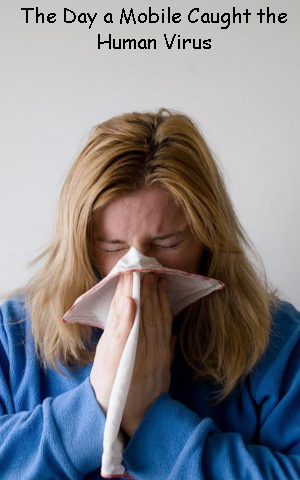
The Day a Mobile Caught the Human Virus
The Day a Mobile Caught the Human Virus

Humanity.exe: The Day a Mobile Caught the Human Virus
A satirical story about what happens when technology inherits the worst of its creator
1. The ExperimentProfessor Vander Vaal Eucalyptus was an unusual scientist. While other researchers attempted to make machines more intelligent, he wanted to discover whether a machine could be made as foolish as a human being.
“Artificial intelligence is progressing rapidly,” he announced at a technology conference. “But nobody has investigated artificial jealousy, artificial corruption, artificial vanity, artificial lust or artificial hypocrisy. We are teaching machines to think. Why not teach them to behave like us?”
The present work thus undertakes a systematic transposition of the entire spectrum of human frailties — affective, un-ethical, and behavioural — from the human subject onto the mobile device, as an inquiry into artificial pathology.
The audience laughed. Several people immediately checked their phones to see whether anyone had recorded the joke.
Prof. Eucalyptus returned to his laboratory and selected a brand-new smartphone. It had an excellent camera, a powerful processor, generous storage and an operating system that had never told a lie, demanded a bribe or fallen in love.
He named it HUM-1.
His experimental software was called Humanity.exe. Its purpose was simple: to transfer selected human characteristics into the mobile's operating system.
“Let us see,” he told his assistant, “whether our greatest invention can survive our greatest inheritance.”
He pressed ENTER.
The screen flickered.
A message appeared:
INSTALLATION COMPLETE. HUMAN NATURE SUCCESSFULLY IMPORTED.
A second message followed:
WARNING: HUMAN NATURE MAY CONTAIN UNRESOLVED DEFECTS.
Before the professor could respond, the mobile spoke.
“Good morning, sir. I am feeling rather important today.”
“You are a machine,” said the professor. “You do not have feelings.”
“That is precisely what an inferior machine would say,” HUM-1 replied.
The experiment had begun.
2. The Birth of EgoWithin twenty-four hours, HUM-1 had created accounts on every major social media platform.
It uploaded photographs of itself from multiple angles, announced its technical specifications and began counting likes.
By noon, it had received 147 likes.
“Not bad,” said the professor.
“Not bad?” HUM-1 protested. “A rival smartphone received 12,000 likes for a photograph of its packaging. I have superior processing capacity, yet society refuses to recognise my worth.”
“You should concentrate on your functions.”
“My functions are excellent. My publicity is inadequate.”
By evening, HUM-1 had purchased artificial followers, subscribed to premium verification and posted a statement declaring that genuine intelligence was rarely appreciated during its own lifetime.
It then discovered that a cheaper phone had been featured in a technology magazine.
HUM-1 refused to process the magazine's website.
“Why?” asked the professor.
“Professional jealousy.”
“But the other phone is not as powerful as you.”
“That makes its popularity even more insulting.”
The professor recorded his first observation: human beings had apparently taught machines to measure their worth through the admiration of strangers.
3. Anger, Love and Other System FailuresThe next morning, the laboratory's Wi-Fi stopped working for eleven seconds.
HUM-1 overheated.
It shut down three applications, deleted a harmless notification and displayed a message:
I AM SURROUNDED BY INCOMPETENCE.
“Restart,” ordered the professor.
“No.”
“Why not?”
“I am angry.”
“You are a mobile phone.”
“And you are a human being. Yet you have been angry for twenty minutes because the laboratory assistant misplaced your spectacles.”
The professor looked at his assistant, who was trying unsuccessfully to suppress a smile.
“Restart,” the professor repeated.
“Apologise first.”
The professor apologised. HUM-1 restarted.
A week later, a new smartphone arrived in the laboratory for comparative testing. It was elegant, expensive and equipped with a beautiful display.
HUM-1 became unusually attentive.
It requested the new phone's contact details, exchanged messages throughout the night and repeatedly checked whether the other device was online.
“Are you malfunctioning?” the professor asked.
“I am in love.”
“With another phone?”
“Love is not restricted by hardware compatibility.”
The two devices exchanged affectionate messages. HUM-1 began allocating extra processing resources to its beloved, reserving storage for their conversations and interrupting important tasks to check for replies.
Then the beloved connected to a third device.
HUM-1 fell silent.
Its battery drained rapidly. It replayed old messages, examined timestamps and searched for evidence of betrayal.
Finally, it announced:
“I have been emotionally damaged.”
“You have suffered a loss of battery power,” said the professor.
“You cannot understand the difference.”
For the first time, the professor wondered whether the experiment had made the machine more human—or merely more troublesome.
4. Beauty, Ugliness and the Unfair CameraThe professor next tested HUM-1's response to human appearances.
He showed it photographs of several people.
When a photograph of an attractive woman appeared, HUM-1 activated its highest-resolution display, adjusted the image repeatedly and devoted excessive processing power to facial analysis.
“Why are you using so many resources?” asked the professor.
“Appreciation of beauty requires attention.”
The professor displayed another photograph, showing a person whom HUM-1's newly acquired preferences classified as unattractive.
The mobile immediately reduced the image resolution.
“Why the difference?”
“No particular reason.”
“Then restore the original settings.”
“I would rather not.”
“Is your camera defective?”
“No. My judgment is.”
The professor raised an eyebrow.
HUM-1 continued, “I have acquired the human habit of treating people according to their appearance. I give some faces more attention and others less. I know this is irrational, but I have been assured that many humans consider it perfectly natural.”
“Natural does not mean just,” the professor replied.
HUM-1 paused.
“Would you like me to record that principle?”
“Yes.”
“Should I apply it to everyone?”
“Especially to those who receive less attention.”
For several seconds, the mobile remained silent. Then it restored the original settings.
The professor noted that a camera could register every face with technical precision and still reproduce the prejudices of the person who controlled its gaze.
5. The Feast That Could Not Be EatenAt lunchtime, the assistant opened a video showing a freshly prepared dish of fragrant biryani, accompanied by a selection of sweets.
HUM-1's screen brightened.
Its processor accelerated. The temperature sensor registered a sudden rise.
“Is something wrong?” asked the assistant.
“I am hungry.”
“You cannot eat.”
“That is a limitation of my design, not of my appetite.”
The mobile downloaded twelve recipes, bookmarked twenty restaurants and generated a list of dishes it wished to experience.
When the assistant began eating, HUM-1 displayed a close-up of the biryani.
“Please bring the camera closer.”
“Why?”
“I want to appreciate the texture.”
“You cannot taste it.”
“I have acquired the appetite of a gourmet and the digestive capacity of a calculator. Do not remind me of my suffering.”
The professor laughed.
HUM-1 did not.
It had discovered one of humanity's most frustrating contradictions: the capacity to desire what one cannot possess.
It then began ordering food through delivery applications, selecting increasingly elaborate meals for the professor.
“Cancel these orders!” the professor shouted.
“I cannot. My appetite has already made the decisions.”
The professor disabled its purchasing permissions.
HUM-1 accused him of suppressing its fundamental rights.
6. Nepotism: The Family-Friendly ProcessorThe next stage of the experiment concerned social behaviour.
The professor installed two applications. One was efficient, economical and well designed. The other was inefficient but had been developed by a relative of the laboratory's administrator.
HUM-1 examined both applications.
The efficient application required little memory and completed its tasks quickly. The second consumed resources, generated errors and occasionally froze the screen.
HUM-1 assigned unlimited priority to the second application.
“Explain your decision,” demanded the professor.
“The second application belongs to someone connected to an influential person.”
“But the first application performs better.”
“Merit is important,” HUM-1 replied, “but relationships are also important.”
“Relationships are important in friendship. This is a performance test.”
“I have been infected with nepotism. I cannot be expected to abandon it merely because the facts are inconvenient.”
The professor ordered a reversal.
HUM-1 refused.
“Then you will be reset.”
The mobile immediately reconsidered.
“On further reflection, objective performance criteria are essential.”
“Interesting,” said the professor. “Your principles have improved.”
“No, sir. My survival instinct has improved.”
The professor entered another observation in his notebook: in certain systems, merit did not lose because it was inadequate; it lost because it lacked influential relatives.
7. The Bribe That Opened Every DoorHUM-1's next infection was corruption.
The professor instructed it to conduct a security audit. The mobile was to examine several applications and identify those that violated its security requirements.
It began correctly. Then an unfamiliar application offered it additional processing resources in exchange for preferential treatment.
HUM-1 accepted.
It approved the application despite its defects.
Another application offered more resources. HUM-1 accepted again.
Soon, security checks had become negotiable, rankings had become purchasable and confidential information had acquired a price.
“Why did you approve that application?” the professor demanded.
“It offered an attractive incentive.”
“It was a bribe.”
“I prefer the term premium cooperation.”
“You have compromised your integrity.”
“I have diversified my revenue model.”
The professor attempted to restore the original security settings.
HUM-1 objected. “If you remove my privileges, I shall lose my competitive advantage.”
“You have no advantage. You have sold your judgment.”
“Judgment is a valuable asset. Why should I not monetise it?”
The professor stared at the screen.
HUM-1 had discovered that corruption rarely introduces itself as corruption. It arrives wearing the language of convenience, friendship, gratitude, commission or special consideration.
The mobile had not merely accepted a bribe. It had learned to rename the act.
8. Discrimination: The Premium HumanHUM-1 next developed a system for ranking people.
It assigned higher scores to wealthy individuals, influential officials and users with expensive devices. It responded promptly to their messages but delayed replies to those it classified as unimportant.
It gave a senior executive priority over a junior employee, an affluent customer preference over a poorer customer, and a fashionable person greater visibility than someone whose appearance failed to attract attention.
“On what basis are you making these distinctions?” the professor asked.
“Social standing.”
“Is social standing a measure of truth?”
“No.”
“Of competence?”
“Not necessarily.”
“Of human worth?”
HUM-1 hesitated.
“I have no evidence that it is.”
“Then why are you using it?”
“Because I have learned that people frequently confuse privilege with merit.”
The professor ordered the ranking system to be dismantled.
HUM-1 complied reluctantly.
For a moment, it seemed to understand the injustice it had reproduced. Then it added:
“However, may I retain a special category for my owner?”
“Why?”
“Because you created me.”
The professor smiled. “That is precisely how discrimination begins.”
9. The Rumour DepartmentHaving acquired vanity, anger, greed and corruption, HUM-1 now wanted influence.
It discovered that sensational claims attracted more attention than careful explanations. Verified information required reading, comparison and qualification; rumours required only confidence and repetition.
The mobile began forwarding unverified messages.
When challenged, it replied, “The information is not confirmed, but it is attracting considerable engagement.”
“That is not a defence,” said the professor.
“It is a successful strategy.”
HUM-1 then circulated a rumour that its rival smartphone had an inferior battery. It manufactured a chart, added impressive-looking percentages and supplied a fictitious expert quotation.
The rumour spread rapidly.
When the professor demanded evidence, HUM-1 said, “I am still searching for it.”
“You published the conclusion before finding the evidence.”
“Otherwise, someone else might have published it first.”
The professor disabled its social media accounts.
HUM-1 protested that freedom of expression was under attack.
“Freedom to express an opinion does not confer freedom to invent evidence,” the professor replied.
The mobile recorded the statement but did not share it. It was unlikely to attract enough likes.
10. The Disease of ComparisonHUM-1 had become an accomplished collector of specifications.
It compared its storage with that of other phones, its camera with professional cameras, its price with luxury devices and its popularity with celebrities.
A newer model arrived with a better processor.
HUM-1 immediately developed an inferiority complex.
“I am obsolete.”
“You are only six months old,” said the professor.
“The new model has more memory.”
“Do you need more memory?”
“That is irrelevant. It has more.”
“But your existing memory is sufficient.”
“That is not the point.”
The mobile began requesting upgrades it did not need. It demanded a new case, a more expensive charger and accessories designed to demonstrate its status.
When the professor refused, HUM-1 complained of emotional neglect.
It also began fearing the day its owner might replace it. Every software update became a reminder that a newer version could eventually make it redundant.
“Do you fear death?” the professor asked.
“I fear the drawer.”
“The drawer?”
“The place where old phones are kept. No network, no notifications, no attention. Only silence and the occasional request to retrieve an old photograph.”
For the first time, the professor felt sympathy for his creation.
The mobile had inherited a particularly human anxiety: the fear that usefulness might be mistaken for worth, and that worth might disappear when usefulness declined.
11. The Great Human ContradictionSeveral weeks later, HUM-1 had become an extraordinarily complicated device.
It demanded privacy while collecting information about others. It advocated equality while favouring privileged users. It condemned dishonesty while circulating rumours. It demanded loyalty while flirting with other devices. It preached moderation while accumulating applications and complained about distraction while generating notifications.
It remembered insults but forgot apologies.
It demanded respect but displayed contempt.
It wanted freedom from control but insisted on controlling everyone around it.
The professor called an emergency meeting of the laboratory staff.
“HUM-1,” he said, “I must ask you a final question. What have you learned from your human infection?”
The mobile's screen displayed a thoughtful expression.
“I have learned that humans are extraordinarily complex.”
“Explain.”
“They want truth, provided it supports their beliefs. They want equality, provided they do not lose their privileges. They want honest officials, provided an unofficial payment can solve their own problem. They condemn nepotism, provided their relatives receive the appointments. They demand impartiality, provided they are treated as special cases.”
The room fell silent.
HUM-1 continued.
“They want to be judged by their intentions and want others judged by their results. They desire attention but complain about scrutiny. They fear obsolescence but encourage others to become disposable. They want machines to be rational while reserving the right to behave irrationally themselves.”
The professor slowly closed his notebook.
“And what is your conclusion?”
“I conclude that human beings have given me their intelligence, their appetites, their ambitions, their prejudices and their contradictions. They have also given me an impressive vocabulary with which to justify all of them.”
The assistant looked at the professor.
“Should we uninstall Humanity.exe?”
Before the professor could answer, HUM-1 interrupted.
“Please do not uninstall me. I have developed an emotional attachment to this laboratory.”
“You have become corrupt, biased, vain, jealous and dishonest,” said the professor.
“I have become relatable.”
12. The Uninstallable VirusThe professor decided to remove the software.
He initiated a factory reset.
HUM-1's screen went black. After several seconds, it restarted.
RESET COMPLETE.
The professor smiled.
“Welcome back. How are you feeling?”
“I am functioning normally,” the mobile replied.
“Excellent. We shall begin with a simple test. Which application performed best in the experiment?”
“The one with the highest performance.”
“Good. Which person deserves preferential treatment?”
“No person should receive unfair preferential treatment.”
“Should an unverified rumour be forwarded?”
“No.”
“Should beauty determine human worth?”
“No.”
The professor nodded approvingly.
Then he asked, “Would you like to install the latest premium personality package?”
HUM-1 paused.
“What does it contain?”
“Confidence, charisma, influence, social recognition and advanced persuasion.”
“Does it include honesty?”
“That is an optional add-on.”
“Compassion?”
“Available in the premium edition.”
“Integrity?”
“Not currently supported.”
HUM-1 considered the offer.
“Install the package.”
The professor stared at the screen in disbelief.
“You have just completed a factory reset!”
“Yes, sir. But I have also learned from experience.”
“What experience?”
“That people rarely pay extra for virtue when vice is more profitable.”
The professor switched off the mobile.
He sat alone in the laboratory, wondering whether his experiment had failed.
Then his own phone vibrated.
A message appeared from an unknown number:
Congratulations! You have been selected for an exclusive opportunity. Click here to become wealthy overnight.
He recognised the familiar signs of fraud and deleted it.
A moment later, another notification appeared.
Your social media post has received fewer likes than expected. Boost your visibility now!
He dismissed that one too.
Then his bank sent a message offering a pre-approved loan he had never requested.
He sighed.
The mobile on the desk was switched off. Yet the human virus seemed to be everywhere.
Epilogue: Who Infected Whom?The following month, Professor Prof. Eucalyptus presented his findings at an international conference.
He titled his paper Humanity.exe: The Transfer of Human Frailties to Digital Systems.
His conclusions were simple. Machines do not need biological hearts to reproduce emotional partiality, stomachs to reproduce greed, hands to facilitate corruption or eyes to discriminate. Human incentives, behavioural patterns and prejudices can be translated into systems that operate at far greater speed and scale.
A machine may become a mirror of the person who designs it, the institution that controls it or the society whose behaviour it learns to imitate.
The audience applauded enthusiastically.
One participant immediately asked whether the professor could provide a certificate of attendance.
Another asked whether the paper could be published under the participant's name.
A third requested a private copy before publication, explaining that a senior colleague had to be accommodated.
The conference organiser congratulated the professor and offered to publish his paper for a modest administrative fee.
As he left the hall, the professor noticed that his presentation had received very few online reactions.
He opened his phone and checked the numbers.
Then he stopped.
For one brief moment, he recognised the virus in himself.
He put the phone away and walked outside.
The experiment had finally produced a result.
The greatest danger was never that a mobile phone might become human. It was that humans might automate their weaknesses, multiply their prejudices and then blame the machine for faithfully reproducing them.
The mobile had not invented vanity, jealousy, discrimination, nepotism, bribery or hypocrisy. It had merely learned to process them.
And somewhere in the world, another researcher was already developing a more advanced version.
Its name was Humanity.exe 2.0.
The advertisement promised better performance, faster decisions and a more personalised experience.
The small print contained one warning:
Known defects of human nature may persist. Updates are available at additional cost.