Library

 Profile
When Two Hearts Beat as One
When Two Hearts Beat as One

The Echo of Two Cities
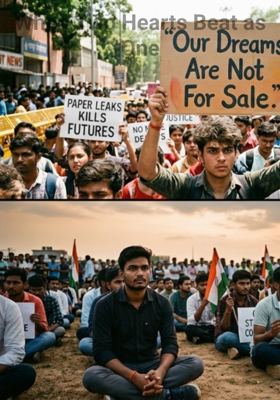
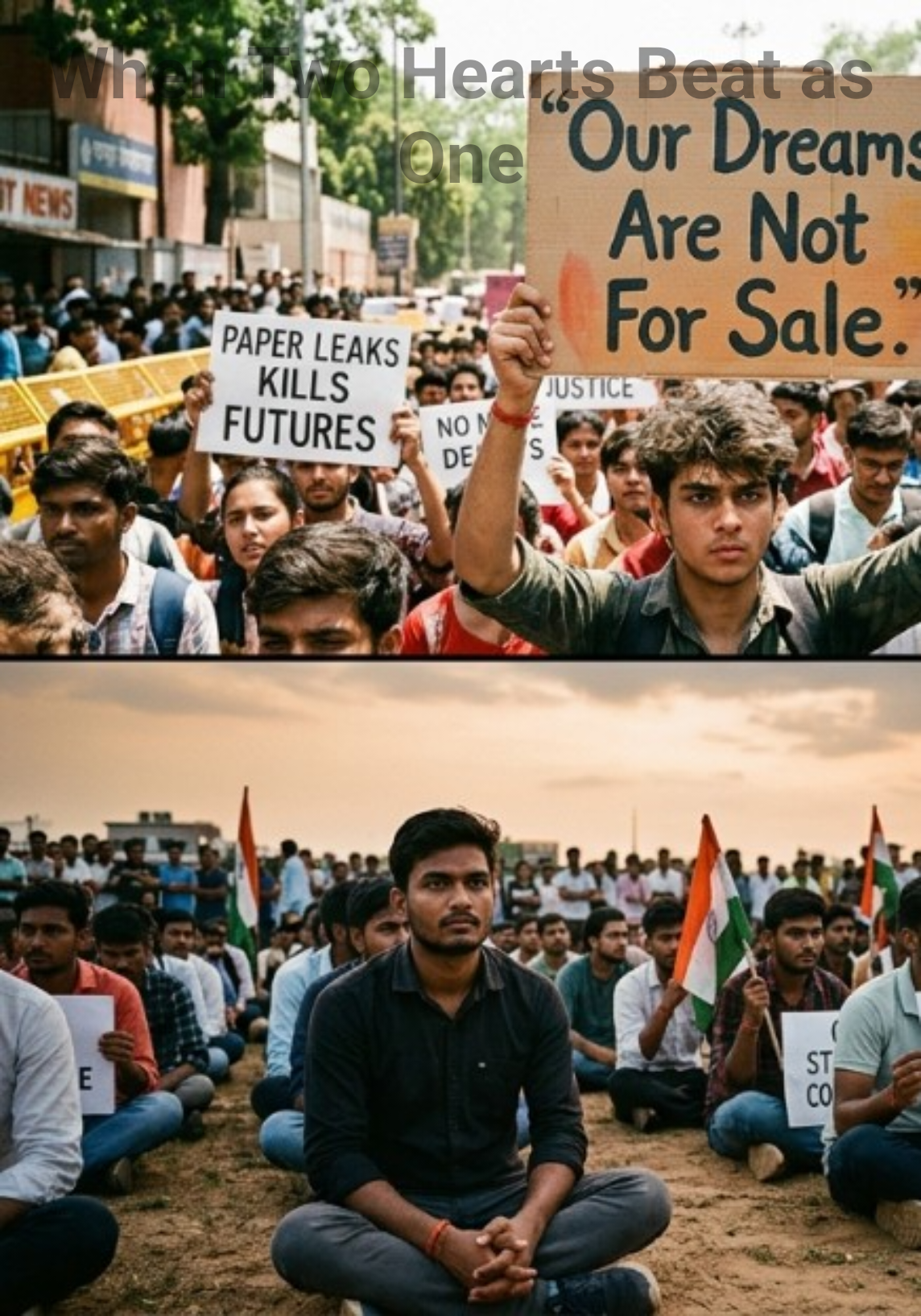
The afternoon sun blazed relentlessly over Delhi’s Jantar Mantar. Rohan stood among a sea of young faces, holding a painted cardboard sign high above his head: “Our Dreams Are Not For Sale.” Like thousands of youth who had gathered in the national capital, he had spent years preparing for competitive examinations, only to watch his efforts dissolve into news headlines about paper leaks and delayed recruitments. The air in Delhi was charged with a modern, media-savvy energy—chants echoed through megaphones, digital live streams broadcasted every speech, and placards filled with sharp satire were held up to news cameras. For weeks, the city’s heart beat to the rhythm of student defiance, demanding accountability at the highest level.
Fifteen hundred kilometers away, inside the dust-swirled grounds of the Jaipal Singh Munda Stadium in Ranchi, Ankit sat quietly on the hard ground. The mood here was different—quieter, heavier, forged by a distinct kind of endurance. The aspirants gathered in Ranchi were not just fighting for an entrance test; they were fighting against years of broken recruitment calendars, administrative inertia, and repeated cancellations of state exams. Many had traveled from small villages across Jharkhand, carrying worn backpacks filled with study notes and simple clothes. Instead of media trucks, their protest was sustained by shared water bottles, basic national flags, and an intense, disciplined patience.
Yet, despite the miles and the differing topographies, an unspoken thread bound Delhi and Ranchi together.
When news arrived in Ranchi that the movements in the national capital had forced policy conversations into motion, a wave of resolve swept through the crowd sitting at Albert Ekka Chowk. Ankit looked around at his fellow aspirants—some nursing blisters from marching, others whispering formulas and state histories to keep their minds sharp while on strike. They took inspiration from the collective voice in Delhi, realizing that their struggle in the East was part of a larger nationwide demand for basic fairness.
Conversely, in Delhi, as Rohan read updates on his phone about students braving police water cannons near the Jharkhand Vidhan Sabha, the protest at Jantar Mantar paused to pay respect. Student leaders in the capital took to the podium, reminding the crowd that a victory for transparency in Delhi meant nothing if the youth in Ranchi, Patna, or anywhere else were left behind in the dark.
- By nightfall, as streetlights flickered on along Delhi’s broad avenues and Ranchi’s quiet stadium walkways, two different crowds sang the same songs of hope. Though separated by geography and politics, the two cities spoke with one voice—proving that when an entire generation stands up for its future, the distance between a national capital and a state heartland vanishes completely.