Library

 Profile
The Unveiling of Tutankhamun
The Unveiling of Tutankhamun

The year was 1922, and the sun-baked sands of Egypt’s Valley of the Kings stretched endlessly beneath a brilliant blue sky. The desert, vast and timeless, seemed to guard its secrets jealously, with each grain of sand hiding untold treasures of a civilization that had long since faded into legend. Yet, amid the tombs of pharaohs and forgotten nobles, there was one tomb that had eluded discovery for centuries—the tomb of Tutankhamun, the boy king whose reign was barely a whisper in the annals of Egyptian history.
For years, Howard Carter, the British archaeologist with an unyielding passion for Egyptology, had searched the Valley with an obsession that bordered on madness. Carter was not a man to accept failure. Despite setbacks, dwindling funds, and the skepticism of his peers, he pressed on. The tomb of Tutankhamun remained elusive, but Carter’s determination never wavered. The discovery of pharaohs like Ramses and Amenhotep had already been made, but Carter believed that Tutankhamun’s tomb was out there, waiting to be uncovered, hidden just beneath the sands.
It was on the brink of despair that, in the autumn of 1922, fortune finally smiled upon Carter. After years of painstaking excavation in the barren valley, he and his team uncovered a flight of stone steps buried beneath the rubble. His heart skipped a beat. For the first time, there was a glimmer of hope—a sign that their work might bear fruit.
Carter ordered the workers to clear the steps carefully, their movements deliberate and slow. The steps led down into the earth, and as the rubble was removed, a doorway appeared—its stone seal untouched by time, untouched by tomb robbers. Carter stood before it, his breath quickening with excitement. The doorway, etched with faint hieroglyphs, had remained sealed for more than 3,000 years. The tomb of a royal, the symbols suggested, but whose tomb? Could it be the long-lost resting place of Tutankhamun?
With a mix of caution and exhilaration, Carter made his way toward the tomb’s entrance. He knew that this was no ordinary discovery. This was a moment that could alter the course of history. And yet, in that moment, as the team began to clear the entrance, the archaeologist was aware of the weight of the responsibility upon him. Whatever lay inside would forever change the understanding of ancient Egypt.
After what felt like an eternity, the final stone was removed from the tomb’s entrance. A tiny crack appeared, and Carter, holding his breath, peered into the darkness beyond. A faint glimmer of light flickered from the lanterns held by his team, casting eerie shadows against the tomb’s walls. Carter’s heart raced, but he maintained his composure. “Can you see anything?” Lord Carnarvon, his patron and the man who had funded the excavation, asked from behind him.
“Yes,” Carter replied quietly, almost whispering. “I see wonderful things.”
The words echoed through the silence of the tomb as the entrance was finally cleared. The world outside, oblivious to the monumental discovery taking place within, carried on with its daily routine. But inside the tomb, the long-forgotten treasures of Egypt’s past waited to be revealed, each object a key to unlocking a civilization’s secrets.
Carter carefully squeezed through the narrow opening and, with his lantern held high, stepped into the tomb. The air inside was thick and stale, filled with the scent of old resin, incense, and dust. The darkness enveloped him, but his eyes adjusted quickly to the dim light. What greeted him was both overwhelming and breathtaking—everything was in perfect condition. A room that had remained untouched for millennia was now before him.
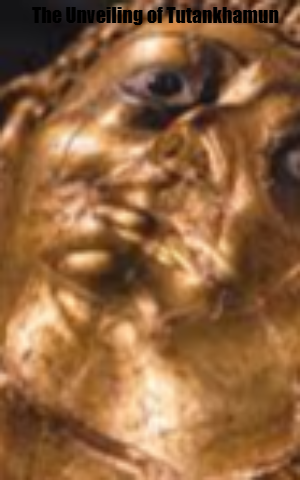
The chamber was filled with treasures of unimaginable wealth: gold statues of gods, intricate pottery, beautifully adorned chests, and piles of richly decorated furniture. The walls were covered in frescoes, still vivid despite the years of neglect. But at the center of it all, resting on a raised platform, was a massive stone sarcophagus. It was adorned with gold, and its lid was carved with the face of a young man—the face of a pharaoh.
Carter’s pulse quickened. This was no ordinary burial. This was the tomb of Tutankhamun. He could feel it in his bones. He had found the final resting place of the boy king, a ruler whose name had been all but erased from history, buried beneath layers of time and myth. The tomb, so remarkably intact, was a time capsule, a bridge between the ancient world and the present.
But it was not just the wealth of Tutankhamun that struck Carter—it was the mystery of the boy king himself. Tutankhamun had come to the throne at a young age, after the death of his father, Akhenaten. He had ruled for only a brief time before his untimely death at the age of 18. His reign, unremarkable in many ways, had been overshadowed by the grandeur of other pharaohs like Ramses and Thutmose. Yet now, in this tomb, the boy king’s life was immortalized in ways that no one could have predicted.
The sarcophagus, which had been sealed for millennia, was carefully opened by Carter and his team. As the lid was removed, a collective gasp escaped from those present. There, lying beneath layers of linen, was the mummy of Tutankhamun. His skin, still visible under the protective wrappings, retained a pale hue, as if frozen in time. The pharaoh’s face, though weathered by age and decay, was still striking, the features of a young man whose life had been tragically cut short. Carter and his team gazed upon the face of a king who had lived and died in obscurity, only to be resurrected in the most extraordinary way.
What followed was a painstaking process of cataloging the treasures that lay within the tomb. Gold chariots, jewel-encrusted daggers, statues, and an array of ceremonial items filled the chamber, each one a testament to the immense wealth and religious significance of Tutankhamun’s burial. There were intricately designed jewelry pieces, including necklaces and bracelets that sparkled even in the dim light. Carter’s team worked for hours, carefully documenting each find, but there was no denying the magnitude of the discovery.
As word spread about the discovery, the world took notice. Newspapers, journalists, and scholars clamored to witness the treasures of Tutankhamun. Carter became a household name, celebrated for his perseverance and attention to detail. The discovery of Tutankhamun’s tomb opened a window into a world long lost to history and revealed the rich cultural and spiritual life of ancient Egypt. The wealth and splendor of Tutankhamun’s tomb painted a picture of a civilization at its height—an empire that had built monuments to the gods and sought immortality through the preservation of the dead.
Yet, with all the grandeur of the find, there was a shadow that loomed over the tomb—the so-called "Curse of the Pharaohs." As members of Carter’s team, including Lord Carnarvon, began to die under mysterious circumstances, whispers of a curse spread across the globe. Some believed that Tutankhamun’s tomb, untouched for centuries, had been sealed for a reason. Carter, however, remained unfazed. The curse, he believed, was nothing more than superstition. What mattered most was the legacy of the boy king—a legacy that had been hidden for millennia, now revealed for the world to see.
The discovery of Tutankhamun’s tomb remains one of the most significant archaeological finds in history. It not only shed light on the life and death of a forgotten king but also sparked an insatiable fascination with ancient Egypt that continues to this day. Howard Carter’s name is forever linked with the boy king, and the tomb of Tutankhamun, with all its treasures and mysteries, remains a testament to the enduring power of discovery and the unyielding pursuit of knowledge.