Library

 Profile

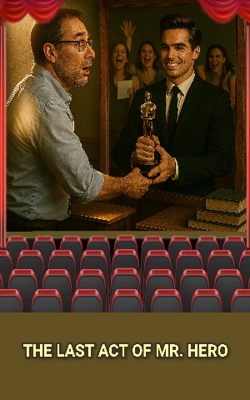
THE LAST ACT OF MR. HERO
THE LAST ACT OF MR. HERO

In the sleepy corridors of Tagore Model College, there was a man who never walked; he entered, as though stepping onto a stage. His name was Professor Hiranyaksha Roy, but the students called him by the nickname of 'Mr. Hero', a name born from the first syllables of his grand, old-fashioned name, with a mix of sarcasm and unease.
He wasn't heroic in the way legends are. He was heroic in the way fallen actors still imagine the limelight loves them. His entire being was stitched together from the rags of old stories: the modelling pageants, foreign girlfriends, long-forgotten college titles. He wore them like armour.
Yes, he had once been Mr. Kolkata. Yes, he claimed a German girl once fell in love with him, and an African poetess wrote him letters. Yes, his wife, a striking woman by all accounts, had, according to him, chased him down in college. 'I didn't go after her,' he'd say, brushing his sagging hair with a proud smirk. 'She came after me. Everyone did.'
But now, Mr. Hero was aging. The face in the mirror no longer matched the myth he spoke of in class. The once-toned body had softened. Alcohol, disappointment, and delusion doing their quiet work. He still played the part, though loud, flamboyant and theatrical.
His classroom was both a stage and a battlefield.
He'd burst into class, bark at students, threaten, 'I'll twist your arm until the bone screams out of your skin'. He'd slam his hand on the desk, eyes blazing, making everyone freeze in a mix of fear and admiration. The students, especially the younger ones, watched him with a strange mix of fear and fascination. Some laughed behind his back. Some pitied him. Most avoided his gaze.
But it was only an act; a fiery burst that cooled in moments, giving way to his disarming laugh, the kind that made even the most anxious student chuckle nervously.
Mitali knew this well. She'd seen the pattern countless times. The theatrics, the explosions of fake rage, a show to maintain control, to keep the narrative flowing. Even his tales of barroom fights, of outsmarting rivals in traffic by playing a don, were just smoke and mirrors. None of it was true. These were only fabrications from a mind that needed a grander story to survive.
But, he was also a man who could make a room burst into laughter, even when the air was thick with despair. The secret was in his voice; a rich, commanding tone that could lift the heaviest heart and spin it into a tale of hope. When Mitali had failed the UGC NET exam twice, feeling the crushing weight of defeat, it was Mr. Hero who sparked a fragile flame in her.
'You're not a failure. You're a warrior. Every great story has its falls. You'll rise,' he had said, with a sincerity that surprised even him. That day, Mitali remembered, he wasn't just the flamboyant professor, he was a mentor, a magician of words.
But while Mr. Hero could enchant others, he could never enchant himself.
If life were a stage, Mr. Hiranyaksharoy would be the actor who forgets his lines but still manages to steal the show. So deep is he in his own private drama that he often forgets people's names. He once called Mitali 'Rohini' despite knowing her for long and even his own son has grumbled about him forgetting his name. In the classroom, he can blank out on whether a student has submitted an assignment, what questions were to go in the exam, or even what the syllabus contained. Yet, despite his forgetfulness, he somehow manages the situation with such charm and sly tactics that people end up laughing with him rather than at him. And the instant there's a chance to mingle with the young crowd or organise a college program, he bursts into action, the script suddenly clear, his youthful energy and self-proclaimed heroism taking centre stage.
A polyglot of sorts, he spoke in Bengali, English, Hindi, German, French, Manipuri, Marathi, Kokborok, Punjabi, Konkani and what not. It was a linguistic symphony mastered for the stage, for cinema, for performance. Languages were his tools to become perfect in his roles, to be the actor who could slip into any character seamlessly. In the academic forums, this earned him respect, a kind of legendary status. Yet, behind those multilingual words was a man desperately chasing a dream he could never catch.
He often spoke with pride of his dream role in a French play Molière's Tartuffe, where he had longed to portray the cunning and charismatic Orgon, the head of the household who is both gullible and grandiose. And not far from that dream was a Punjabi legend whose biopic he wished to enact: the fearless Dulla Bhatti, a rebel folk hero who fought injustice in the heartlands of Punjab. These roles weren't just ambitions; they were the flickering flames of a life he imagined, one where he was not just a teacher but a true star, a hero on and off the stage.
His relationship with his students was complicated.
He hovered around young women with an intensity that sometimes unsettled them. He would offer to carry fainting girls himself, refusing aid, making a spectacle of his chivalry. He'd offer them help, help, compliment them in ways that felt both flattering and invasive. 'Are you from Karnataka?' he once asked a girl. 'You know, I can tell... you have the same fire in your eyes as someone I once loved.'
Another time, when a student fell down in the corridor, he darted forward. 'She needs to be carried to the common room,' he declared. When another faculty member offered help, Mr. Hero swatted the suggestion away. 'I'll carry her. Alone.'
And he did - chest puffed, eyes searching for witnesses.
It wasn't rescue.
It was performance.
Behind this was a man who still saw himself as a hero, the centre of attention, the star of his own play. His grooming was meticulous, his attire carefully chosen to mask the sagging body that time and alcohol had betrayed. His charisma was a magnet, even as it repelled. The other faculty tolerated him. Some excused his eccentricities, others whispered warnings. The Head of Department often shrugged, calling him a 'harmless' man 'living in his own film'. But some students whispered stories of his inappropriate advances, his wandering eyes, and his odd intensity. Yet no one acted - not yet.
Back home, his wife had tried to contain the spiral. She started drinking with him; pouring wine into their evenings, hoping to keep him indoors. 'At least he won't go wandering', she had told Mitali once.
His wife was not just beautiful but patient too but most importantly, she was tired. She was his most frequent co-star who had long stopped improvising and merely learned her lines. Their marriage was a delicate dance of old promises and quiet compromises.
But even at home, Mr. Hero was full of stories. He told them to his mirror, to his wife, to old friends on the phone, to himself. 'I had offers from Bombay. I'm not going to stay with you all for long,' he'd say. 'I was supposed to be a star. A real one. I stayed back for my family. Academia was never mine. It was a compromise.'
And perhaps it was.
He didn't teach; he performed.
He didn't mentor; he entertained.
And slowly, his students stopped listening altogether.
Mitali often wondered about Mr. Hero's loneliness beneath the bravado. He was a man trapped in a web of his own making: a brilliant performer who forgot the difference between the stage and life, between acting and being. She respected his ability to lift others, even if he could not lift himself. She saw the flickers of the man he once was: passionate, talented, hopeful. But those were buried deep under layers of theatrical rage, alcohol and delusions of grandeur.
Everyone in the faculty knew his game. But some of the girls weren't so sure. They felt the way he leaned in too closely, the way he lingered in praise, how he tried to impress them as if seeking a reflection of his younger self in their eyes.
Yet no one stopped him.
Because Mr. Hero hadn't done anything serious.
Not yet.
At home, the photographs still showed a younger man; one with sharper jawlines and confident stares. Trophies lined the shelf, gathering dust. A poster from a college play hung crookedly on the wall:
'Julius Caesar - starring Hiranyaksha Roy.'
That was his peak.
He never came down from the stage after that.
Each day, he prepared like an actor; dabbing cologne, practicing lines, inspecting his hairline. His job was just a script. His students, a captive audience. His wife, a reluctant co-star.
And deep down, maybe, the real man, the boy who once believed in dreams, in love, in cinema had long stepped backstage and never returned.
Now only Mr. Hero remained.
A performer playing the last act of a forgotten drama every day as he stepped onto his stage: the classroom, the corridors, the faculty room and bow, waiting for an audience that no longer applauded.
Because the spotlight was gone.
But the actor could not leave the stage.
He still bowed each day.
As if someone, somewhere, was still watching.