Library

 Profile
The Lady And the Chamunda Sticker
The Lady And the Chamunda Sticker

The afternoon sun blazed mercilessly over Bhubaneswar, sending heat shimmers dancing above the asphalt. The narrow lanes of our colony looked deserted, save for the small corner grocery shop. Inside sat Umma—a woman in her seventies, short, thin, sharp-eyed, and wielding a tongue that could slice through the confidence of any customer. She was known for two things: absolute honesty in business, and an explosive temper directed at anyone she believed was trying to pull a fast one on her.
One afternoon, I walked into her shop carrying a cloth bag and a grocery list from my wife.
Out of a strange habit, I handed over a crisp five-hundred-rupee note first.
"Here, Aunty," I said. "Keep this first."
Without a glance, she stretched out her hand and slipped it into the drawer beneath the counter. "What do you need?"
I read out the list—rice, mustard oil, turmeric, sugar, tea, and coffee powder. She packed everything in silence, weighed the items, and tallied the bill.
"Four hundred and sixty-two rupees," she announced.
"Fine," I smiled. "Please give me the balance from the five hundred I gave you."
She stopped dead. Slowly, her sharp eyes met mine. "What five hundred?"
"The note I gave you before we started."
"You never gave me any note!"
"Aunty, please... don't joke."
"I don't joke while doing business," she snapped.
"I gave it to you before buying anything!"
"No."
"Yes!"
"I said no!"
A crowd gathered. Neighbours tried to intervene, but Umma exploded, accusing me of trying to cheat an old woman out of her goods. There was no CCTV, no proof—just her furious certainty against my rising panic. Humiliated, my pride wounded, I pulled out a second five-hundred-rupee note, handed it over, took my change, and walked away. I carried the groceries home, but the sting of being called a liar burned for months.
Time passed.
One evening, I stopped at Kalpana Square to buy fruits—apples, grapes, pomegranates. The stout, moustached fruit seller, Jaga, packed two kilograms of apples and some grapes. While waiting, I absentmindedly ate an apple from the display.
When Jaga announced the total—four hundred and eighty rupees—I reached into my pocket. Empty. I checked the other pockets. Nothing. My wallet was sitting on my bedroom door hook in the trousers I had worn earlier that morning.
I tried paying via PhonePe, but the screen flashed: Server Unavailable. I tried calling my wife, but her phone was switched off for an office meeting.
Jaga lost his patience. "You ate my fruit and now you say you have no money? You people always have excuses!"
A crowd began to form. My face burned as he shouted, accusing me of being a thief. Just as I wished the ground would swallow me whole, a soft voice interrupted.
"Arre, Jaga! Why are you shouting like this?"
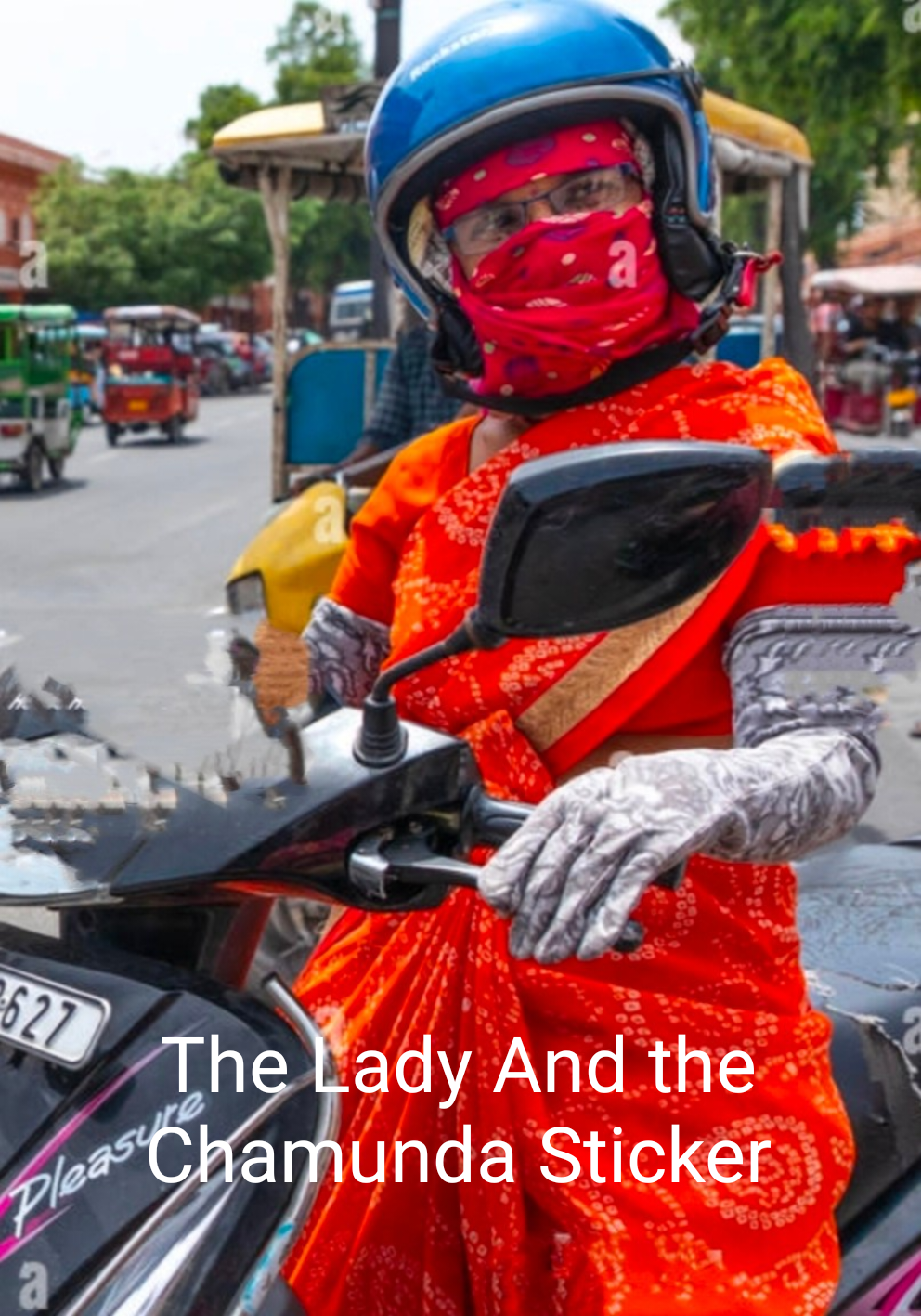
A woman wearing a simple cotton sari stood beside a black scooty, wearing a helmet that obscured her face.
Jaga complained loudly, "He bought fruit, ate an apple, and now claims his server is down!"
The woman turned to me. "Is that true?"
I folded my hands in shame. "I forgot my wallet. My phone app isn't working."
Without another word, she opened her handbag, pulled out a five-hundred-rupee note, and handed it to Jaga.
"No, Madam..." I protested, bewildered. "I don't even know you!"
"You can repay me later," she said softly.
"How? Who are you?"
"If destiny wishes, we shall meet again."
Before I could process what was happening, she started her scooty and melted into the evening traffic. The only defining feature I caught was a striking sticker on the front panel of her deep black scooty: the fierce, divine image of Goddess Chamunda.
Weeks passed. I kept an eye out for that black scooty, convinced that Umma must have eventually audited her cash drawer that fateful afternoon, realized she was five hundred rupees over, and sought me out at the market to quietly make amends. The rescue felt like her silent way of returning my money without losing face.
Then came a pleasant evening near the colony shops. I was eating papdi chaat with a few retired friends when a young boy pointed toward the curb. "Didi! The tyre of your scooty is flat!"
Umma grumbled, walking out of her grocery shop to check. Instinctively, my eyes followed her to the vehicle parked right outside her door.
It was a deep black scooty. On the front panel sat the exact sticker—Goddess Chamunda.
My spoon froze. My heart hammered against my ribs. I walked over slowly.
"Aunty... is this your scooty?"
She looked up, frowning. "Of course it's mine."
"Were you at Kalpana Square a few months ago? By the fruit stall?"
Her eyes narrowed slightly. "Yes."
"You... you were the lady who paid Jaga?"
She gave a brief, indifferent nod. "I was.
"
A wave of relief and validation washed over me. I smiled softly. "I knew it. You realized your mistake about that afternoon in your shop, didn't you? You found the extra five hundred in your drawer later that night and recognized me at the market."
Umma stopped inspecting her flat tyre and stood up straight. Her sharp, piercing gaze locked onto mine, completely devoid of the guilt or softness I had expected.
"Mistake?" she barked, her voice cutting through the evening air. "What mistake?"
I blinked, taken aback. "The money... the five-hundred-rupee note at the shop."
"You didn't give me any money that afternoon," she said, her tone absolute and unyielding. "I checked my drawer thrice that night. The cash matched my ledger to the exact rupee. You never paid me first."
My jaw dropped. "Then... why? If you still believe I tried to cheat you that day, why on earth did you pay for my fruits?"
Umma folded her arms across her chest. Her face was as stern as ever, but her eyes held a heavy, weary depth.
"Because I saw an honest man trapped in a bad moment," she said simply. "I saw a gentleman standing in the middle of a crowded market, dying of shame over four hundred and eighty rupees.
You might have tried to pull a fast one on me in my shop—or maybe you genuinely misremembered—but at Kalpana Square, you weren't a thief. You were just helpless. I had five hundred rupees in my bag. I wasn't going to let Jaga humiliate you over a piece of fruit."
I stood utterly speechless.
She hadn't saved me out of guilt. She hadn't cleared a debt or admitted error. In her mind, I was still the man who had disputed a bill in her shop. Yet, when she saw me drowning in embarrassment, her conviction that I was "in the wrong" didn't stop her from extending a hand.
"So..." I swallowed hard, my voice barely a whisper. "You helped me even while believing I owed you?"
"Grace isn't a trade," Umma said quietly, turning back toward her shop. "You don't only help the people who are right."
She walked back inside, leaving me standing beside the black scooty with the image of Goddess Chamunda staring back at me.
Later, I learned the full truth of her life—how she had been abused by her in-laws, abandoned by her husband for failing to bear a son, and left to raise two daughters entirely on her own. Life had made her sharp, suspicious, and fiercely defensive of her small business. She guarded her ledger with a hawk's intensity because she had to.
Yet, beneath that impenetrable, quarrelsome exterior lived a quiet, fierce morality. She didn't need to be wrong to be kind. She didn't need me to be innocent to show me mercy.
I had spent months waiting to hear an apology, only to receive something far grander: a lesson in unconditional compassion from a woman who owed me nothing, believed nothing good of my memory, but chose to protect my dignity anyway.