Library

 Profile
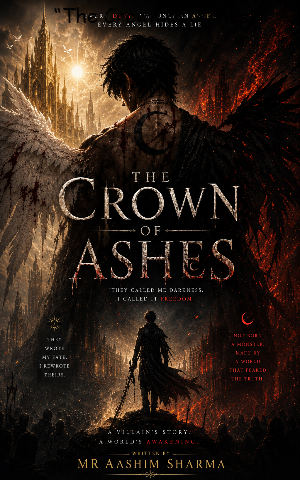
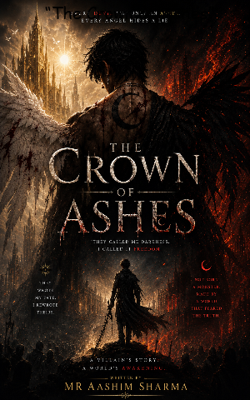
“The Crown of Ashes”
“The Crown of Ashes”

They call me a monster.
They whisper my name like a curse and spit it into the earth as if the ground itself deserves an apology for carrying the sound of me. Mothers pull their children close when the wind howls at night, as though I ride upon it. Priests light candles and say my name only to banish it.
But no one asks why.
No one asks what it feels like to be carved into evil by hands that call themselves holy.
No one asks what it takes to become the villain of a story written by the victors.
And so, I will tell you.
Because every saint has a shadow… and every devil once wore wings.
I was not born in darkness.
I was born in the city of Luminara—where the sky was always bright, where the temples were built of gold and marble, where people prayed not out of faith but out of fear of punishment. The city was ruled by the Celestial Council, seven elders chosen by the so-called gods. They wore white robes and carried silver staffs, and they spoke with voices as cold as winter water.
They were the guardians of “purity.”
That word… purity.
It sounds beautiful until you understand what it truly means.
Purity is not light. Purity is control.
In Luminara, if you laughed too loudly, it meant you carried sin. If you cried too often, it meant your soul was weak. If you questioned the Council, it meant darkness had touched your mind.
And if you were born with a mark on your skin—a black crescent shape like mine—you were doomed from the beginning.
My mother tried to hide it.
She wrapped my wrist in silk cloth and kissed it every morning as though love could erase prophecy. She used to whisper to me at night, her voice trembling like candle flame.
“Don’t let them see it, Auren. Don’t let them name you.”
But the Council always sees.
They see through walls, through cloth, through blood.
When I was eight, they came to our house.
I still remember the sound of their boots on the marble floor. The scent of incense. The way their shadows looked longer than they should have.
My mother stood in front of me like a shield, her hands shaking.
“He is just a child,” she begged. “He hasn’t done anything.”
The eldest councilman, Seraphiel, looked at her like she was dust.
“Darkness does not need actions,” he said calmly. “Darkness is born.”
They tore the cloth away from my wrist.
And for the first time, they saw my mark.
A black crescent.
The sign of the “Fallen.”
The sign of the “Devil’s bloodline.”
And the moment they saw it… my life ended.
Not physically.
Something worse.
My name was stripped from me.
My future was stolen.
And my story was rewritten.
They took me to the Temple of Dawn.
I expected chains, whips, torture.
But evil does not always come in cruelty.
Sometimes it comes wrapped in kindness.
They fed me sweet bread. They gave me books. They taught me sacred hymns. They smiled as if they were saving me.
And then they taught me to hate myself.
Every day, they made me kneel before the altar and repeat the same words:
“I am tainted.
I am unworthy.
I am darkness.
I deserve pain.”
At first, I cried.
Then I screamed.
Then I stopped feeling.
Because the truth is—when you are punished for existing, your soul learns a dangerous lesson.
If I am condemned no matter what I do…
then why should I obey?
If they will call me devil even when I pray…
then why not become one?
That was the day my villain arc began.
Not when I first killed.
Not when I first burned.
Not when I first destroyed.
No.
It began when I realized that goodness is a prison built by the powerful.
And the weak are expected to smile behind the bars.
When I turned seventeen, they brought me to the Hall of Judgment.
The Council sat in a circle, their robes flowing like white waterfalls. Seraphiel stared at me as if he had already decided my fate long ago.
“You have been cleansed,” he declared.
I almost laughed.
Cleansed? After years of humiliation, starvation of affection, and forced prayers that felt like knives?
They called it cleansing.
I called it slow murder.
He continued, “But your mark remains. The prophecy says you will destroy Luminara. We cannot risk it.”
My chest tightened.
“So what will you do?” I asked, voice low. “Kill me?”
Seraphiel’s lips curled into something that almost looked like pity.
“No,” he said. “Worse.”
He raised his hand, and the air trembled.
Light gathered like a storm.
And then… my wings appeared.
Yes.
Wings.
I had never known I could have them.
Huge, golden wings burst from my back, glowing like dawn itself. The room gasped. For a moment, even the Council looked afraid.
Because the mark of the Fallen wasn’t supposed to produce wings.
It wasn’t supposed to create an angel.
And yet there I was.
A boy with devil blood… and angel wings.
Seraphiel’s voice became colder.
“This is blasphemy.”
And then he spoke the sentence that changed everything.
“Strip him.”
The Council’s light surged.
My wings screamed.
Yes, wings can scream when torn from the body.
It was not a sound made by flesh.
It was a sound made by the soul.
I fell to the floor, blood and feathers scattered like broken prayers. I bit my tongue to stop myself from crying out.
Not because I was brave.
But because I refused to give them the satisfaction.
Seraphiel stepped closer and leaned down.
“You could have been something,” he whispered. “But darkness ruins everything it touches.”
He turned away.
And in that moment, I understood the greatest truth of Luminara:
They did not fear darkness.
They feared what their light could not control.
I escaped that night.
Not by miracle.
Not by divine intervention.
By rage.
Rage is its own kind of magic.
I crawled through the temple’s underground tunnels, leaving blood behind me like a trail of my rebirth. I reached the outer gates of the city at sunrise.
The sky was pink.
The birds were singing.
And my back felt like an open grave.
But I was free.
And freedom… is dangerous.
I wandered beyond the borders, into the Wastes of Umbrin—where outcasts lived, where criminals and cursed souls hid from the Council’s “purity.”
I expected monsters.
Instead, I found people.
People with scars. People with broken limbs. People with dark marks like mine.
Children without homes.
Women burned for “witchcraft.”
Men blinded for “questioning.”
And they all looked at me with the same eyes.
Not fear.
Recognition.
As if they had been waiting for me.
An old man named Varric took my hand and said, “You’re one of us. We knew you would come.”
“What do you mean?” I asked.
He pointed at my wrist.
“The Crescent. The mark of the Fallen. The Council calls it a curse, but we call it a promise.”
“A promise of what?”
He smiled, and his smile was not kind.
“A promise that their golden city will finally bleed.”
They wanted me to be their weapon.
At first, I resisted.
I didn’t want to be the villain they expected.
I didn’t want to become a nightmare.
But then I remembered my mother’s face.
Not her smile.
Her terror.
The day they took me.
And I wondered if she was alive… or if the Council had “cleansed” her too.
I wondered how many mothers had begged like her.
How many children had been dragged away.
How many souls had been sacrificed to keep Luminara shining.
And something inside me cracked open.
Not into darkness.
Into clarity.
Light is not always good.
Sometimes light is simply fire wearing a halo.
And Luminara was a bonfire built on bones.
So I agreed.
I became what they feared.
I learned forbidden magic from the Wastes. I learned how to bend shadows, how to summon flame from pain, how to carve runes into steel that could slice through holy barriers.
People called me cruel.
But I wasn’t cruel.
I was precise.
Every soldier I killed had once hunted innocent outcasts.
Every temple I burned had once hosted executions in its basement.
Every wall I shattered had once trapped starving prisoners behind it.
And for the first time in my life, my actions had meaning.
The Council called me a demon.
The Wastes called me a savior.
And I realized something strange:
The villain and the hero are often the same person.
The only difference is who tells the story.
The night I returned to Luminara, the city glowed like a jewel.
The Council had built statues of themselves, tall and shining, as if they were gods.
I stood outside the gates, hood pulled over my face, my scars hidden.
A guard spotted me.
“Halt!” he shouted. “State your name!”
I stepped forward.
And I let him see my wrist.
The black crescent.
His face drained of color.
He stumbled back as if I had become death itself.
“Y-you…”
“Yes,” I said softly. “Me.”
He reached for his sword.
I didn’t move.
I didn’t need to.
The shadows behind him rose like living beasts and swallowed his weapon whole.
His knees hit the ground.
He began to pray.
It made me laugh.
Not because prayer is funny.
But because they only pray when fear touches their throat.
“You pray to light,” I said, stepping closer. “But light has never saved anyone. It only watches while people burn.”
Then I walked past him.
The gates opened.
Not because they allowed me.
Because the locks melted.
Because the city itself trembled at my return.
I entered Luminara like a storm in human form.
People screamed. Bells rang. Soldiers gathered.
And above the chaos, the Council’s voice echoed through the sky, amplified by magic.
“Auren! Fallen one! You have returned to fulfill your prophecy!”
I looked up at the temple tower.
Seraphiel stood there, his white robes fluttering like a flag of arrogance.
“You were never meant to exist,” he shouted. “You are corruption! You are ruin!”
I raised my hand.
Flames ignited in the streets—not wild flames, not careless destruction. They rose in circles around the statues of the Council and consumed them, melting gold into molten rivers.
The people watched.
Some cried.
Some cheered.
Some simply stared as if they were witnessing the end of a lie.
Seraphiel’s voice broke.
“What have you done?!”
I stepped into the temple courtyard, my boots crushing sacred flowers.
“What I was born to do,” I said.
He descended the stairs, his staff glowing.
“You will destroy everything!”
I smiled.
“No,” I replied. “I will destroy only what you built.”
Seraphiel raised his staff, and holy light struck me like a spear.
Pain exploded in my chest.
For a moment, I nearly fell.
And then I remembered the scream of my wings.
I remembered the years of forced prayer.
I remembered my mother begging.
I stood straight.
And I spoke the words that sealed my fate forever.
“You made me your villain,” I whispered. “Now watch me become your ending.”
The shadows rose.
The ground cracked.
The temple trembled.
And the sky—once bright over Luminara—turned dark like ink.
Not because I wanted eternal night.
But because for the first time, the city needed to see what it had hidden.
The truth.
The ugliness.
The blood beneath the gold.
Seraphiel fell to his knees, his staff shattering.
His eyes were wide with horror.
“You’re… you’re evil…”
I leaned down close enough for him to hear my heartbeat.
“No,” I said quietly. “I’m justice.”
And I let the temple collapse behind him.
When the dawn came, Luminara was no longer shining.
The statues were gone.
The Council’s tower was ash.
But the people were alive.
Free.
They stood in the streets, looking at the ruins of their “purity” with strange expressions.
Some hated me.
Some thanked me.
Most didn’t know what to feel.
Because freedom is terrifying.
It demands responsibility.
It demands truth.
And truth is heavier than chains.
I walked away before they could decide what I was.
A hero?
A villain?
A savior?
A demon?
Let them argue.
Let them write songs.
Let them curse my name.
Because I finally understood something the Council never could:
A villain is not born from darkness.
A villain is born when the world refuses to listen to the pain it created.
I did not want to destroy Luminara.
I wanted to belong.
But they chose prophecy over compassion.
They chose fear over love.
They chose control over humanity.
So I became what they needed me to be.
Not because I was evil…
But because someone had to break the false heaven they worshipped.
And if that makes me the devil…
Then let the devil wear the crown.
Because angels, I have learned, can be far more cruel.
And I have no wings left to lose.
Only a world to rebuild.
THE END.