Library

 Profile
Tea Is Served
Tea Is Served

In our family, tea is not a beverage.
It is a courtroom.
A newsroom.
A comedy club.
A confession booth.
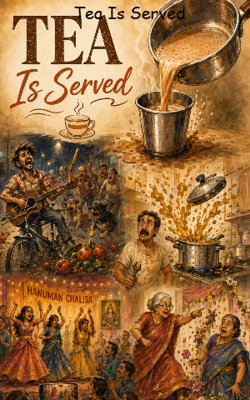
Every evening at exactly five-thirty, my grandmother bangs her steel spoon against the edge of the saucepan like a temple bell announcing the arrival of judgment day. The tea boils violently with cardamom, ginger, and enough milk to revive the dead. Chairs scrape across the floor. Slippers slap against mosaic tiles. Someone shouts from another room, “Save my cup!” while someone else yells, “Don’t give him extra sugar, he already talks too much.”
And then it begins.
The daily national broadcast of our family’s greatest embarrassments.
If historians ever lose records of civilization, they should simply visit Indian households during tea time. Entire generations are preserved through gossip and exaggerated storytelling.
Our family is especially gifted in this field.
No secret survives beyond two cups of tea.
The first story everyone tells newcomers concerns my uncle, known throughout the family as “The Romantic Revolutionary.” Not because he ever successfully romanced anyone, but because he once attempted to impress a girl and nearly started a neighborhood riot.
This happened in the early 2000s, during the golden era of Bollywood-inspired confidence and absolutely no practical intelligence.
My uncle had fallen deeply in love with a girl from two streets away. He owned exactly three shirts, one bicycle, and the confidence level of a movie hero standing in artificial rain.
One evening, after borrowing perfume from his friend and styling his hair with coconut oil strong enough to survive cyclones, he decided to perform a grand romantic gesture.
He would sing outside her house.
Unfortunately, he could not sing.
This small detail did not discourage him.
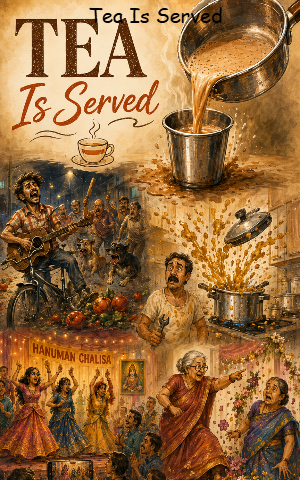
At around eight-thirty at night, armed with a borrowed guitar missing two strings, he parked himself beneath her balcony and began singing an emotional love song with the vocal quality of a dying tractor engine.
Dogs started barking immediately.
Lights switched on across the lane.
Someone’s baby began crying.
The girl’s father stepped onto the balcony like an angry king ready for battle.
But the true disaster happened when the electricity suddenly went out in the entire neighborhood.
Now, in complete darkness, all anyone could hear was my uncle screaming heartbreak lyrics into the void.
Panic spread instantly.
People thought thieves had entered the colony.
One neighbor grabbed a cricket bat. Another arrived carrying a pressure cooker lid as a shield. An elderly aunt started chanting prayers loudly enough to summon every deity available.
Meanwhile, my uncle—terrified by the gathering crowd—attempted to escape on his bicycle, forgot the guitar was hanging from his shoulder, and crashed directly into a vegetable cart.
Tomatoes rolled everywhere.
Someone yelled, “Catch him!”
And that is how a failed love song turned into a full-speed chase involving fourteen residents, three stray dogs, and approximately six kilograms of brinjals.
To this day, whenever he offers relationship advice, someone quietly asks, “Should we turn the electricity off first?”
Tea nearly spills from everyone’s laughter every single time.
Then comes my mother’s favorite story: The Great Pressure Cooker Explosion of 2011.
My father firmly believes he can repair anything. Fans, radios, watches, plumbing, emotional trauma—according to him, all problems simply require “proper adjustment.”
One Sunday morning, my mother casually mentioned that the pressure cooker whistle was acting strangely.
A normal person would have taken it to a repair shop.
My father disappeared into the kitchen with a screwdriver and the confidence of a NASA engineer.
For two hours, metallic sounds echoed through the house.
Clank.
Bang.
“Bring me pliers!”
“Where is the tape?”
“Who touched my screwdriver?”
We should have recognized the warning signs.
At lunch, the cooker was proudly presented back to my mother.
“Better than before,” my father declared.
Five minutes later, while dal cooked peacefully on the stove, the whistle launched itself into the ceiling like a missile.
The lid flew sideways.
Dal exploded upward in majestic slow motion.
Yellow lentils decorated the walls, ceiling fan, calendar, refrigerator, and somehow even the family photograph in the living room.
My grandmother walked into the kitchen, surveyed the destruction silently, and said the most terrifying sentence ever spoken in Indian households:
“Move.”
No shouting. No anger. Just disappointment.
Even the cooker looked ashamed.
For months afterward, bits of dal continued appearing in impossible places. One cousin found dried lentils behind a curtain nearly a year later.
The next story belongs to my cousin Riya, whose greatest talent is creating disasters through excessive confidence.
During a family wedding, she volunteered to manage the choreography for a dance performance.
Now, Indian family weddings operate on two fuels: emotion and overconfidence.
Riya organized rehearsals like a military commander. She screamed counts, assigned formations, and behaved as though the performance would determine national security.
The song selection itself was chaotic—three Bollywood songs stitched together with transitions abrupt enough to cause neck injuries.
Still, we practiced faithfully.
The big night arrived.
Relatives gathered around the stage with phones ready. Children ran between chairs. Uncles argued over volume levels. Someone was already crying emotionally despite nothing emotional happening yet.
Music started.
Everything went wrong immediately.
The Bluetooth speaker disconnected.
Then reconnected to another cousin’s phone.
Suddenly, instead of our dance song, the loudest possible Hanuman Chalisa began blasting through the speakers.
Complete silence froze the hall.
Our formation collapsed instantly.
One uncle folded his hands respectfully because he thought it was intentional.
My cousin, still committed to professionalism, whispered furiously, “KEEP DANCING!”
So there we were—performing dramatic Bollywood dance moves to devotional chanting while confused relatives stared in spiritual horror.
The video still exists.
It resurfaces every Diwali.
No one has recovered.
But the undisputed champion of family embarrassment is my grandmother.
At seventy-three years old, she has mastered two things: making extraordinary tea and unintentionally destroying public dignity.
Last winter, she attended a neighbor’s engagement ceremony. She wore her best saree, carried a handbag large enough to transport furniture, and promised everyone she would “behave respectfully.”
That promise survived approximately eleven minutes.
At the ceremony, she noticed another elderly woman wearing an identical saree.
Now, in most situations, people might laugh politely.
Not my grandmother.
She marched directly toward the woman and loudly announced:
“You copied me.”
The entire hall went silent.
The poor woman blinked in confusion.
My grandmother continued confidently, “Mine looks better because I have stronger shoulders.”
To demonstrate this bizarre claim, she attempted an aggressive posture adjustment, stepped backward onto the edge of the decorative carpet, lost balance dramatically, and pulled down half the floral decoration while trying to save herself.
Flowers fell everywhere.
One decorative light snapped.
Someone screamed.
A child started clapping because he thought it was part of the entertainment.
Meanwhile, my grandmother remained seated on the floor, adjusting her glasses calmly, and asked the nearest waiter:
“Did anyone save my samosa?”
Honestly, that single sentence summarizes our entire family.
Chaos first. Snacks second. Dignity never.
But beneath all the laughter, tea-time storytelling carries something deeper.
These stories survive because they remind us who we are.
The failed romances. The kitchen disasters. The wedding embarrassments. The accidental public humiliations. They become family folklore passed from one generation to another like treasured heirlooms.
Nobody remembers perfect days.
Nobody gathers around hot tea to discuss moments when everything went according to plan.
We remember disaster.
We remember foolish confidence.
We remember the humanity in our mistakes.
Every family hides pain somewhere behind closed doors. Ours is no different. Life has given us hospital visits, financial struggles, misunderstandings, funerals, and years we do not speak about easily.
But somehow, at five-thirty every evening, tea arrives like a peace treaty.
Stories return.
Laughter heals what pride cannot.
Even the most embarrassing moments soften with time until they become legends repeated so often that they no longer belong to individuals—they belong to the family itself.
And perhaps that is the real magic of tea in Indian households.
Not the flavor.
Not the ritual.
But the strange miracle of how steam rising from chipped cups can pull exhausted people back toward one another again and again.
Tea is served.
And with it, the entire family history.