Library

 Profile
The Day the Stars Fell Quiet
The Day the Stars Fell Quiet

15 mins
22
The first time I noticed something was wrong with Aarav, it wasn’t because he cried.
It was because he didn’t.
Aarav was eight years old—an age where emotions came quickly and loudly. When he was happy, the whole house knew it. When he was upset, even the ceiling fan seemed to slow down out of sympathy. But that Thursday evening, he came home from school and moved through the house like a shadow.
No complaints. No stories. No dramatic “Mummaaa!” as he tossed his bag on the sofa.
Just silence.
He removed his shoes neatly, placed them beside the rack, and walked to his room without even asking for the snacks he usually demanded like a king returning from battle.
I stood in the kitchen holding a spoon mid-air, staring at the door that had closed behind him.
Something in my heart tightened.
“Maybe he’s tired,” I whispered to myself.
That was the first excuse.
I would make many more.
---
That night, Aarav sat at the dining table with his dinner plate. He ate slowly, chewing as if he had to convince his mouth to do the job.
“School was okay?” I asked casually, trying not to sound like a detective.
“Yes,” he replied, without looking up.
“What did you do in class today?”
“Nothing.”
My husband, Rohan, was on a business trip. It was just me and Aarav in the house, and the quiet between us felt louder than the television.
I tried again.
“Any homework?”
“A little.”
He finished his food, carried his plate to the sink without being asked, and walked away.
I watched him go, confused.
This wasn’t my Aarav.
My Aarav was the boy who couldn’t keep secrets for more than five minutes. He was the boy who narrated every single thing—from what his teacher said to what his friend sneezed.
Now he was a closed book.
And I didn’t know how to read him.
---
The next morning, I decided to watch carefully.
Sometimes, when you love someone, you think you already know them. You assume their smiles mean happiness, their silence means peace, their anger means mischief.
But parenting teaches you something painful:
Sometimes silence means storm.
Aarav got ready for school with strange perfection. His shirt was tucked in properly. His hair was combed. His tie was straight. Even his water bottle was filled without reminders.
He looked like a child trying to become invisible by becoming perfect.
When I dropped him at school, he stepped out of the car and walked away without waving back.
He always waved.
Always.
I sat there for a moment, gripping the steering wheel. The school gate swallowed him like a big mouth, and my heart felt like it had dropped into my stomach.
---
That afternoon, I tried calling his class teacher.
“Hello, Mrs. Meera,” I said politely. “I just wanted to ask if everything is okay with Aarav.”
His teacher sounded cheerful.
“Oh yes, Aarav is a very well-behaved child! Quiet, obedient. No complaints at all.”
Quiet.
That word hit me like a stone.
“Is he… talking with friends? Playing?”
“Well,” she paused, “he sits mostly by himself these days. But children go through phases. Don’t worry.”
Don’t worry.
Adults said those words like they were magic spells.
But mothers knew better.
I thanked her and hung up, my mind racing.
Sits by himself these days.
These days.
So this wasn’t just one day. It had been happening for a while, and I hadn’t noticed.
The guilt arrived quietly, like dust settling on furniture you forgot to clean.
---
That evening, Aarav came home and went straight to his room again.
I followed, carrying a glass of milk.
When I opened the door, he was sitting at his desk with a sheet of paper in front of him.
He was drawing.
But it wasn’t the usual superheroes and rockets. It was something else.
A night sky.
A big moon.
And stars… but some of the stars were crossed out with thick black lines.
I stepped closer.
“Aarav,” I said softly, “what are you drawing?”
He didn’t answer. His pencil moved again, darker, harder.
I placed the milk on his desk. “Drink this.”
He nodded, still not looking at me.
I wanted to ask him what was wrong.
But the words got stuck in my throat.
Because what if he said something I didn’t know how to fix?
So I did what many parents do when they are scared:
I tried to fix the surface.
“Do you want to go to the park?” I offered.
“No.”
“Want ice cream?”
“No.”
“Want to watch a movie?”
“No.”
I forced a smile. “Okay, then. Study well.”
And I left.
But as I closed the door, I heard it.
A tiny sound.
Not loud enough to be called crying.
But loud enough to break my heart.
It was the sound of a child trying not to cry.
---
That night, after Aarav fell asleep, I entered his room quietly.
His face looked peaceful in sleep, like the world hadn’t touched him.
But I knew the world had.
It always does.
His school bag was on the chair. I wasn’t proud of what I did next, but I did it anyway.
I opened it.
There were notebooks, a pencil box, a lunchbox.
And then I saw something folded at the bottom.
A crumpled paper.
I unfolded it carefully.
It was a drawing.
A stick figure of a boy standing alone.
A group of other stick figures were drawn far away, laughing.
Above the boy’s head, someone had written in messy handwriting:
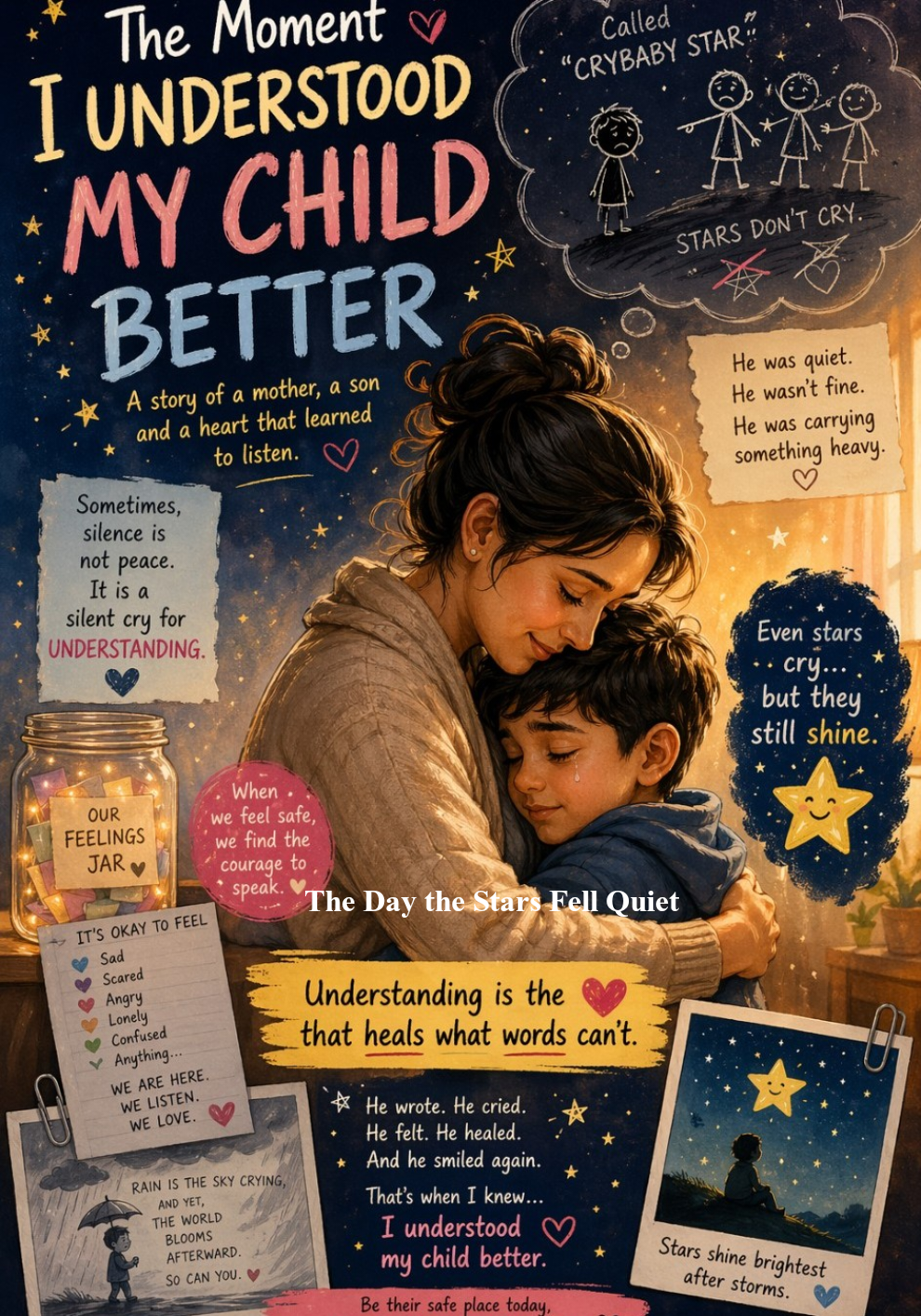
“Crybaby Star.”
My breath caught.
Crybaby Star?
What did that mean?
I turned the paper around and saw another line:
“Stars don’t cry.”
I sat on the floor, holding that paper like it was a piece of my child’s heart.
And suddenly, the crossed-out stars in his drawing made sense.
He wasn’t crossing out stars.
He was crossing out himself.
---
The next morning, I didn’t pack Aarav’s lunch quickly. I packed it slowly, thoughtfully.
I made his favorite—paratha with cheese—and I cut it into star shapes using a cookie cutter I had forgotten in the back of the drawer.
I also packed a small note.
Not a lecture.
Not advice.
Just five words:
“It’s okay to feel.”
I placed it in his lunchbox and watched him leave for school, still quiet.
Still distant.
But now I had a direction.
And I wasn’t going to ignore the storm again.
---
That afternoon, I decided to pick him up early.
When the bell rang, children poured out like colorful confetti. Aarav walked slowly, holding his bag tightly.
When he saw me, his eyes widened.
“Mumma? Why are you here?”
“I missed you,” I said.
He blinked, as if he didn’t believe parents could miss children too.
In the car, I didn’t ask about school. I didn’t ask about friends.
I asked something else.
“Aarav,” I said gently, “do you know what I did today?”
He shrugged.
“I learned something.”
“What?”
I took a deep breath. “I learned that sometimes, when people don’t talk… it doesn’t mean they are fine. It means they are carrying something heavy.”
He stared out of the window, his fingers twisting the strap of his bag.
I continued. “And I also learned that maybe I didn’t notice your heavy things in time.”
He turned toward me, surprised.
Parents weren’t supposed to admit mistakes.
Parents were supposed to be perfect.
But I wasn’t trying to be perfect.
I was trying to be present.
---
At home, I made him sit with me in the living room.
No television.
No mobile phone.
Just us.
I brought out a small jar and placed it on the table.
He looked confused. “What’s that?”
“It’s a Feelings Jar,” I said.
“A jar?”
“Yes. Whenever we feel something big—sad, angry, scared—we write it on a small paper and put it inside. And then we talk about it when we’re ready.”
Aarav frowned. “Why can’t we just talk?”
“Because sometimes,” I said, “words get stuck. And paper helps them come out.”
He didn’t answer.
So I picked up a paper myself and wrote something.
Then I folded it and dropped it into the jar.
Aarav leaned forward. “What did you write?”
I smiled. “I wrote, ‘I feel guilty.’”
His eyes widened. “Why?”
“Because I think my child has been sad, and I didn’t understand it sooner.”
The room became very quiet.
Aarav’s lips trembled.
And then, as if something inside him cracked open, tears rolled down his cheeks.
He covered his face quickly.
“No,” he whispered, shaking his head. “I’m not supposed to cry.”
That sentence hurt more than any scream could have.
I moved closer and wrapped my arms around him.
“Who told you that?” I asked softly.
He sniffed. “They did.”
“Who?”
He hesitated, then whispered, “Some boys in class.”
I held him tighter. “What happened?”
Aarav’s voice came out in broken pieces.
“I… I cried last week.”
“Why?”
He wiped his nose with his sleeve. “In sports period, I fell. My knee was bleeding. It hurt. I cried a little.”
“That’s normal,” I said immediately.
“But they laughed,” he said. “They said I’m a baby. They started calling me Crybaby Star.”
My heart clenched.
He continued, “Then yesterday, when I was reading in class and I got a word wrong, everyone laughed again. One boy said, ‘Stars don’t cry.’ And then they said I should stop talking because my voice sounds like I’m going to cry.”
His shoulders shook.
“I tried to stop crying,” he whispered. “I tried to stop feeling. I tried to be quiet so they wouldn’t notice me.”
That was the moment.
The moment I understood my child better.
Not as an “obedient” boy.
Not as a “quiet” boy.
But as a brave boy trying to survive in a world that sometimes forgets kindness.
---
I gently lifted his chin.
“Aarav,” I said, “listen to me carefully.”
He looked at me with wet eyes.
“Crying is not weakness. Crying is your heart talking. And hearts are not supposed to be silent.”
He swallowed hard.
“But they said—”
“They are wrong,” I said firmly. “Even stars cry.”
He frowned. “Stars cry?”
“Yes,” I said. “Do you know what rain is?”
He blinked. “Water?”
“It is also the sky crying. And yet, after rain, the world becomes fresh. Trees grow. Flowers bloom. Rain is not shameful. It is necessary.”
Aarav stared at me as if he was seeing the world differently.
Then he whispered, “But I don’t want them to laugh.”
I nodded. “Nobody wants that. But we can’t stop other people from being unkind. We can only decide what kind of person we will be.”
He looked down. “I don’t know how.”
I took a paper and handed him a pen.
“Write it,” I said. “Put it in the jar.”
Aarav hesitated, then slowly wrote something. His handwriting was shaky.
He folded the paper and dropped it inside.
“What did you write?” I asked.
He whispered, “I feel scared.”
I nodded. “Thank you for telling me.”
He leaned into my arms again.
And for the first time in days, he cried openly.
Not loudly.
Not dramatically.
Just honestly.
And in that moment, I didn’t try to stop him.
I didn’t say, “Don’t cry.”
I didn’t distract him with ice cream.
I didn’t rush him.
I simply stayed.
Because sometimes, children don’t need solutions.
They need safety.
---
The next day, I met his teacher.
I didn’t go angrily.
I went wisely.
I explained everything, calmly but clearly. The teacher listened, her smile fading.
“I had no idea,” she admitted.
“Many children don’t speak,” I said. “They learn silence early.”
That line stayed with her.
She promised to handle it gently in class, to encourage kindness, to address bullying without pointing fingers.
When I returned home, Aarav was sitting on the floor, drawing again.
This time, it was another night sky.
But the stars were not crossed out.
Instead, each star had a tiny smiling face.
One star was bigger than the others.
In the center.
I sat beside him. “Who is that big star?”
Aarav smiled faintly.
“That’s me,” he said.
“And why is it bigger?”
He shrugged. “Because… it survived.”
My eyes filled with tears again, but this time they were warm.
Not heavy.
Not painful.
Hopeful.
---
That evening, Aarav stood in front of the mirror before school the next day.
He adjusted his tie and looked at his reflection.
Then he turned to me and said something I wasn’t expecting.
“Mumma?”
“Yes?”
“If I cry again… will you be angry?”
I shook my head immediately. “Never.”
He nodded slowly, like he was storing that promise inside his heart.
Then he opened his lunchbox and found another note I had placed.
This time it said:
“Stars shine brightest after storms.”
Aarav smiled, and for the first time in a week, he hugged me tightly.
Not quickly.
Not half-heartedly.
But like a child who had finally found his safe place again.
---
When I dropped him at school, he stepped out of the car.
Then he turned back.
And he waved.
That small wave felt like sunlight after a long night.
As he walked toward the gate, I realized something important:
My child didn’t need me to fight his battles every day.
He needed me to understand his heart.
Because once a child feels understood, they don’t just feel loved.
They feel strong.
And that day, as Aarav disappeared into the school crowd, I whispered softly to myself:
“Even stars cry… but they still shine.”
And this time, I believed it.