Library

 Profile
The Silent Symphony of a Broken Toy
The Silent Symphony of a Broken Toy

My son, **Karthik**, is ten years old. For most people, he is a 'difficult' child—a puzzle with missing pieces. At school, his teachers’ remarks in the diary are always the same: "Karthik is distracted," "He lacks focus," or "He lives in his own world." At home, he is a shadow in the hallways, often quiet, retreating into his sanctuary filled with Lego blocks, half-finished sketches, and the smell of glue.
I, on the other hand, am a man of logic, blueprints, and rigid schedules. As a project manager, my life is governed by deadlines and efficiency. I grew up believing that discipline was the only bridge to a successful future. I viewed parenting as another project to be managed. I spent most of my evenings barking orders, telling him to "speak up," "be faster," or the one I regret the most: "stop daydreaming and do something productive."
I thought I knew my son. I thought his slow pace was laziness and his silence was a lack of ambition. I was looking at him through the lens of my own expectations, never realizing that the lens was blurred. I was profoundly wrong.
The moment that shifted the earth beneath my feet happened two weeks ago. For nearly a month, Karthik had been working on a science project—a wooden model of a wind turbine. It wasn't just a school assignment for him; it was an obsession. He had spent every spare minute sanding the reclaimed wood, meticulously fixing the tiny motor he salvaged from an old toy, and painting the blades a bright, hopeful yellow. I had watched him from the doorway a few times, thinking he was wasting too much time on the aesthetics rather than the mechanics. I didn't say it, but my impatience was a cold fog in the room.
That specific Thursday, I came home late, drained and frustrated by a failed presentation at work. My mind was a mess of angry thoughts and corporate stress. As I swung open the living room door, my eyes hit the floor. There, in the center of the rug, lay Karthik’s project—shattered. The wooden blades, which he had polished with such care, were snapped into jagged pieces. The tiny motor was ripped out, hanging miserably by a single copper wire.
Karthik was standing over the ruins, his small frame trembling. His face was as pale as a sheet of paper.
My **First Brain**—the one wired for reaction, fueled by a long day’s stress and a lifelong obsession with order—took control. I didn't see a grieving child; I saw a mess. I didn't see an accident; I saw carelessness.
"Karthik!" I shouted, the volume of my voice startling even me. "How many times have I told you to keep your things on the worktable? Look at this! A whole month of work, gone! All because you couldn't be bothered to be careful. Do you have any idea how much effort is wasted when you are this irresponsible?"
I expected him to explode in tears, to scream back, or to offer a clumsy excuse about how the cat knocked it over. But he did none of those things. Instead, he just looked up at me. His eyes weren't full of defiance or anger; they were filled with a hollow, crushing sadness that felt ancient. He didn't utter a single word of defense. He simply turned around, walked into his room, and closed the door with a click so soft it felt like a final goodbye.
His silence was louder than any scream I had ever heard. It echoed in the hallway, mocking my anger.
For the next few hours, I sat in the kitchen, staring at my coffee. Slowly, the adrenaline of my work stress began to fade, and my **Second Brain**—the calmer, wiser part of me that I usually kept buried under schedules—began to nudge my conscience. A thought struck me like a physical blow: *I hadn't even asked him what happened.*
Around 10:00 PM, driven by a mixture of guilt and a strange new restlessness, I walked toward his room. I stood outside the door for a long time, my hand hovering over the knob. I heard a faint, muffled sound from inside. He wasn't crying. He was whispering.
I pushed the door open just a crack and peeped in. The room was dark, except for a small nightlight. Karthik was sitting on the floor by his bed, clutching a small, torn photograph. It was a picture of my father, his Thatha, who had passed away a year ago. My father had been a carpenter by hobby, and he was the one who had first put a chisel and a piece of wood into Karthik’s small hands. They had shared a secret language of wood grain and sawdust that I had never bothered to learn.
"I tried, Thatha," Karthik whispered to the photograph, his voice breaking. "I tried to fix the blade the way you showed me. I wanted to adjust the angle so it would catch the wind better. But the wood was too dry, and it snapped in my hands. I tried to catch it, but everything fell. Now Dad thinks I’m just careless. He doesn’t know... he doesn’t know I was trying to make it perfect so he would finally be proud of me."
At that moment, my heart felt like it was being squeezed by a giant, invisible hand. The air in the room felt heavy. I realized the magnitude of my blindness. I had looked at the broken model and seen 'waste' and 'clutter.' Karthik had looked at the broken model and seen a failed tribute to the grandfather he missed and a shattered bridge to the father he feared.
I had been living with this child for ten years, but I realized I had never truly **seen** him. I had been looking at a reflection of my own disappointments.
I realized then that Karthik wasn't 'distracted' or 'lazy.' He was an observer, a deep feeler who processed the world in slow, beautiful layers. While I was rushing him to skim the surface of life, he was diving into the depths. He was carrying an emotional weight far heavier than a school project: the grief of losing his best friend—his Thatha—and the suffocating pressure of my impossible expectations.
I didn't knock. I didn't want to be a 'manager' anymore. I just walked in and sat on the floor next to him. He stiffened instantly, his shoulders hunching up, expecting another lecture on responsibility.
"I’m so sorry, Karthik," I said, my voice barely a whisper.
He looked at me, his eyes wide with genuine shock. "For what, Dad? I broke the project."
"No, son," I said, reaching out to pull him closer. "I’m sorry for only seeing the wood and the motor. I didn't see the love you put into it. I didn't see that you were doing this to remember Thatha... and I definitely didn't see that you were doing it for me. I was the one who was careless, not you."
The wall he had spent years building around his heart seemed to crack right there in the dim light of the nightlight. He leaned his head against my shoulder, and for the first time in years, the silence between us wasn't a barrier; it was a healing balm.
"It snapped when I was trying to make it better, Dad," he sobbed into my shirt. "I just wanted it to work so perfectly so you would smile when you saw it. I just wanted you to see that I could do it."
I stayed there, holding him, for a long time. The clock on the wall ticked away, but for the first time, I wasn't worried about the time. I understood then that parenting isn't a project to be completed or a child to be 'fixed.' It’s about protecting the connection. My true superpower wasn't my logic or my ability to provide; it was the hard-earned ability to **pause** my own ego and anger long enough to witness his soul.
The next morning, the world felt different. I didn't check my emails. I didn't look at my schedule. I called my office and took a day off—the first 'unplanned' day of my career.
"Come on," I told Karthik. "We’re going to the hardware store."
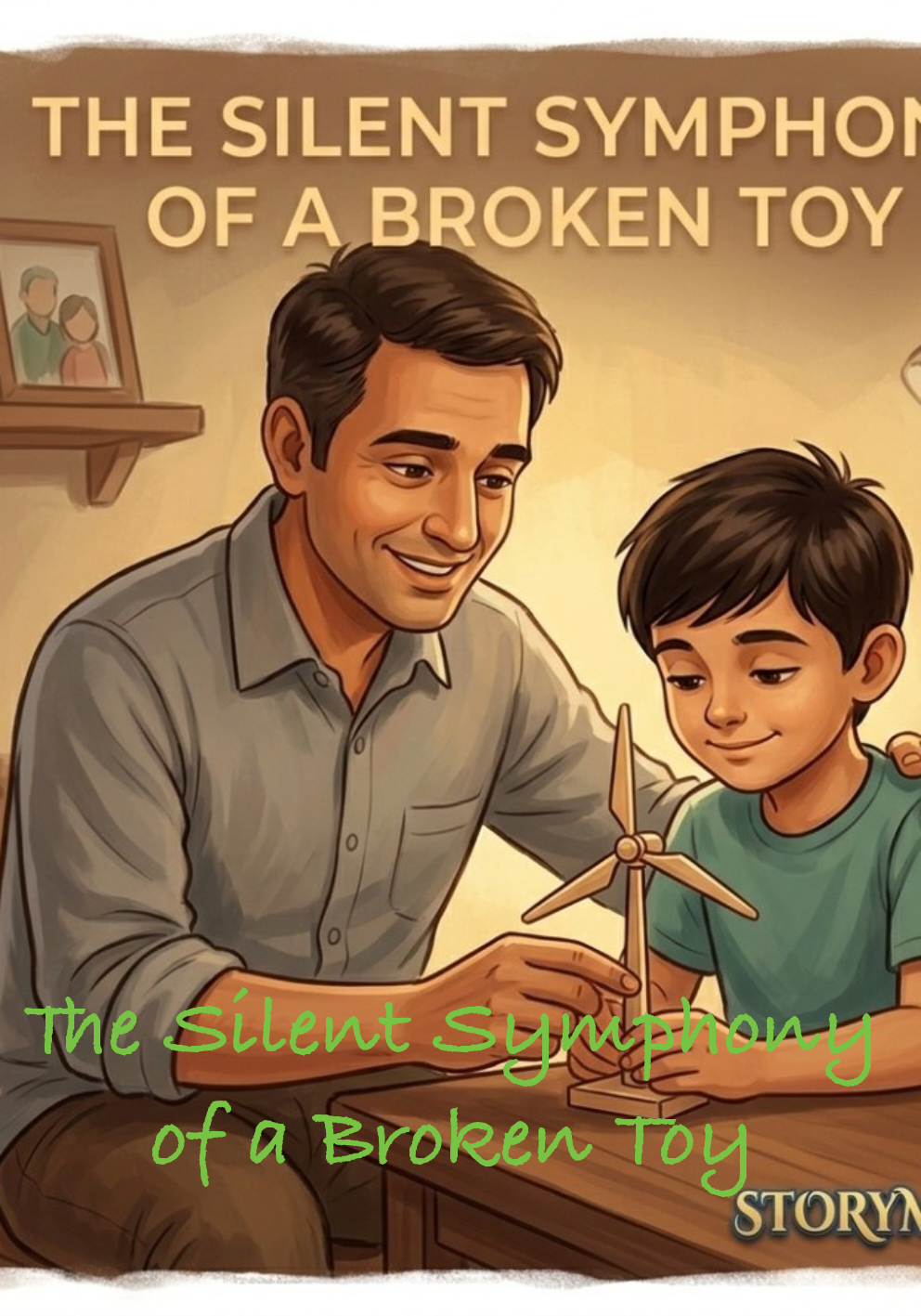
We didn't just buy new wood that day; we bought time. We bought a second chance. We spent the entire afternoon on the porch. As we sat there, rebuilding the turbine blade by blade, I didn't give him instructions. I didn't tell him to hurry. Instead, I asked him questions. I listened—really listened—as he told me stories about what Thatha had taught him. I watched the way his fingers moved with such incredible patience and grace. I realized my son wasn't slow; he was precise. He wasn't distracted; he was captivated by the beauty of the craft.
By the time the sun began to set, the turbine was spinning again, its yellow blades catching the evening breeze. But something much larger had been repaired in our home. The silence in our house changed that day.
I finally understood my child. I understood that his quietness wasn't a lack of words, but a wealth of thoughts. Now, whenever my First Brain wants to react with a shout or a criticism, I remember that rainy Thursday. I take a deep breath, I look into his eyes, and I choose the "Pause." I choose to listen.
Because I’ve learned that the best way to guide a child isn't to push them toward your world, but to let them lead you, hand in hand, into the quiet, beautiful corners of their heart.