Library

 Profile
The Man Next Door
The Man Next Door

I moved into Maple Lane on a Thursday morning in late July. The rain had just stopped, and the town looked freshly washed — the trees glistened, the air smelled of earth, and the roofs still dripped in lazy rhythm. It should have felt peaceful, but peace is a strange word for someone who’s forgotten what it means.
I wasn’t looking for a new beginning. Just an end that wasn’t too loud.
The broker had promised, “Quiet locality, friendly neighbours, near the park.”
He wasn’t wrong — it was all of that. A small Indian town where everyone knew everyone, where the milkman was also the news-bearer, and where silence was considered suspicious.
I arrived with two bags, one photograph, and the weight of everything I had lost — my wife, my son, my family, my mind.
I had served in the Air Force for fifteen years. I had seen men fall from the skies and never return, heard sounds so loud they still echoed inside my head at night. But nothing prepared me for the silence of losing my child.
It happened while I was away on duty — a hit-and-run outside his school. I wasn’t there to hold him, to save him, even to say goodbye.
My wife, Raina, tried to stay. She really did. But my grief became unbearable to her. I would stare at the walls for hours, flinch at sudden noises, and talk to our son in my sleep. One morning, she left a note on the dining table: “I can’t breathe in this house anymore.”
My parents blamed me.
“God took your son because of your sins,” my mother said.
They never spoke to me again.
So when I found this small house on Maple Lane, I didn’t ask for more. I just wanted walls that wouldn’t talk back.
The first few days were quiet, except for the murmurs.
“Who’s the new tenant?”
“Looks rough. Must’ve been in the army.”
“Stays alone — that’s never a good sign.”
I could feel eyes on me when I stepped out to buy groceries or water the small patch of soil in the backyard. Sometimes people would smile politely, other times they would just look away.
One afternoon, Mrs. Dutta from across the lane brought a bowl of dal.
“It’s our custom,” she said, forcing a smile. “New neighbours shouldn’t eat alone.”
I thanked her, but when she left, I didn’t eat it. Not because it wasn’t kind — but because it came wrapped in something that wasn’t kindness either.
They meant well, perhaps. But their care had sharp edges.
They asked questions they called concerns —
“Don’t you get lonely?”
“Where is your family now?”
“Why did your wife leave?”
They didn’t want answers. They wanted stories to tell others.
Then, one afternoon, a new family moved into the house next to mine — the Vermas.
The mother, Anjali, was a schoolteacher. The father, Sameer, worked in a bank. And their daughter, Mia, was seven — all questions, no filters.
The first time she saw me, I was fixing the fence.
“Uncle, why do you never smile?” she asked, her small face tilted in genuine curiosity.
I was taken aback. Most adults avoided talking to me; this little girl came straight to the heart of it.
“I forgot how,” I said finally.
“Then I’ll teach you,” she declared.
From that day, she began appearing at my gate almost every evening — with her bicycle, her homework, her half-eaten mango candies.
“Uncle, do you know the clouds are actually elephants in disguise?”
“Uncle, what does your tattoo mean?”
“Uncle, did you ever fly a plane?”
Her words were like sunlight filtering through old curtains — sudden, unexpected, but comforting.
At first, I tried to keep my distance. Children’s laughter had been too painful since my son. But Mia had no concept of boundaries.
One evening, she brought over a crumpled drawing — two stick figures under a blue sky.
“This is me,” she said, pointing to the smaller one. “And this is you. I named it ‘Sky Friends.’”
I laughed — actually laughed — for the first time in years.
The neighbours noticed.
“She’s spending too much time there.”
“He’s not family.”
“You can’t trust men who live alone.”
They said it quietly, but in towns like ours, whispers travel faster than sound.
One day, Anjali knocked on my door. I braced myself — I thought she’d ask Mia to stop coming over.
Instead, she smiled. “I just wanted to thank you. Mia talks about you all the time — says you taught her about constellations. You’re the reason she’s started reading again.”
I nodded, unsure what to say.
“She’s always been drawn to older people,” Anjali added softly. “I think she feels safe with you — maybe it’s your calmness. You listen to her the way most adults don’t.”
Something loosened inside me that day — the invisible chain I’d been dragging for years.
Weeks turned into months.
Mia would wave at me every morning before school, her pigtails bouncing, her smile brighter than the sun.
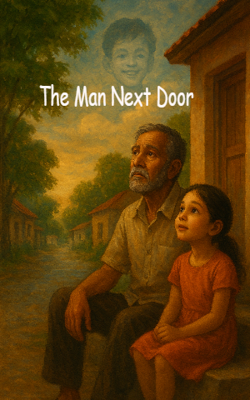
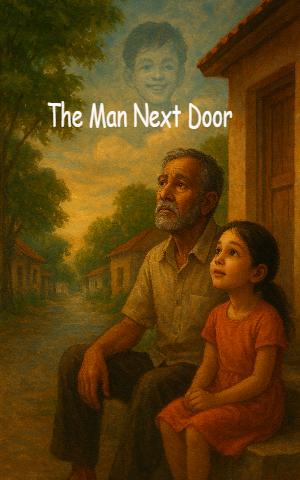
Sometimes we’d sit on the porch at dusk, watching the sky change colours.
I told her about the stars, the aircrafts, the silence above the clouds.
She told me about her friends, her new red bicycle, and how she planned to become an astronaut.
She made me believe that maybe, just maybe, the world hadn’t run out of light.
But the neighbours didn’t stop.
Their concern grew louder.
“Mr. Verma, it’s not appropriate,” someone told her father at the market.
“Children shouldn’t be so attached to strangers,” said another.
The Vermas handled it gracefully, but I could see the strain. I began keeping a little distance, hoping to protect both Mia and myself.
Still, every evening, she’d find her way to my gate.
“Uncle, are you angry at me?”
“No, little one. Just the world sometimes.”
“Then I’ll make you tea tomorrow. Mamma says tea fixes everything.”
And somehow, it did.
Then came the day everything changed.
It was a Sunday evening. I was reading in the backyard when I heard the screech of tires, followed by a scream.
When I ran out, I saw a small crowd gathered near the corner — and her red bicycle lying twisted on the road.
Mia.
I don’t remember how I reached her, or how long I shouted her name. Her tiny body was limp, her face pale, her parents crying out for help.
The ambulance came. The hospital lights blurred. Doctors spoke in words I barely understood.
“She has internal bleeding.”
“Kidney failure.”
“Needs a donor urgently.”
Her parents were tested first. No match.
I heard myself asking, “Can you test me?”
The nurse looked surprised. “You’re not family.”
“I am,” I said. “In every way that matters.”
Hours later, the doctor returned.
“You’re a perfect match,” he said. “But you’re not in ideal health. It’s risky.”
I didn’t need time to think.
I had been given a second chance at life the day Mia entered mine — this was how I’d return it.
The surgery took place the next morning.
I remember the sterile smell, the hum of machines, and a voice telling me to count backwards.
When I woke up, there was pain — dull but distant. Through the haze, I heard another voice, small and trembling.
“Uncle?”
I turned my head. Mia was there, pale but smiling, holding her mother’s hand.
“You’re okay,” she whispered. “We’re both okay.”
For the first time, my eyes filled not with grief, but with gratitude.
The weeks that followed were strange.
The neighbours who once whispered now came with fruits, flowers, and awkward apologies.
They called me “brave,” “kind,” “a hero.”
But I wasn’t any of those things. I was just a man who had forgotten how to live — until a little girl reminded him that love isn’t always loud or perfect. Sometimes it’s just a cup of tea and a child’s laughter on a quiet porch.
Mia recovered beautifully. She visits every day after school again, though now her mother insists she stays indoors after sunset.
Sometimes she brings her friends, proudly introducing me as “my Sky Uncle.”
I’ve started teaching her how to use the old telescope I once hid away.
She says one day we’ll look for my son among the stars — and wave to him together.
I’ve started sleeping better.
The nightmares still come, but they don’t win anymore.
Last week, Mrs. Dutta stopped me near the market.
“We all misjudged you, Mr. Mehta,” she said, avoiding my eyes. “We thought we were caring by keeping an eye on you. Turns out, we were just being cruel.”
I smiled gently. “It happens,” I said. “Sometimes we mistake noise for care and silence for danger.”
She nodded slowly. For once, she had no words.
It’s been a year now since I moved here.
My garden blooms again. Children’s laughter echoes through the lane.
The same people who once crossed the road to avoid me now wave when they pass.
But I’ve learned something — forgiveness doesn’t need witnesses. It just needs space.
At dusk, Mia still sits beside me, tracing shapes in the sky.
Sometimes she calls me her best friend.
Sometimes she says I saved her life.
But what she doesn’t know is — she saved mine first.