Library

 Profile
Bina Devi - A Lesson On Forgiveness: Biography
Bina Devi - A Lesson On Forgiveness: Biography

Bina Devi - A Lesson on Forgiveness : Biography
My sister, Mrs. Tapasi Ghosh Bhattacharyya, has been working as a Matron in some of the most renowned institutions in Kolkata for a little over a decade. She landed up with her first job as a Warden of North Point School in 2012 at the age of 52.
She has been working since she decided to stay away from her husband, a retired Deputy Bank Manager. I have spoken to her a number of times regarding her decision to sever ties with my brother-in-law, without any success. My sis may be gifted with a lot of good qualities but unfortunately, she has not inherited one quality from our late mother, Mrs. Bina Devi Bhattacharyya - the quality of Forgiveness.
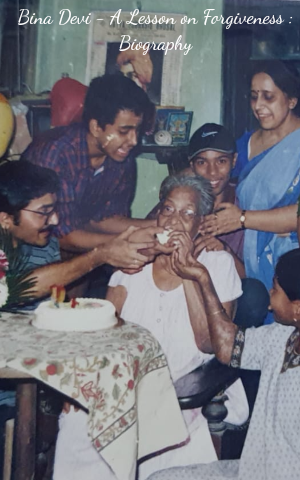
All her life, Ma was a living example of Forgiveness. So, without any further preliminaries, let me tell you briefly about this unsung daughter of India. Born on 28th February, 1919, Bina Bhattacharyya was the third of the six children of late Professor Akshoy Bhattacharyya, a scholar of Sanskrit and Bengali. After partition, Prof. Bhattacharyya taught at Srirampur College. A humble, amicable man, he saw to it that all his children were imparted some basic values in Life.
My maternal grandmother was no less a sagacious woman. I heard it from my eldest brother, Dr. Debesh Bhattacharyya, a much-travelled man that nowhere had he met a more scholarly and saintly woman than my granny. With her hair turned completely white, she reminded me time and again of the wife of Atree Muni. With such quality people as her parents, it was only natural that Ma imbued some great values from them from early on in life.
I have already written about Ma's exceptional intellectual bent of mind, her selflessness and sacrificing mentality. The reader can very well find out more about some of those qualities by following the link below : (http://masb6.blogspot.com/2013/12/mrsbina-devi-bhattacharyya-forgiveness.html?m=1)
I would also like to reproduce a part of that article here just to show what my paternal grandfather, Haridas Siddhantabagish, one of the greatest scholars that India has ever produced, thought of his daughter-in-law. Here is the extract :
She was the best mother in the world for me. I trust my Ma enough to believe what she told my grandfather, Haridas Siddhantabagish had remarked about her : “ Ekta bhadraloker meyeke bari niye esechi” (I have brought a gentleman’s daughter to my house) and all her life, my Ma tried to lead her life by this remark. When grandpa finally bought the ancestral home at Deblane, my Ma offered all her wedding jewellery to him for the purpose. Though Dadu (grandfather) paid her back everything once he fell into good times, he never forgot this act of selflessness of my Ma.
For lack of space and the word limits, I will mainly focus on the quality that set Ma apart from most of the other women of her generation or the generations following.
Ma got married when she was only 13! A balika badhu. My father, Principal Jogesh Chandra Bhattacharyya was 17 at that time. As per the customs and conventions of those days, Ma had to give up her studies after marriage while Baba pursued his Master's in English, worked as a Professor of a grade one college in Punjab before accepting the offer to be the founding Principal of Sreepat Singh College, Jiagang, Murshidabad. Ma - I heard it from my aunts, her sisters - was an outstanding student. A topper all through till Class-VI, when she was given off in marriage, she even had the good fortune of meeting Gandhiji when he paid a visit to her school in Barisal, modern Bangladesh.
Ma loved narrating the story of how impressed Gandhiji was with the khadi cloth she had woven using the charka. Let me just narrate another incident here that shows how Ma imbued the quality of Forgiveness soon after marriage. One day, Baba returned home with an earthen bhand (pot) of rasgullas. He went up to his room and handed the bhand to his child-bride asking her to savor the sweets. She was merely fifteen or sixteen at that time, so she wasted little time in devouring all the rasgullas. Baba, in the meanwhile, went down to tell his sisters that the sweets he had bought for them was kept in the custody of their sister-in-law! Imagine Ma's surprise when her nandais (husband's sisters) came running up asking for the sweets! She would tell us that she never felt so ashamed of herself before or after! The incident also taught Ma a Lesson on Forgiveness.
With time, I reckon, these happenings will transform into some kind of myths. What is even more disquieting is the fact that my own children may be laughing such truths off as nothing but mere stories in the days to come!
Anyway, to come back to Ma's sense of Forgiveness - with a very large family to raise, cook for and feed, Ma had very little time for self-grooming. Not that she bothered much about the concept of self-grooming either. She was always the first to get out of bed and the last to retire to it! I can still see her blowing into the mouth of the mud oven in order to keep the fire, made up of coal and cow dung cakes, going. Her face blackened, glowing in the smoke and heat emanating from the oven. Yet, she delighted in discharging the daily chores like it was her bounded duty. I never heard her complaining about her circumstances or fate!
While her sons and daughters were growing up, Ma tried teaching them the best of those values that she herself had inherited from her parents. She raised a family of 12, yet she never laid a finger on any of her children! Imagine her pride when the offspring's started discharging their destined roles, making their marks as responsible, contributing citizens of the society, both in India and abroad.
For me, Ma will always be the epitome of Forgiveness and Selflessness. I have already told you of her patience while dealing with her growing up children. Let me also tell you, in this connection, that I never found her losing her cool. How could someone be so cool? She never had to raise her voice, let alone her hand, on any of her children! Can you believe me, dear reader? Only a stern look on the face, would do the job of putting them in the right perspectives quite well. In today's world, when raising a kid is turning out to be so stressful, Ma adored her children and was a joy to be around.
(2)
Things were beginning to raise their ugly heads by the late 1950s. Baba, who had joined Dum Dum Motijheel College by the 1950s, was falsely accused of embezzlement. He fought tooth and nail against the West Bengal Government for the sake of his pride and prestige. The case lasted for some 17 long and painful years. Finally, he got honorably acquitted. The famed Writer's Building, the seat of Government Administration in those days, had to be croaked to pay Principal Jogesh Bhattacharyya the money due to him. But the long 17 years had taken a toll on him. Besides, he was never Dame Luck's favorite child.
During this long wait to be honorably acquitted, he had an attack of gangrene followed by a fracture in the leg. Subsequently, he had to walk with crutches. The man who could have owned the whole world, was unjustifiably maimed in the prime of his life! He got confined to the easy chair and despite the outward joviality and valor, he was not the same person internally any more.
Had Ma not been there with him during those unbearably hard days, Life could have been crueler for Baba. He was Ma's hero. She must have fallen in love with him at first sight though theirs was an arranged marriage. Over six feet tall, with a physique that earned him the envy of a lot of contemporaries and left him with a permanent scar on his right thigh, Baba was someone you would call a hunk of a man, in the modern day parlance. No wonder that he was taken to be the leader of the Hindus in his locality during the riots of the 1940s and stabbed on his right thigh! Educated during the British Raj in India, Baba was literally hero-worshipped by Ma.
His extreme good looks all through his life drew the famme fatale to him, on and off. I still remember the framed picture of a British lady called Dorothy that hung on top of the wall beside his bed in the bedroom. Yet Ma never bothered about his charm or charisma for the fairer sex. Her philosophy was quite simple. As her husband was a handsome man, it was not surprising at all that women fell flat for him!
Baba was, most probably, in his late fifties when one Sushma Sen, who was an employee of the Central Government and gradually rose to be an Officer of the local Post Office, former student of Baba, crawled her way back into his life.
(2)
I was still in my teens when Sushmadi, who used to teach me English and Maths, became an issue and raised a huge hue and cry in the family circles. Starting with his surviving siblings to his own children, no one supported Baba at that time. Personally, I think that Baba's authority as the Head of the family also started waning at around the same time.
Barda, Dr. Debesh Bhattacharyya, who was working as a Lecturer at The University of Sydney, decided to intervene and took over the affair of running the family soon afterwards. Barda was a lot closer to Ma than he was to Baba. Had there been any other woman in Ma's shoes, she would have set this very successful son against a man, who had not treated her the way she deserved. But for Ma, Baba's family would have been in utter jeopardy and disarray.
Being a very level-headed lady, Ma never lost her cool during this extremely troubled time for the family. She made sure that things did not get out of control and helped maintain the balance in the family. In due course of time, Sushmadi came to be accepted as a part and parcel of the family, owing mainly to Ma's sagacity, goodness and far-sightedness.
I still remember the near 1-month India Trip I made with my widowed Ma and Sushmadi in the mid-eighties. Sushmadi, I am sorry to state, was not as compromising and accommodating as Ma was, but during the entire trip I never saw them divided or quarrelling over anything. I would venture to opine, in this connection, that by the time Baba breathed his last in 1985, Sushmadi must have started looking up to Ma as an elder Sister, as someone who was too full of 'the milk of human kindness'.
Ma made the greatest of sacrifices from the point of view of a woman, to accept Sushmadi in her life. Ma's acceptance made others in Baba's family adopt a more watchful and lenient approach towards her while dealing with her. Things, in Baba's family, could have gone horribly amiss but for Ma's forgiving nature. That must have been one of Ma's great qualities that made Baba remark in his deathbed :
"Jodi para janam bole kichhu thake, ta be tomakei jeno stree hisabe pai… . " ( If there is something called The Next Life, I'd like to have you as my wife.)
Ma's reply to Baba's deathbed wish was in sharp contrast to the intelligence she displayed in having played second fiddle to Baba as long as he was alive. She is said to have told her husband then, " Oma, seki! Ami je paro janame purush hoye janmate chai!" ( Gracious Goodness! I thought I'd love to be born as a man in my next life.")
Ma's reply also conveyed the latent pain, setbacks and sacrifices she had to make almost all her married life! She got so fed up with all those days, months and years of untold misery and heartaches she endured that she did not want to be born as a woman in this predominantly male-dominated society again!
Ma passed away on 11th August, 2006, after a brief illness at the Peerless Hospital, Kolkata, at the ripe old age of 85. She led a contented, fulfilled life and will be remembered as a 'ratnagarva' ( the one with a bejeweled womb) due to the fact that almost all of her 12 children went up to distinguish themselves in one field or the other.
When I was working at CCS, Tshimalkha, Bhutan, I had a Prize for The Best Student of the School instituted in her memory. It was done away with when Mr. Tashi Chonjur took over as the new Principal of the school. But no prizes, awards or rewards can do justice to a woman of unparalleled devotion and forgiveness like my Ma, Mrs. Bina Devi Bhattacharyya. I know that no statue or temple will ever be erected in memory of my late Ma. But so long as there are women like Ma, embodying the values, the spirit and essence of India, India will continue to shine and be a glowing example of Love, Honor, Forgiveness, Selflessness and Sacrifice to the rest of the world.