Library

 Profile
Are rich people always bad and poor people always good?
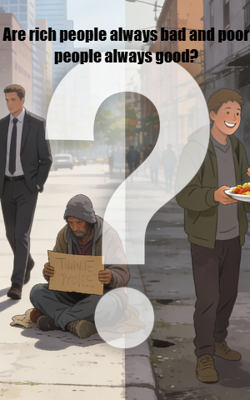
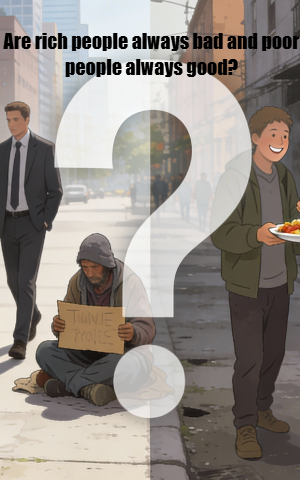
Are rich people always bad and poor people always good?

Across movies worldwide—Hollywood, Bollywood, or any other “wood”—there is a familiar, comfortable cliché: the rich are selfish, cruel, and corrupt, while the poor are honest, kind, and morally pure. It’s a narrative we’ve seen repeated endlessly. The villain lives in a mansion; the hero comes from the streets. Wealth is shown as a moral stain, poverty as a badge of virtue.
But is this idea true, or is it simply convenient storytelling?
This cliché got me thinking. Are rich people bad because they are rich? Or did they become rich because they were bad? Or is it possible that they were once good people who slowly changed after acquiring wealth and power? On the other hand, are poor people always good—or do we romanticize poverty because it makes for a more emotionally satisfying story?
Cinema thrives on clear contrasts. Moral complexity is harder to sell than simple opposites. A rich antagonist immediately signals greed and corruption; a poor protagonist instantly earns sympathy. These shortcuts save time and help audiences connect quickly. But real life rarely works this way.
In my opinion, wealth does not create character—it reveals it. Money amplifies who a person already is. A compassionate person with wealth may build schools and hospitals; a selfish one may exploit others more efficiently. Poverty, too, does not automatically produce goodness. Struggle can build empathy, but it can also breed resentment, desperation, and cruelty.
This reminds me of Loki’s mask from the original The Mask movie (and don’t even get me started on the sequels). In the film, the mask is undeniably a source of immense power. But an important question often gets overlooked: was it the mask that turned Stanley Ipkiss into a Robin Hood–like hero, or was it that same power that made Dorian Tyrell cruel and destructive?
The answer is simple—the mask itself was neither good nor evil.
It didn’t create morality. It amplified it.
When Stanley wore the mask, his suppressed kindness, playfulness, and sense of justice burst forth in exaggerated ways. When Dorian wore it, his hunger for dominance and cruelty was magnified just as dramatically. The same object, the same power, yet completely different outcomes.
That makes the mask a perfect metaphor for wealth.
Money, like the mask, does not possess morality. It doesn’t have the power to turn a good person bad or a bad person good. What it does have is the ability to magnify what already exists within someone. Kindness becomes generosity; insecurity becomes control; ambition becomes influence; greed becomes exploitation.
The difference between Stanley and Dorian was never the mask. The difference between a benevolent billionaire and a ruthless one is never the money.
Wealth simply removes limits. And when limits disappear, character is exposed.
Another uncomfortable truth is that we often confuse systemic inequality with individual morality. Many people are poor not because they are virtuous, but because the system is unfair. Likewise, many are rich not because they are evil, but because they had access—education, connections, inheritance, or opportunity. Blaming or glorifying individuals distracts us from examining the structures that create inequality in the first place.
Movies often show us the world not as it is, but as we wish it to be—much like religion, controversial as that comparison may sound. Both offer moral frameworks that are easier to accept than reality itself.
We like to believe that goodness is rewarded, if not with wealth then at least with moral superiority. It is comforting to think that suffering automatically ennobles a person, while success inevitably corrupts them. This idea sits at the very core of many belief systems across the world.
Reality, however, is far less poetic.
Pain does not guarantee virtue, and prosperity does not ensure moral decay. Some people grow kinder through hardship; others grow bitter. Some remain ethical despite success; others were never ethical to begin with. Stories—whether told on screen or passed down through centuries—often simplify these truths because complexity is uncomfortable.
But the real world does not operate on fables.
It operates on choices.
And those choices, not suffering or success, reveal who we truly are.
There are generous millionaires and cruel beggars. There are honest laborers and dishonest tycoons. Goodness and badness do not follow bank balances—they follow choices.
Perhaps it’s time we move beyond this tired trope. Instead of asking whether rich people are bad or poor people are good, we should ask better questions: What systems reward greed? What environments encourage kindness? And how do power and money test human values?
Because wealth and poverty are conditions. Character is a choice.