Library

 Profile
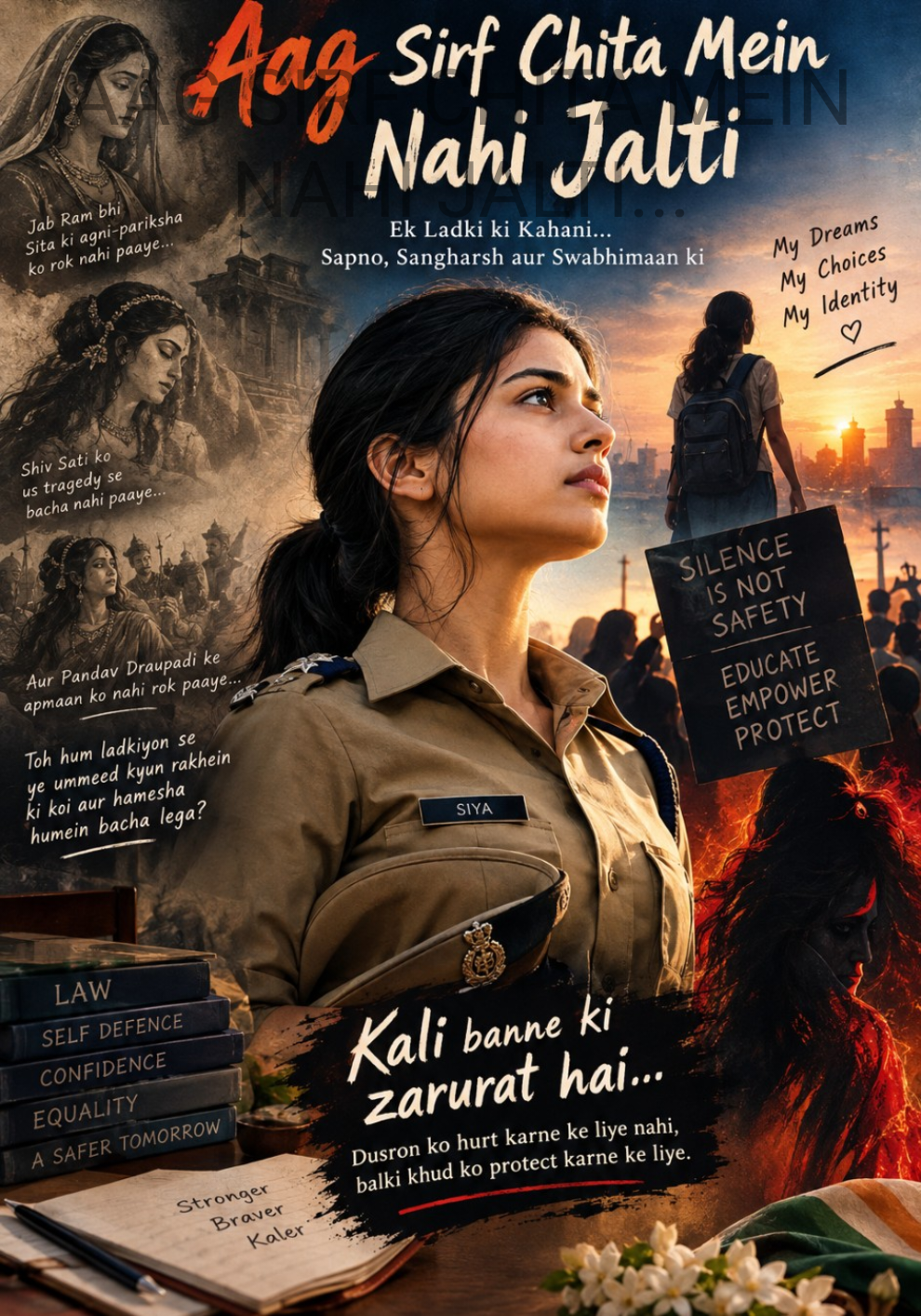
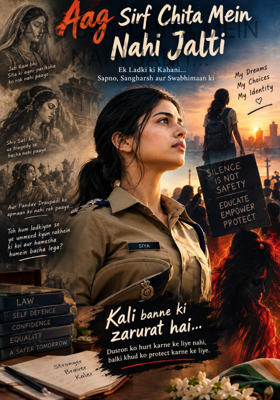
AAG SIRF CHITA MEIN NAHI JALTI...
AAG SIRF CHITA MEIN NAHI JALTI...

AAG SIRF CHITA MEIN NAHI JALTI
A story about Siya, patriarchy, freedom and the courage to protect oneself
Siya was seventeen when she decided what she wanted to become.
Not a doctor.
Not an engineer.
Not someone’s perfect daughter-in-law.
She wanted to become a police officer.
Her father once laughed when she told him.
“Police officer? Tum? Itna tough profession hai.”
Siya smiled.
“Isi liye toh banna hai, Papa.”
Her dream was not just to wear the uniform.
She wanted to wear it because she had grown up watching women being told to be careful everywhere.
Don’t go out alone.
Don’t come home late.
Don’t talk too loudly.
Don’t trust strangers.
Don’t wear that.
Don’t do this.
Adjust.
Compromise.
Be a good girl.
Siya had one question:
“Why is the world teaching girls how to live carefully instead of teaching people how to behave respectfully?”
Nobody had a simple answer.
---
The First Lesson
One morning, Siya's college held a discussion on women's rights.
The topic was the Roop Kanwar case.
Her professor explained that in 1987, eighteen-year-old Roop Kanwar died on her husband's funeral pyre at Deorala in Rajasthan. The incident was subsequently surrounded by public glorification and political controversy.
Siya listened silently.
The professor said,
“Don't understand this only as a story about an old custom. Ask a bigger question: Why is a woman's life sometimes valued less than the social ideas attached to her?”
Siya raised her hand.
“Ma'am, can we really call something a woman's choice if society has never allowed her to make ordinary choices freely?”
The classroom became quiet.
The professor looked at her.
“That,” she said, “is exactly the question you should keep asking.”
Siya wrote it in her notebook.
Choice without freedom—is it really choice?
---
Patriarchy Doesn't Always Shout
Until that day, Siya thought patriarchy meant only obvious discrimination.
But slowly she realised that patriarchy does not always arrive with anger.
Sometimes it comes softly.
It comes as a mother's advice:
“Beta, sasural mein thoda adjust karna.”
It comes as a father's fear:
“Log kya kahenge?”
It comes as a relative's warning:
“Ladkiyon ko zyada independent nahi hona chahiye.”
It comes as a question:
“Career karogi toh ghar kaun sambhalega?”
And sometimes it comes as a compliment:
“Tum toh bahut achhi ladki ho, kabhi jawab nahi deti.”
Siya wondered—
Why is silence considered a virtue in girls?
---
Ayesha's Dream
Siya's friend Ayesha wanted to study engineering.
Her relatives told her,
“Engineering ladkiyon ke liye bahut difficult hai.”
Ayesha asked,
“Difficult mere liye hai, ya aapke expectations ke liye?”
Nobody answered.
She worked hard, got admission and left for college.
Before leaving, her grandmother hugged her and said,
“Apni zindagi ka decision khud lena.”
Those words stayed with Siya.
She realised:
Education is not only about getting a degree.
Education teaches you that you have the right to have a voice.
---
The Question of Safety
One evening, Siya saw a news report about a woman facing harassment.
The comment section was filled with questions.
“Woh wahan gayi hi kyun?”
“Us waqt bahar kyun thi?”
“Usne aise kapde kyun pehne?”
Siya stared at the screen.
She whispered,
“Crime kisi aur ne kiya… sawaal usse hi kyun?”
She closed her phone.
That night she wrote:
«“A society that constantly teaches women how not to become victims must also teach people not to become perpetrators.”»
---
The Stories We Inherit
The next week, Siya's professor discussed stories from Indian mythology.
They talked about Sita, Sati and Draupadi.
Siya suddenly thought about something.
She stood up and said:
“Ma'am, humare stories mein powerful women bhi hain. Lekin har generation mein hum girls ko un stories se sacrifice aur suffering hi kyun yaad karvate hain?”
The professor asked,
“What do you think?”
Siya took a breath.
Then she said:
“Jab Ram bhi Sita ki agni-pariksha ko rok nahi paaye, Shiv Sati ko us tragedy se bacha nahi paaye, aur Pandav Draupadi ke apmaan ko nahi rok paaye—agar hamari kahaniyon ke sabse powerful purush bhi har baar apni women ko protect nahi kar paaye, toh hum ladkiyon se ye expectation kyun rakhein ki koi aur hamesha humein bacha lega?”
The class was silent.
Siya continued:
“Isliye mujhe lagta hai ki ladkiyon ko sirf kisi protector ka intezaar karna nahi, khud ko strong banana bhi seekhna chahiye.”
She paused.
“Humein Kali banna chahiye—dusron ko hurt karne ke liye nahi, balki zarurat padne par apni awaaz, apni boundaries aur apni safety ke liye khud khade hone ke liye.”
Her professor smiled.
“Remember, Siya—strength doesn't mean violence. Strength means awareness, courage, confidence, self-defence, education and the ability to say NO.”
Siya nodded.
---
Siya's Uniform
Years passed.
Siya studied harder.
She ran in the morning.
She prepared for competitive exams.
She learned about the law.
She learned self-defence.
But most importantly, she learned how to speak.
Not aggressively.
Not fearfully.
Confidently.
One day, she finally wore the uniform she had dreamed about.
Her father looked at her.
His eyes became emotional.
“Tum sach mein kar gayi.”
Siya smiled.
“Papa, aapne kaha tha tough hai.”
Her father laughed.
“Haan. Lekin mujhe nahi pata tha tum usse bhi zyada tough ho.”
---
The Case That Changed Her
As a young police officer, Siya met many women.
Some were educated.
Some were not.
Some were rich.
Some were poor.
Some lived in cities.
Some lived in villages.
But Siya noticed one common thread.
Many women had been taught from childhood to tolerate.
“Tolerate your husband.”
“Tolerate your in-laws.”
“Tolerate harassment.”
“Tolerate discrimination.”
“Tolerate insults.”
And sometimes—
“Tolerate because you are a woman.”
Siya realised that patriarchy survives not only because some people impose it, but also because society sometimes teaches the next generation to accept it as normal.
---
A Different Kind of Revolution
One day, Siya visited a school to speak to young girls.
A little girl raised her hand.
“Ma'am, kya ladkiyon ko strong banne ke liye ladkon jaisa banna padega?”
Siya smiled.
“No.”
“Strong hone ke liye tumhe kisi aur jaisa banne ki zarurat nahi.”
She looked at the girls.
“Strong ladki woh nahi jo kabhi dare hi nahi. Strong ladki woh hai jo darr ke bawajood apne liye khadi hoti hai.”
“Tumhari strength tumhari awaaz mein ho sakti hai.”
“Tumhari education mein ho sakti hai.”
“Tumhari awareness mein ho sakti hai.”
“Tumhari financial independence mein ho sakti hai.”
“Tumhari self-defence training mein ho sakti hai.”
“Ya sirf itna kehne ki himmat mein—”
“No. This is not acceptable.”
---
Aag Ka Matlab
Siya's final college presentation had once been titled:
“Aag Sirf Chita Mein Nahi Jalti.”
Years later, she understood its meaning differently.
Aag sirf funeral pyre mein nahi jalti.
Aag tab bhi jalti hai—
when a girl's dreams are burned by social expectations.
When her voice is silenced by fear.
When her choices are controlled in the name of honour.
When violence is called a family matter.
When the victim is questioned instead of the perpetrator.
When a woman is praised only for sacrifice.
When society tells her:
“Adjust.”
But there is another kind of fire too.
The fire of resistance.
The fire that says:
“I will study.”
“I will work.”
“I will speak.”
“I will decide.”
“I will protect myself.”
“And I will not apologise for existing on my own terms.”
---
The Last Question
At the end of her speech, Siya looked at the audience.
She didn't ask them whether women were weak.
She asked something much more uncomfortable:
“If a woman needs permission to choose her clothes, her education, her career, her marriage and her life—then how can we say she is truly free?”
Nobody spoke.
Siya continued:
“Women's empowerment ka matlab men ko replace karna nahi hai.”
“Women's empowerment ka matlab women ko equal human being samajhna hai.”
She looked at the young girls sitting in the front row.
“And remember…”
“Humein hamesha koi bachane nahi aayega.”
“Isliye ladkiyon ko sirf protected nahi—prepared bhi hona chahiye.”
She touched the badge on her uniform.
And smiled.
Because the little girl who had once written “My life. My choices. My identity.” on a piece of paper had finally understood something:
A woman doesn't need to become someone else's shadow to be safe.
She needs the freedom, knowledge and courage to stand in her own light.
Aag sirf chita mein nahi jalti.
Kabhi-kabhi woh ek ladki ke andar bhi jalti hai—
aur wahi aag usse khud ki pehchaan banane ki himmat deti hai.