Library

 Profile
The Rain on Bindusagar
The Rain on Bindusagar

The sky over Old Town was the color of a bruised plum.
Ananya adjusted the strap of her Nikon, her sneakers firm on the ancient, dark laterite stones. She had been chasing the light, hoping to capture the precise moment the sun hit the towering spire of the Lingaraj Temple. The temple stood massive and magnificent, a masterpiece of Kalinga architecture with its intricate carvings etched into the dark, weathered stone.
But the clouds had other plans. A low rumble of thunder rolled across the horizon, vibrating in her chest.
"Not today, then," she whispered. In Bhubaneswar, you didn't fight the rain; you welcomed it.
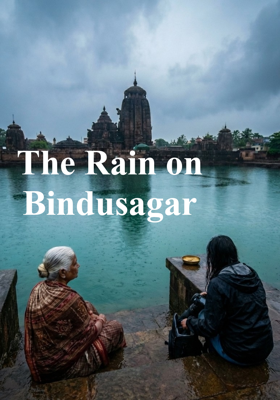
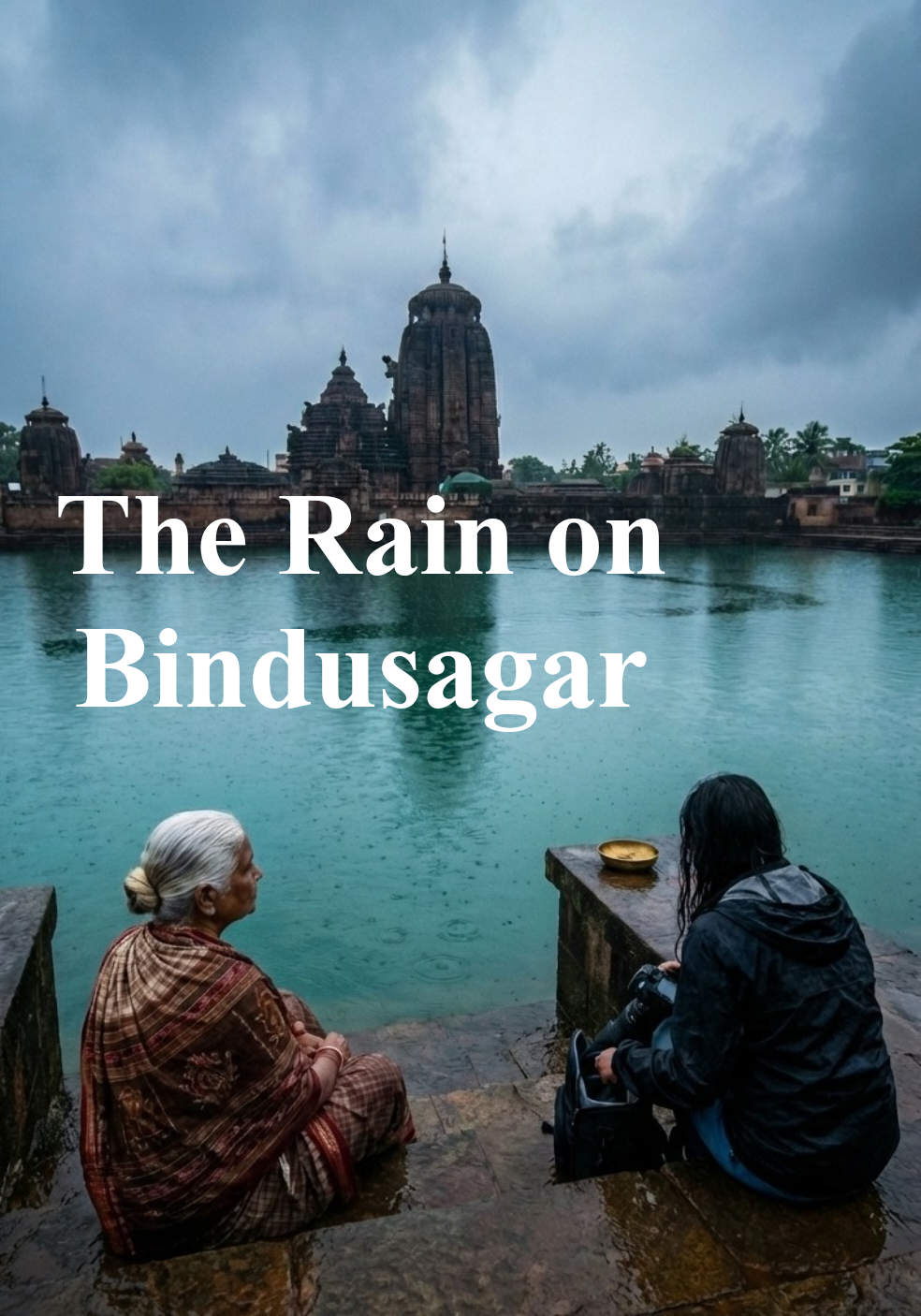
As the first heavy droplets began to fall, she ducked under the arched stone canopy of a small shrine overlooking Bindu Sagar lake. The vast tank sat still, its deep greenish-blue water glowing with an inner light, even as the sky darkened. The surface, usually a calm mirror to the surrounding shrines, began to ripple into a thousand tiny circles as the downpour intensified.
"It’s better this way," said a raspy, gentle voice.
Ananya turned to see an elderly woman sitting on a low stone ledge by the lake. She wore a simple cotton saree, her white hair tied in a neat bun. In her lap sat a small brass bowl filled with Mudhi (puffed rice).
"The temples look more honest when they're wet," the woman continued, tossing a handful of grain into the lake. "The rain washes away the dust, and you see the real face of the stone."
Ananya moved closer, the heavy scent of wet earth filling the air. She looked at the Lingaraj shikhara; the rain had turned the dark stone into a shimmering, majestic black. "I was worried about the light," Ananya admitted. "I wanted that golden glow."
The woman chuckled, her eyes crinkling. "Gold is for the tourists, ma. But the dark stone? That is the heart of the city. And look at the water, see how the green deepens when it drinks the rain?"
Ananya leaned over the edge. The greenish-blue water of Bindu Sagar seemed to absorb the storm, remaining tranquil despite the lashing rain. Near the steps, fish surfaced in a rhythmic dance, undisturbed.
"I’ve lived by this water for sixty years," the woman said, offering the brass bowl to Ananya. "I’ve seen it during the Shivratri or Chandan yatra crowds and in the silence of the night. It always stays calm. It knows how to hold everything."
Ananya took a handful of the mudhi and tossed it to the lake. The pressure of her city life felt distant, replaced by the steady, ancient pulse of the Old Town.
Ananya looked at the woman’s hands. They were thin and leathered, the color of the earth she had walked upon for decades, contrasting beautifully with the bright brass of the bowl.
The rain was now a steady curtain, blurring the distance. The greenish-blue of Bindu Sagar was now a deep, mystical teal, and the old woman’s hand paused over the water, a few grains of mudhi still clutched between her fingers.
"May I?" Ananya asked softly, lifting her camera.
The woman didn't pose. She simply nodded, a small, knowing smile playing on her lips as she looked out toward the dark, wet crown of the Lingaraj Temple.
Click.
Ananya looked at the digital display. It wasn't the wide-angle, postcard shot she had planned. It was a close-up: the weathered, dark stone of the shrine in the foreground, the woman’s wrinkled hand suspended in air, and in the background, the soft, blurred ripples of the teal water.
"You found it," the woman said, without even looking at the screen. "The quiet."
"I did," Ananya whispered.
The rain began to slow, transitioning into a gentle mist that clung to the ancient walls. The air felt lighter, cooler. The woman stood up, smoothing her saree.
"The light will come back tomorrow, ma," she said, tucking the empty brass bowl under her arm. "But the rain... the rain gives you a different kind of sight. Don't forget to look at the shadows sometimes."
As the old woman walked away, her footsteps disappearing into the narrow lanes of Old Town, Ananya stayed a moment longer. She watched the reflection of the black-stone temples begin to stabilize on the surface of Bindu Sagar as the ripples died down.
She hadn't just captured a photo; she had captured a breath. Packing her camera away, she realized she didn't need the "perfect" sunset anymore. The greenish-blue water and the dark, wet stone had told her everything she needed to know about home.