Library

 Profile
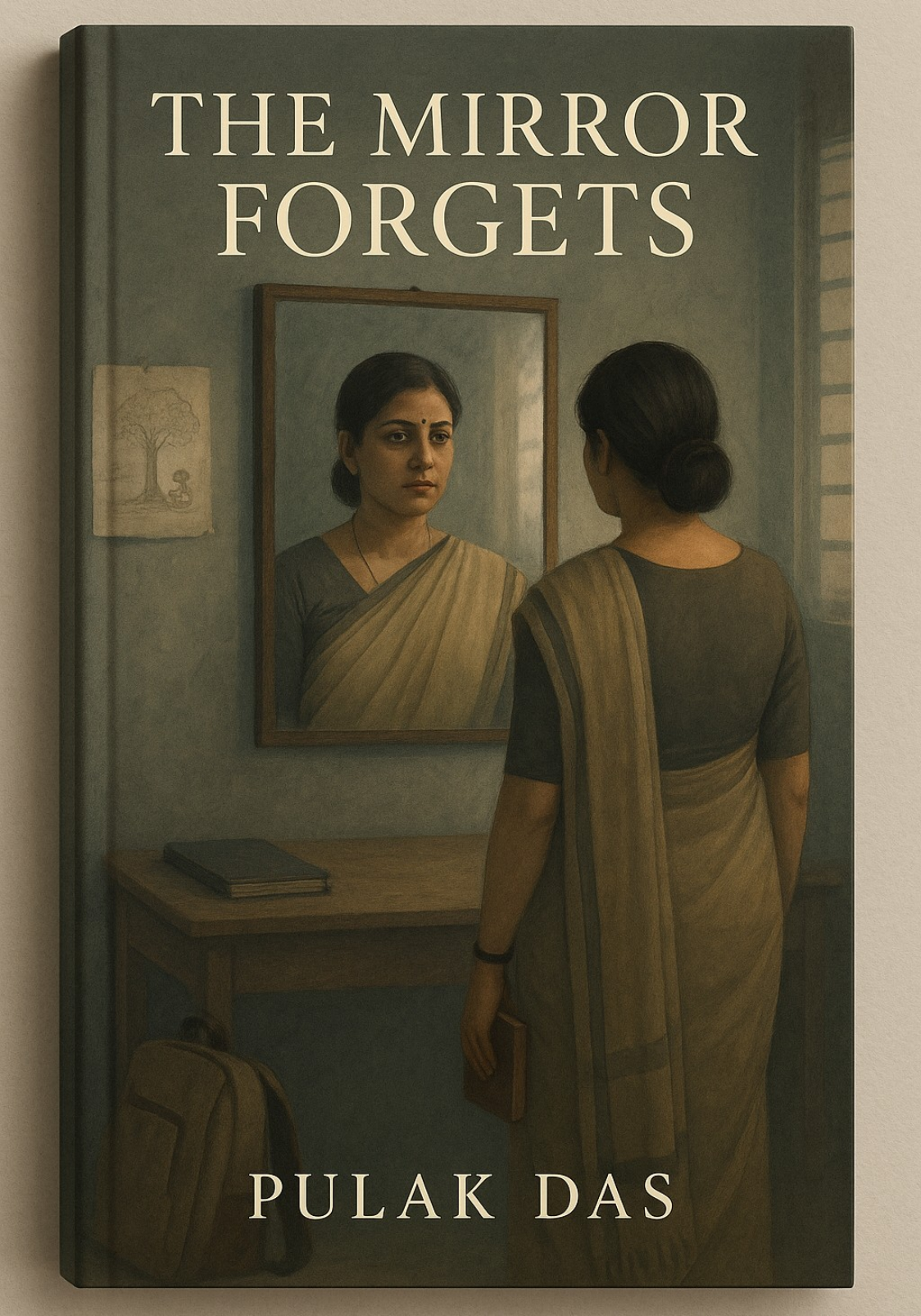
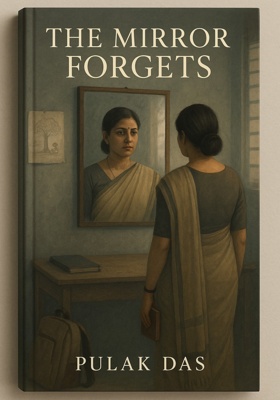
The Mirror Forgets
The Mirror Forgets

Every morning, Mira stood in front of the cracked mirror in her small flat—the one that caught the early light filtering through the dusty window. She straightened her cotton saree—always blue or white now, never anything that might be called flashy—fixed her bindi with practiced precision, and rehearsed a smile. The ghost of yesterday’s chalk clung to her fingers, stubborn as habit, mingling with the jasmine oil she dabbed at her wrists—a small rebellion she still allowed herself.
It was the face of a teacher—patient, composed, dependable. The children called her Mira Ma'am with the kind of reverence that once made her feel important. Needed, even. But the woman in the mirror felt like someone she had met long ago, a faded acquaintance she could barely remember.
She could still recall the exact moment she stopped humming while grading papers. It was three years ago, during her probationary review. Mrs. Sharma, the principal, had walked into the staffroom and found Mira swaying slightly to a tune only she could hear, red ink dancing across homework sheets.
"Mira," Mrs. Sharma had said—not unkindly—"we need our teachers to project seriousness. The parents are watching."
The humming died in her throat that day. It never returned.
Mira had once loved teaching—truly loved it. Not the sanitized, rehearsed version they demanded now, but the messy, electric joy of it. She remembered the morning she’d taught fractions by bringing in her grandmother’s recipe for payesh, letting the children divide and multiply servings, their fingers sticky with rice pudding as they learned. That was before the standardized curriculum, before every lesson had to be pre-approved and documented in triplicate.
Her old poetry journal once lay open on her desk, its pages filled with verses of monsoon clouds and children’s laughter—words that captured how understanding could bloom across a young face, sudden and bright as sunrise. Now it lay buried beneath towers of worksheets and assessment forms, its leather cover cracked from neglect. Sometimes, late at night, she could feel it calling to her from under the papers—but her hand would reach for the next stack of tests instead.
The staffroom reeked of stale tea and frustration. Fluorescent lights buzzed overhead, washing everything in a sickly green glow that deepened the exhaustion on every face—even the youngest teachers looked worn. Mira sat at her designated corner desk—the one with the wobbly leg that no one bothered to fix—mechanically entering attendance data into the school’s new digital system. Around her, colleagues whispered about impossible deadlines and irate parents, their voices carrying the weary cadence of people who’d forgotten why they chose this work.
"You know what I admire about you, Mira?" said Ravi, the Hindi teacher who’d joined the school five years after her. He was still young enough to gesture when he spoke, still naive enough to argue with administrators. "You never let them see you break. Always so composed—like you’re made of something unshakable."
Mira’s fingers paused over the keyboard. Through the window, she could see children playing in the courtyard, their shouts drifting up to the second floor. She watched them chase each other around the banyan tree, their white uniforms already dusty and untucked.
Something twisted in her chest.
"That’s the secret," she said quietly, not looking at Ravi. "Don’t let them see you’re human."
She measured her words with surgical precision now, careful not to be “too emotional” during faculty meetings. When Mrs. Gupta blamed her for her son’s failing grades—"You teachers just don’t care anymore"—Mira smiled and suggested tutoring options. When the new evaluation system reduced each child to a series of numbers, she complied. When they asked her to stay late for the third time that week, she simply nodded.
The perfect teacher: silent, sacrificing, selfless.
Invisibility wasn’t just about being unseen—it was disappearing from your own life, until even your reflection in the mirror began to feel like a stranger.
One Thursday afternoon, as monsoon clouds gathered outside, a supervisor arrived for a routine inspection. Mr. Joshi was new to the district, still eager to impress with detailed reports and sharp observations. He stood at the back of Mira’s classroom, clipboard in hand, watching her guide thirty-seven children through a lesson on water conservation.
Afterward, as the children filed out for recess, he approached her desk.
"Remarkable," he said, scribbling notes. "You maintained perfect classroom management even when that boy—Arjun—was clearly having a difficult day. You never raised your voice. Never showed frustration. It’s like nothing ever touches you."
Mira smiled—the same one she’d practiced in the mirror that morning.
"Thank you, sir."
But as Mr. Joshi left, something inside her splintered. Like the parched earth of a long drought finally surrendering to the first hesitant drops of rain.
Because the truth was that everything touched her.
Arjun’s anger touched her, because she saw the quiet panic in his slumped shoulders, a mirror of his father’s recent job loss. Priya, the new girl, touched her because homesickness leaked from her eyes like unshed tears. Even Mr. Joshi’s praise touched her—because it celebrated the very numbness that was slowly hollowing her out.
She simply stopped letting it show.
Stopped letting herself feel.
That evening, alone in the staffroom as the building sighed into silence, Mira began gathering her things. The janitor, Mr. Das, was mopping the floor with water that smelled of phenyl and resignation. As she reached for her bag, she knocked over a small stack of papers left behind on the next desk.
Among them was a crumpled drawing.
A child had sketched a tree—not neat or symmetrical, but wild and alive, its branches stretching in impossible directions. Beneath it sat a figure with long hair, surrounded by scattered books and what might have been flower petals or falling leaves. The drawing was signed in uneven letters:
"For Mira Ma'am, who tells the best stories. From Kavya."
Mira stared at it.
Something fragile and old stirred in her chest—a flutter, then a thud, like a bird remembering how to fly.
Kavya was one of her quieter students, a girl who often sat by the window during lunch, watching the clouds. When had Mira last told a story in class? When had she last done anything that wasn’t measured, documented, or timed?
She held the drawing carefully, as if it might dissolve.
That night, she stood before her mirror again—not to fix herself, but to look.
Really look.
The face that stared back was older than she remembered, marked by lines at the corners of her eyes—lines from squinting at policy printouts, from swallowing back words too often. But there was something else too, something not yet extinguished.
"You’re still here, Mira," she whispered to her reflection.
"You’re still here."
She pulled the stack of worksheets from her desk, feeling the weight in her hands. Beneath them, her poetry journal lay waiting, its leather cover worn smooth by years of her fingers tracing its edges.
She lifted it like an archaeologist uncovering something sacred.
The pages fell open to her last entry, dated three years ago:
> Today I taught them about rivers,
how water always finds its way
around stones,
through cracks,
toward something larger than itself...
She sat down at her small table, still in her teaching saree, Kavya’s drawing propped against the lamp. Her pen felt foreign in her hand at first, like a tool she’d forgotten how to hold.
The first word came slowly: Remember.
Then the second: Breathing.
And then—like water finding its course after a long drought—came the sound of Arjun’s voice catching with understanding, the way Priya hummed softly when she thought no one heard, the laughter of children mixing with the monsoon’s steady drumbeat.
She wrote until her fingers ached and the first pale light of dawn crept through her window, as if the world itself was waking with her.
When she finally looked up, her reflection in the darkened glass looked different—not fixed, not transformed, but somehow more present.
Tomorrow, there would still be worksheets to grade, standards to meet, administrators to appease. The system wouldn’t change overnight.
And neither would she.
But tonight—for the first time in three years—she had remembered the sound of her own voice.
And that, she thought, tracing the wild branches of Kavya’s imperfect tree,
might be just enough—
to begin again.