Library

 Profile
HOLI !
HOLI !

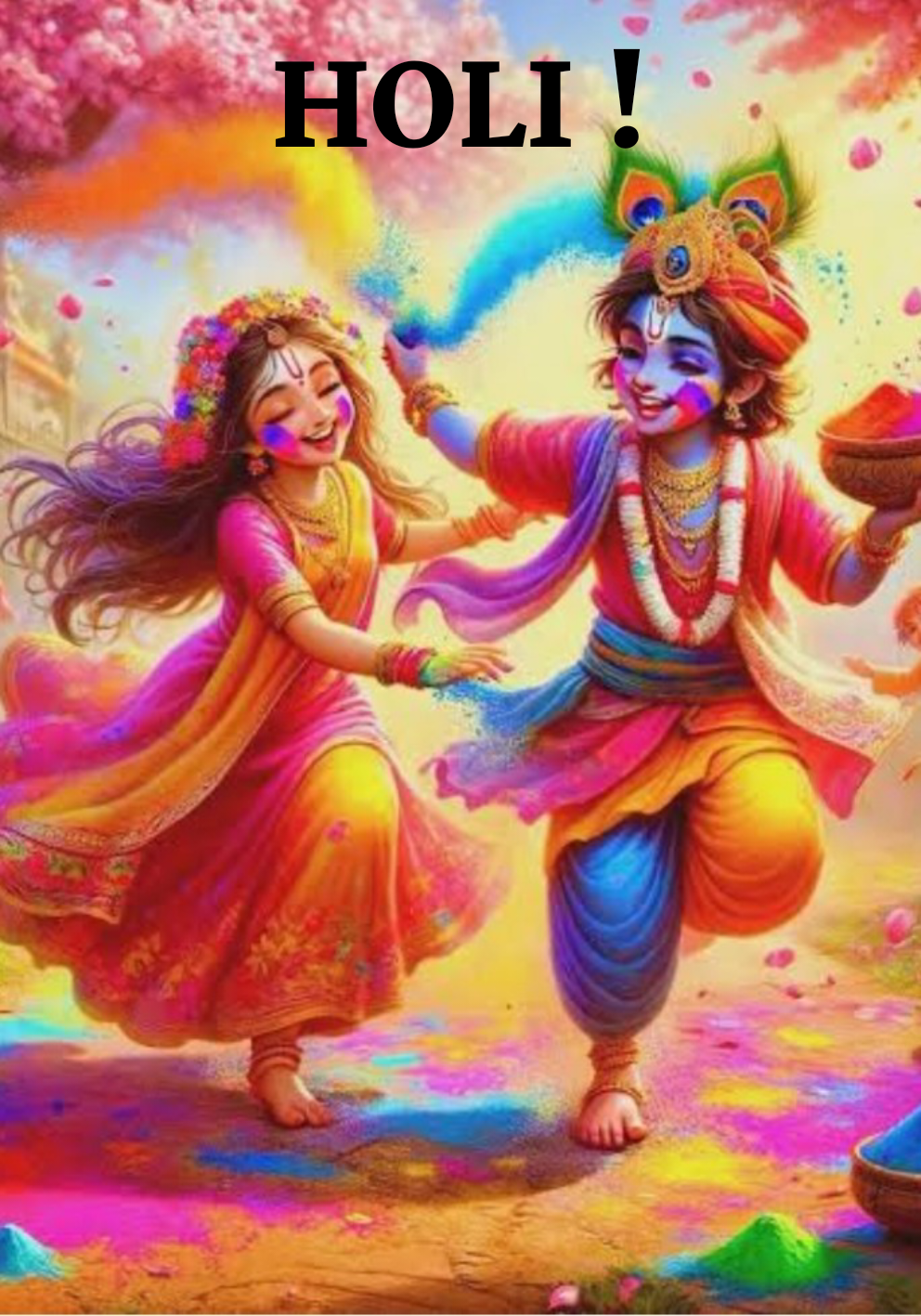
Holi is a popular and significant festival in India among Hindus. It is a festival of Love , Spring and colours . It celebrates the divine love of Lord Radha and Krishna. Additionally, the day also signifies the triumph of good over evil ,as it commemorates the victory of Lord Vishnu and Narasimha Narayana over Hiranyakashipu . Holi is originated and it is predominantly celebrated in Indian Subcontinent but has also spread to other Asian and Western parts of the world . Holi also celebrates the arrival of Spring in India, The end of winter and the blossoming of Love .It is also an invocation for a good Spring Harvest Season .It lasts for a day and a night starting in the evening on Full Moon Day
( Purnima ) falling in Hindu calender in the month of Phalguna which falls in the middle of March in Gregorian calender
History of Holi says that Holi is an ancient festival among Hindus
with its cultural rituals . Since time immemorial , this festival finds colours in numerous scriptures such as in works
like Jaimini ' s Purva Mimasa Sutras
and Kathaka Grhya Sutras with even detailed description in accient texts like
Narad Purana and Bhavishyad Purana .The festival of ' Holikosav ' was also mentioned in 7th century work , Ratnavali , by King Harsha .It is mentioned in Puranas , Dasakumara
Charita , and by the poet Kalidasa during the 1st century reign of Chandragupta The celebration of Holi is also mentioned in the 7th century of Sanskrit Drama Ratnavali . The festival of Holi caught the fascination of the European Traders and British Colonial staff by the 17th century .Various old edition of Oxford English Dictionary mention it
but with varying , phonetically derived spellings ' Houly ' (1687),' Hooly ( 1698)
' Huli ' ( 1789) ' , Hohlee ' ( 1809 ) , Hoolee (1925 ) and Holi in editions
published after 1910 .
Mythology says that in Braj region of India where the deities Radha and Krishna grew up , the festival is celebrated until Rang Panchmi in commemoration of their devine love for each other . The festivities officially usher in Spring with Holi celebrated with love . Garga Samhita a puranic work by sage Garga was the first literature to mention the Romantic Discription of Radha and Krishna playing Holi .There is also a popular simbolic legend behind the festival . In his Youth , Krishna despaired weather fair skinned Radha would like him because of his dark skin colour . His mother Yashoda , tired of his desperation ask him to approach Radha and ask her to colour his face in any colour , she wanted . This Radha did , and Radha and Krishna became couple
Ever since , the playful colouring of face between Radha and Krishna became a popular festival named Holi in India as Hindus follow the Hindu religion.
Some days before the festival , people start gathering wood and combustible material for the bonfire in park , community centres , near the temple or other open places .On the top of the pyre is an effigy to signify Holika ,who tricked Prahlad into fire . Inside homes people stock up on pigments ,food ,party drinks
and festive seasonal foods such as gujhiya, malpuas and mathri and other religional delicacies.
Holi celebrations start the night before Holi with the ritual of Holika Dahan where people gather and perform religious rituals in front of the bonfire and pray that their internal evils be destroyed ,the way Holika ,the sister of Demon King Hiranyakashipu ,was killed in the fire .On the eve of Holi , typically
at or after sunset , the pyre is lit to signify Holika Dahan .The ritual symbolises the victory of good over the evil .People gather around the fire to sing and dance
The next day is celebrated as Holi where people smear and drench each other's in colours .Water guns and water filled balloons are often used to play
and colour each other in Holi Colours and with anyone and in any place being considered fair game to colour . Groups also carry their Dhol ( Drums ) and other musical instruments going to place and place to dance and sing . Throughout the day people visit their families and friends .Foes come together to enjoy the celebration, foods and drinks . Traditionally , washable natural plant derived colours such as neem , dhak ,
kumkum and turmeric were used but water based commercial pigments are increasingly used nowdays .All the colours are used to celebrate Holi .
Every one in open areas such as streets and parks is a game but inside homes or doorways only dry powder is used to smear at someone ' s face . People throw colours and get their targets completelly coloured up. It is like a water fight but with coloured water People take delight by spraying coloured water on each other. By late morning, everyone lookslike a canvas of colours. This is why Holi is given the name "Festival of Colours".Groups sing and dance, some playing drums and dholak. After each stop of fun and playwith colours people offer gujiya, mathri, malpuas and other traditional delicacies such as Cold drinks, including drinks made withmarijuana and are also part of the Holi festivity.
After a day of play with colours, people clean up, wash and bathe, sober up and dress up and in the evening and greet friends and relatives by visiting them and exchanging sweets. Holi isalso a festival of forgiveness and new starts, which ritually aims to generate harmony in society. Many cities in Uttar Pradesh also organise Kavi Sammelan in the evening.
There are several cultural rituals associated with Holi. In the Braj region around Mathura, in north India, the festivities may last more than a week. The rituals go beyond playing with colours, and include a day where men go around with shields and women have the right to playfully beat them on their shields with sticks. It is known as Lathmar Holi, traditionally celebrated in the Barsana. Barsana is the hometown of goddess Radha and there women assume the role of gopikas (Radha's friends) and men as gopas (Krishna's friends).
In southern India, some worship and make offerings to Kamadeva, the god of lust in Indian mythology.
In Bihar, Eastern Uttar Pradesh and Jharkhand , Holi is known as Phaguwa or Fagua in the Bhojpuri language. In this region as well, the legend of Holika is prevalent. On the eve of Phalgun Poornima, people light bonfires. They put dried cow dung cakes, wood of the Araad or Redi tree and Holika tree, grains from the fresh harvest and unwanted wood leaves in the bonfire. At the time of Holika people assemble near the pyre. The eldest member of the gathering or a purohit initiates the lighting. He then smears others with colour as a mark of greeting. Next day the festival is celebrated with colours and a lot of frolic. Traditionally, people also clean their houses to mark the festival.
Holi Milan is also observed in Bihar, where family members and well-wishers visit each other's family, apply colours (abeer) on each other's faces, and on feet, if elderly. Usually, this takes place on the evening of Holi, day after Holi with wet colours is played in the morning through the afternoon. Due to large-scale internal migration issues faced by the people, recently, this tradition has slowly begun to transform, and it is common to have Holi Milan on an entirely different day either before or after the actual day of Holi.
Children and youths take extreme delight in the festival. Though the festival is usually celebrated with colours, in some places, people also enjoy celebrating Holi with water solutions of mud or clay. Folk songs are sung at high pitch and people dance to the sound of the dholak (a two-headed hand-drum) and the spirit of Holi. Intoxicating bhang, made from cannabis, milk and spices, is consumed with a variety of mouth-watering delicacies .such as pakoras and thandai, to enhance the mood of the festival.
In the Kanpur area, Holi lasts seven days with colour. On the last day, a grand fair called Ganga Mela or the Holi Mela is celebrated. This Mela (fair) was started by freedom fighters who fought British rule in the First Indian War of Independence in 1857 under the leadership of Nana Saheb. The Mela is held at various ghats along the banks of the River Ganga in Kanpur, to celebrate the Hindus and Muslims who together resisted the British forces in the city in 1857. On the eve of Ganga Mela, all government offices, shops, and courts generally remain closed. The Ganga Mela marks the official end of "The Festival of Colours" or Holi in Kanpur.
In Gorakhpur, the northeast district of Uttar Pradesh, the day of Holi starts with a special puja. This day, called "Holi Milan", is considered to be the most colourful day of the year, promoting brotherhood among the people. People visit every house and sing Holi songs and express their gratitude by applying coloured powder (Abeer).
In Goa Holi is locally called Ukkuli in Konkani. It is celebrated around the Konkani temple called Gosripuram temple. It is a part of the Goan or Konkani spring festival known as Śigmo in Koṅkaṇī or Śiśirotsava, which lasts for about a month. The colour festival or Holi is a part of longer, more extensive spring festival celebrations. Holi festivities (but not Śigmo festivities) include: Holika Puja and Dahan, Dhulvad or Dhuli vandan, Haldune or offering yellow and saffron colour or Gulal to the deity.
In Gujrat , Holi is a two-day festival. On the evening of the first day, a bonfire is lit and raw coconut and corn is offered to the fire. The second day is the festival of colour or "Dhuleti", celebrated by sprinkling coloured water and applying colours to each other. Dwarka, a coastal city of Gujarat, celebrates Holi at the Dwarkadhish temple with citywide music festivities.Holi marks the agricultural season of the rabi crop.
In some places, there is a custom in undivided Hindu families that the woman beats her brother-in-law with a sari rolled up into a rope in a mock rage and tries to drench him with colours, and in turn, the brother-in-law brings sweets (Indian desserts) to her in the evening.
Holi celebrations are much in line with the general definition of Holi celebrations: a high-spirited festival to mark the beginning of the harvesting of the summer crop, with the throwing of coloured water and powder and singing and dancing.
In Karnataka, Traditionally, in rural Karnataka, children collect money and wood in the weeks prior to Holi, and on "Kamadahana" night, all the wood is put together and lit. The festival is celebrated for two days. People in northern parts of Karnataka prepare special food on this day.
In Maharashtra, Holi Purnima is also celebrated as Shimga, festivities that last five to seven days. A week before the festival, youngsters go around the community, collecting firewood and money. On the day of Shimga, the firewood is heaped into a huge pile in each neighbourhood. In the evening, the fire is lit. Every household brings a meal and dessert, in the honour of the fire god. Puran Poli is the main delicacy and children shout "Holi re Holi puranachi poli". Shimga celebrates the elimination of all evil. The colour celebrations here take place on the day of Rang Panchami, five days after Shimga. During this festival, people are supposed to forget and forgive any rivalries and start new healthy relations with all.
Manipuris celebrate Holi for 6 days. Here, this holiday merges with the festival of Yaosang.Traditionally, the festival commences with the burning of a thatched hut of hay and twigs. Young children go from house to house to collect money, locally known as nakadeng (or nakatheng), as gifts on the first two days. The youths at night perform a group folk dance called Thabal chongba on the full moon night of Lamta (Phalgun), traditionally accompanied by folk songs and rhythmic beats of the indigenous drum, but nowadays by modern bands and fluorescent lamps. In Krishna temples
devotees sing devotional songs, perform dances and celebrate with aber (gulal) wearing traditional white and yellow turbans. On the last day of the festival, large processions are taken out to the main Krishna temple near Imphal where several cultural activities are held. In recent decades, Yaosang is a type of Indian sport, has become common in many places of the valley, where people of all ages come out to participate in a number of sports that are somewhat altered for the holiday.
In Odisha people of Odisha celebrate Dola or Pushpadola on the day of Holi where the icons of Jagannath replace the icons of Krishna and Radha.Dola Melana, processions of the deities are celebrated in villages and bhoga is offered to the deities. "Dola yatra" was prevalent even before 1560 much before Holi was started where the idols of Jagannath, Balabhadra and Subhadra used to be taken to the "Dolamandapa" (podium in Jagannath temple).People used to offer natural colours known as "abira" to the deities and apply on each other's feet .
the eight days preceding Holi are known as luhatak.Sekhon (2000) states that people start throwing colours many days before Holi.
In Punjab , Holi is preceded by Holika Dahan the night before when a fire is lit. Historically, the Lubana community of Punjab celebrated holi "with great pomp and show. The Lubanas buried a pice and betel nut. They heaped up cow-dung cakes over the spot and made a large fire. When the fire had burnt out, they proceeded to hunt for the pice and betel-nut. Whosoever found these, was considered very lucky." Elsewhere in Punjab, Holi was also associated with making fools of others. Bose writing in Cultural Anthropology: And Other Essays in 1929 noted that "the custom of playing Holi-fools is prevalent in Punjab".
On the day of Holi, people engage in throwing colours on people engage in throwing colour on each other. For locals, Holi marks the end of winter. The Punjabi saying Phaggan phal laggan (Phagun is the month for fructifying) exemplifies the seasonal aspect of Holi. Trees and plants start blossoming from the day of Basant and start bearing fruit by Holi.During Holi in Punjab, walls and courtyards of rural houses are enhanced with drawings and paintings similar to rangoli in South India, mandana in Rajasthan, and rural arts in other parts of India. This art is known as chowk-poorana or chowkpurana in Punjab and is given shape by the peasant women of the state. In courtyards, this art is drawn using a piece of cloth. The art includes drawing tree motifs, flowers, ferns, creepers, plants, peacocks, palanquins, geometric patterns along with vertical, horizontal and oblique lines. These arts add to the festive atmosphere.Folk theatrical performances known as swang or nautanki take place during Holi,with the latter originating in the Punjab.According to Self (1993), Holi fairs are held in the Punjab which may go on for many days.Bose (1961) states that "in some parts of Punjab, Holi is celebrated with wrestling matches".
In Tamil Nadu, it is celebrated as the Panguni Uthiram festival that signifies the blossoming of love and marriage. Rati and Kamadeva are worshipped in many parts. Temples also celebrate the marriages of Parvati and Parameswara, Murugan and Deivanai, Kodhai Aandaal and Rangamannar on this day. In the Sarangapani temple in Kumbakonam, Narayana marries Komalavalli Naachiyar and gave Kalyana Kola Seva to his Bhakthas on this day. Valmiki's Ramayana says it is on this day that Sita's marriage with Rama was celebrated. Devotees throng to temples to witness the divine wedding ceremonies. It is also an auspicious date for engagements and weddings to finalise. From Brahmanda Puranam, it is said that on this Panguni Uthiram, all holy waters join the seven sacred tanks in Tirupati Tirumala.
In Telengana, Holi is called as Kamuni Punnami/Kama Purnima or Jajiri in Telugu. Hindus celebrate Holi as it relates to the legend of Kamadeva. Holi is also known by different names: Kamavilas, Kamuni Panduga and Kama-Dahanam.It is a 10-day festival in Telangana, of which last two days are of great importance. As in other parts of India, in rural Telangana, the 9 days preceding Holi, children celebrate kamuda by playing Kolata sticks along with singing folk songs called jajiri and collect money, rice, corn and wood.[30] For this reason Holi is well known for "Jajiri Paatalu Kamudi aatalu", which means festival of "Jajiri songs and Kamudi games" and on 9th night i.e. Holy eve, all the wood is put together and set on fire representing Kama Dahanam.Next morning i.e. 10th day is celebrated as Holi, with colours traditionally extracted from Moduga/Gogu Flowers (Palash/Butea monosperma )
In Tripura , Holi is known as "Pali" which means colour in Tripuri language, it's celebrated all over Tripura.
In Western Uttar Pradesh, the Braj region of North India, women have the option to playfully hit men who save themselves with shields; for the day, men are culturally expected to accept whatever women dish out to them. This ritual is called Lath Mar Holi. Barsanana , a town near Mathura in the Braj region of Uttar Pradesh, celebrates Lathmar Holi in the sprawling compound of the Radha Rani temple. Thousands gather to witness the Lath Mar Holi when women beat up men with sticks as those on the sidelines become hysterical, sing Holi songs and shout "Radhe Radhe" or "Sri Radhe Krishna". The Holi songs of Braj Mandal are sung in pure Braj, the local language. Holi celebrated at Barsana is unique in the sense that here women chase men away with sticks. Males also sing provocative songs in a bid to invite the attention of women. Women then go on the offensive anduse long staves called lathis to beat the men, who protect themselves with shields.
Mathura, in the Braj region, is the birthplace of Krishna. In Vrindavan this day is celebrated with special puja and the traditional custom of worshipping Radha Krishna; here the festival lasts for sixteen days. All over the Braj region and neighbouring places like Hathras, Aligarh, and Agra, Holi is celebrated in more or less the same way as in Mathura, Vrindavan and Barsana.
A traditional celebration includes Matki Phod, similar to Dahi Handi in Maharashtra and Gujarat during Krishna Janmashtami, both in the memory of god Krishna who is also called makhan chor (literally, butter thief). This is a historic tradition of the Braj region as well as the western region of India. An earthen pot filled with butter or other milk products is hung high by a rope. Groups of boys and men climb on each other's shoulders to form pyramids to reach and break it, while girls and women sing songs and throw coloured water on the pyramid to distract them and make their job harder. This ritual sport continues in Hindu diaspora communities.
In Uttarakhand , Holi in Uttarakhand includes a musical affair. It takes different forms such as the Baithki Holi, the Khari Holi and the Mahila Holi. In Baithki Holi and Khari Holi, people sing songs with a touch of melody, fun, and spiritualism. These songs are essentially based on classical ragas. Baithki Holi is also known as Nirvan Ki Holi, begins from the premises of temples, where Holiyars sing Holi songs and people gather to participate, along with playing classical music. The songs are sung in a particular sequence depending on the time of day; for instance, at noon the songs are based on Peelu, Bhimpalasi and Sarang ragas, while evening songs are based on the ragas such as Kalyan, Shyamkalyan and Yaman. The Khari Holi (खडis mostly celebrated in the rural areas of Kumaon. The songs of the Khari Holi are sung by the people, who, sporting traditional white churidar payajama and kurta, dance in groups to the tune of ethnic musical instruments such as the dhol and hurka. In the Kumaon region, the Holika pyre, known as Cheer , is ceremonially built in a ceremony known as Cheer Bandhan fifteen days before Dulhendi. The Cheer is a bonfire with a green Paiya tree branch in the middle. The Cheer of every village and neighbourhood is rigorously guarded as rival mohallas try to playfully steal each other's cheer.
The colours used on Holi are derived from natural sources. Dulhendi, known as Charadi (from Chharad , is made from flower extracts, ash and water. Holi is celebrated with great gusto much in the same way all across North India.
In West Bengal , Holi is known by the name of "Dol Jatra", "Dol Purnima" or the "Swing Festival". In Shantiniketan, West Bengal, Holi is known as “Basanta Utsav”. The festival is celebrated in a dignified manner by placing the icons of Radha and Krishna on a picturesquely decorated palanquin which is then taken round the main streets of the city or the village. On the Dol Purnima day in the early morning, students (mainly in Shantiniketan) dress up in saffron-coloured or pure white clothes and wear garlands of fragrant flowers. They sing and dance to the accompaniment of musical instruments, such as the ektara, dubri, and veena. The devotees take turns to swing them while women dance around the swing and sing songs. During these activities, the people keep throwing coloured water and dry colours, abir, at them.
Around 500 years ago, Sri Chaitanya Mahaprabhu went to Vrindaban in present day Uttar Pradesh to witness the festival there at the birthplace of Lord Sri Krishna. After his return to Bengal, he thought of starting the festival here. So he asked his followers to smear color or abir to Lord Krishna's idol and then put that abir on each other. He also instructed them to give the other person a treat with a local sweet called malpoa. The biographies of Sri Chaitanya say that he was very fond of this sweet.
The colours used on Holi are derived from natural sources. Dulhendi, known as Charadi (छरड़ी) (from Chharad (छरड़)), is made from flower extracts, ash and water. Holi is celebrated with great gusto much in the same way all across North India
Flowers of Dhak or Palash are used to make traditional colours. The spring season in which the weather changes is believed to cause viral fever and cold .The playful throwing of colours called 'gulal ' has a medical significance .The colours are traditionally made of neem , Kumkum , Haldi and Bilvia and other medicinal herbs are suggested by aurvedic doctors . Many colours are obtained by mixing primary colours. Artisans produce and sell many of the colours from natural sources in dry powder form , in weeks and months preceding Holi . Some of the traditional natural plant - based sources of colours are Red and Orange .The flowers of Palash or Tesu tree are also called the flame of the forest and are typical source of bright red and deep orange colours . Powdered fragrance of sandalwood , dried hibiscus flowers , madder tree , raddish and pomegranateare alternate sources and different shades of red . Mixing lime and turmeric powder creates an alternate source of orange powder .
Green colour is made of Mehendi and dried leaves of Gulmohar tree offer a source of green colour . In some areas the leaves of spring crops and herbs have been used as a source of green pigment.
Turmeric powder is used to make yellow colour . Sometimes it is mixed with chickpea or other flour to get the right shade .Bael fruit , Amaltas ,species of marigold are the alternate sources of yellow colour
Indigo plant , Indian berries , species of grapes , blue hibiscus and Jakaranda flowers are the traditional source of blue colour at Holi .
Dried tea leaves offer a source of brown coloured water and certain clays are also a source of brown colour .
Species of grapes, fruits of gooseberry and Vegetable Carbon ( Charcoal) offer grey to black colour .