Library

 Profile
The Unyielding Thar: Beyond the Mirage of Western
The Unyielding Thar: Beyond the Mirage of Western

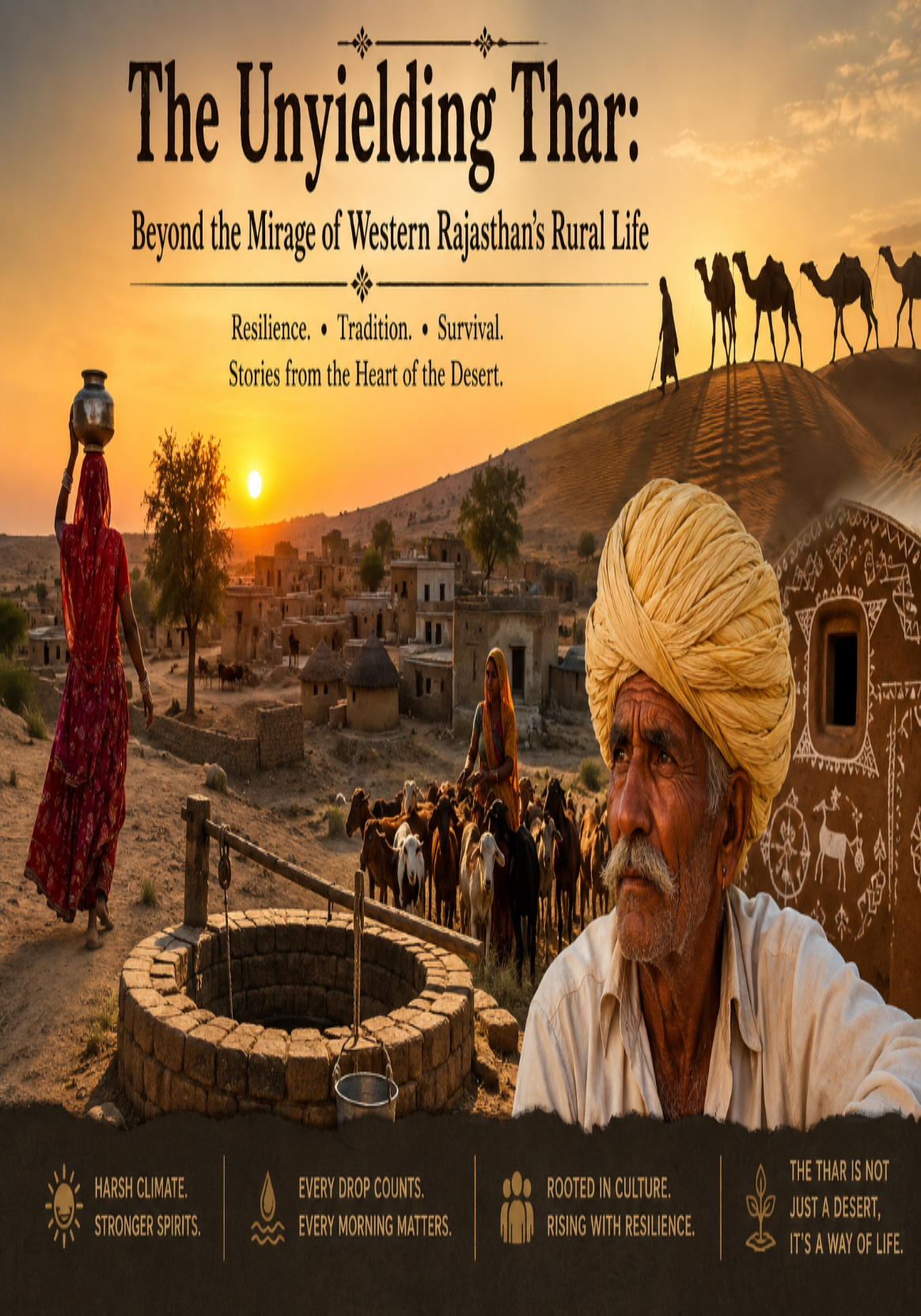
The Unyielding Thar: Beyond the Mirage of Western Rajasthan’s Rural Life To the outsider, Western Rajasthan is often a cinematic montage: endless dunes, majestic forts, and men with magnificent mustaches singing soulful melodies under a starlit sky. But strip away the romantic filters of tourism, and you arrive at the raw, pulsing heart of the Marwar, Bikaner, and Jaisalmer belts. Here, rural life is not a performance; it is a masterclass in human endurance. Life in the villages of the Thar Desert is a paradox. It is incredibly vibrant yet intensely brutal. To understand rural Western Rajasthan, one must look beyond the palaces and peer into the courtyards of mud-plastered dhani (hamlets), where every drop of water has a price, and every tradition has a purpose. The culture of Western Rajasthan was born out of a psychological rebellion against the barren, monochromatic landscape. When nature offers nothing but the pale yellow of sand and the faded green of thorny scrubs, human beings invent their own palette. This is why the women drape themselves in fluorescent odhnis of red, yellow, and magenta, and the men wear safas (turbans) that look like blooming flowers against the desert horizon. Tradition here is inextricably linked to the ecosystem. The veneration of the Khejri tree, for instance, is not mere superstition; it is ecological survival. The Bishnoi community’s centuries-old tenet of protecting wildlife—even sacrificing their lives to save trees, as Amrita Devi did in 1730—is a testament to a culture that understands that nature is the only real wealth. Music is the soul’s language in this arid land. The Manganiyars and Langas do not sing for entertainment; they sing to document history, to summon the monsoon clouds, and to find solace in the scorching heat. Their instruments—the Kamaicha and the Khartal—carry the echoes of centuries of joy and grief. Families operate in deeply knit, multi-generational systems. Hospitality is sacred; the adage "Padharo Mhare Desh" (Welcome to my land) is practiced with a fierce sense of honor, where a guest is offered the last cup of sweet tea even if the household is running out of milk. Yet, behind the vibrant veils and the welcoming smiles lies a relentless, exhausting struggle. The rural populace of Western Rajasthan fights battles that rarely make it to mainstream news. The Chronic Thirst: The most severe crisis is, unsurprisingly, water. Ground-water levels in districts like Barmer, Jalore, and Nagaur have plummeted to alarming depths. Worse, what little water remains is often heavily contaminated with fluoride and salinity, silently crippling entire generations with skeletal fluorosis and joint deformities. Women and young girls still walk miles in the unforgiving summer heat, balancing metal pots on their heads, paying with their physical health and lost educational opportunities just to keep their families hydrated. Agrarian Distress and Climate Extremes: Agriculture here is a gamble with the sky. Farmers rely entirely on the erratic monsoon to grow bajra (pearl millet), moth, and guar. In recent years, climate change has severely warped this fragile cycle. Prolonged droughts are now frequently punctuated by sudden, destructive unseasonal floods. When the crops fail, debt spirals. The Silent Migration: Stripped of reliable farming income, the youth of Western Rajasthan are leaving. There is a massive, quiet exodus of young men migrating to Gujarat, Maharashtra, and southern India to work as daily wage laborers, truck drivers, or helpers in textile and plywood factories. Villages are increasingly populated only by the elderly, women, and young children, fracturing the traditional joint family structure. The Fading of Artisans: The rural economy once thrived on handicrafts—intricate leatherwork, block printing, and weaving. Today, these artisans are being choked by industrialization and cheap, machine-made knock-offs. Middlemen eat the bulk of the profits, leaving the actual creators in abject poverty. If the desert is a cruel teacher, the people of Western Rajasthan are its most brilliant students. They do not merely survive; they adapt with an ingenuity forged by necessity. Their survival strategy begins with indigenous water management. Long before modern engineers spoke of rainwater harvesting, the villagers of the Thar were building Tankas—underground cisterns built in the courtyards of homes to catch and store every drop of monsoon rain. They utilize Khadins, traditional runoff farming systems that capture moisture in the soil, allowing crops to grow even in minimal rainfall. When agriculture fails, livestock becomes the ultimate safety net. Animal husbandry is the true backbone of the rural economy. Breeds native to the region—the Tharparkar cow, the Marwari sheep, and the hardy camel—are uniquely adapted to survive on little water and dry fodder. A family might lose their entire bajra crop to a drought, but the milk and wool from their herds keep starvation at bay. The diet itself is a marvel of survival science. The staples are foods that require minimal water to cook and can last for days without spoiling in the intense heat. Bajre ki roti, raw onions, garlic chutney, and the famous Ker Sangri (wild desert beans and berries) are not just culinary delicacies; they are nutrient-dense survival rations that provide immense energy and cooling properties to the body. Furthermore, there is a slow but steady integration of modern solutions. Solar panels are becoming a common sight atop mud houses, bringing electricity to off-grid dhanis. Women-led self-help groups (SHGs) are cutting out the middlemen, using social media and NGOs to sell their embroidery and handicrafts directly to conscious buyers, slowly taking back their financial independence. Rural Western Rajasthan is not a place for the faint-hearted. It is a landscape that demands everything from its people and gives very little in return. Yet, the people do not curse the sand; they build their homes upon it. To look at a farmer in Barmer looking up at a cloudless July sky, or to watch a woman in Jaisalmer meticulously embroider a piece of cloth by the light of a kerosene lamp, is to witness the sheer, unbreakable dignity of the human spirit. They are grappling with modern neglect, climate change, and economic marginalization, but they are doing so with their spines straight and their culture intact. They are like the Khejri tree—deep-rooted, weather-beaten, yet forever standing tall in the storm. Author Yuvraj Singh RathoreThe Rhythm of the Sands: Culture and Timeless Traditions
The Harsh Reality: Cracks in the Sun-Baked Earth
The Architecture of Survival: How Marwar Endures
A Legacy Carved in Sandstone