Library

 Profile

THE UNRATABLE MAN
THE UNRATABLE MAN

A Novel of Transactions, Detachment, and One Man's Search for Peace in a World That Demands ROI
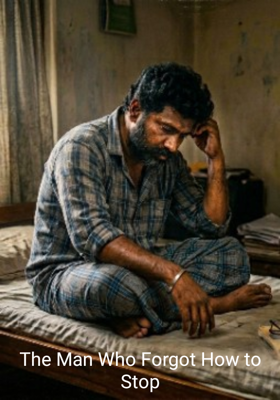
Chapter 1: The Silver PlateThe steel thali sat on the kitchen counter, polished to a mirror shine, holding three neatly folded one-thousand-rupee notes. Arjun Reddy stared at it—a ritual he had performed on the first of every month for the last fifteen years. His mother, Savitri, would emerge from the pooja room, take the notes without a word, and return to lighting the camphor.
Today, she didn't take it immediately. She looked at him with eyes that held calculation, not tenderness.
"Your sister's husband needs help with the down payment for the new flat. Thirty lakhs. You have the fixed deposit maturing next week."
Arjun didn't flinch. He had been waiting for this line, rehearsing it in his head for months. Instead of answering, he recalled a different moment—twenty-two years ago, 2004, when his batchmates at the engineering college in Warangal were obsessing over Infosys campus placements and US onsite opportunities.
"Arjun, why aren't you applying?" his friend Vikram had asked, practically vibrating with ambition. "The signing bonus alone is—"
"I don't want to go," Arjun had said, simply.
Vikram had looked at him as if he'd grown a second head. "You're turning down dollars? For what?"
"For home."
Arjun had stayed. He had watched his friends leave for Dallas, for Singapore, for London. He had watched them return with accents, with foreign wives, with houses in gated communities. He had watched them run the corporate hamster wheel, chasing promotions, chasing status, chasing women who demanded white weddings and designer bags.
He had stayed in Hyderabad. In the same three-bedroom house in Himayatnagar. In the same room where his father, Raghav, had taught him to balance a checkbook. Where his mother had scolded him for playing cricket instead of studying. Where the dust of sixty years of family history coated the ceiling fans.
And now, at forty-four, standing in front of that thali, he realized something with crystalline clarity:
They never asked me if I was happy. They only ever asked me for the money.
Chapter 2: The InterviewThree months earlier, Arjun had reluctantly agreed to an arranged marriage meeting.
Not because he wanted to marry—Ketu in his fifth house had killed that urge ages ago—but because his mother had threatened to stop eating. "You will leave me without seeing my grandchildren," she had wept. "What will I tell your father's ancestors?"
So he had showered, worn a crisp white kurta, and sat in the air-conditioned lobby of a Banjara Hills café across from Kavya, a thirty-two-year-old marketing professional, and her parents.
Kavya was beautiful. Not in a magazine way—in a practical, well-maintained, investment-grade way. Her nails were painted a muted pink. Her blazer cost at least eight thousand rupees. Her smile was calibrated, professional, and utterly devoid of warmth.
Her father, Mr. Sharma, didn't bother with pleasantries.
"Arjun, what is your annual CTC?"
Arjun blinked. "Around thirty-two lakhs."
"Hmm. Fixed or variable?"
"Fixed base is twenty-four. Rest is performance-linked."
"Properties?"
"An apartment in Gachibowli. Rented out. The family house here."
"EMIs?"
"None. Car paid off."
Mr. Sharma nodded, making invisible notes in his head. Kavya smiled approvingly.
Then Mr. Sharma leaned forward. "And what about dependents? Your parents? Any siblings?"
Arjun felt his throat tighten. "My father is retired. My sister is married. I support my parents entirely."
The temperature in the room dropped by five degrees. Kavya's smile flickered. Mr. Sharma's nostrils flared slightly.
"Entirely? Medical expenses? Lifestyle?"
"Everything. They don't have independent income."
Kavya exchanged a glance with her mother. That glance said everything: High liability. Diminishing ROI. Hard pass.
The rest of the meeting was a formality. They asked him about his hobbies—he said "reading philosophy and tending to my terrace garden." They asked him about his future plans—he said "I want to stay in Hyderabad, near my parents." Each answer seemed to inch the "Reject" stamp closer to his file.
As he walked out, Kavya's mother didn't even shake his hand. She was already on her phone, dialing the next prospect.
Arjun didn't feel angry. He didn't feel sad. He felt something far worse: seen as a product, not a person.
Chapter 3: The ATM in the Living RoomThe transaction with the thali wasn't new. It was the architecture of his existence.
Every month, his mother would take the money and mentally allocate it:
₹15,000 for the cook and maid.
₹10,000 for groceries.
₹5,000 for electricity and water.
₹8,000 for medicines.
The rest—whatever was left—would disappear into a separate "emergency" fund that she controlled but never told him about.
When he had earned ₹30,000 a month fresh out of college, they had managed. Now at ₹2.6 lakhs net per month, they managed. It was never enough. There was always more—distant cousin's wedding, new refrigerator for the kitchen, a pilgrimage to Tirupati that required first-class tickets because "your father's knees can't handle general compartment."
His father, Raghav, sat in his armchair every evening, reading the newspaper, occasionally looking up to say, "The price of gold is rising. You should invest."
Not "How was your day, son?"
Not "Your eyes look tired. Did you sleep well?"
Gold. Futures. Fixed deposits. That was their love language.
One evening, Arjun had sat down beside his father and said, "Papa, I turned down an onsite opportunity in 2007. Did you know that?"
Raghav lowered the newspaper. "Why would you do that? Ambition is—"
"I stayed because you both needed me. Amma's health was fragile. Your pension wasn't enough. I gave up my own path."
Raghav stared at him for a long moment. Arjun waited for a thank you, a hug, perhaps just a softening of those stern eyes.
Instead, Raghav said, "Well, you're here now. So give the money to your mother."
Arjun stood up. Walked to his room. Shut the door. And for the first time in fifteen years, he did not cry. He simply stared at the ceiling, realizing that he had become a noun—the provider—and ceased to be a verb—the person who feels, who dreams, who hurts.
Chapter 4: The Old Soul's DiagnosisA week later, Arjun found himself in the clinic of Dr. Ananth Shastri—half-psychologist, half-astrologer, a strange hybrid that only India could produce.
The room smelled of sandalwood and old books. Dr. Ananth was seventy-two, with silver hair that cascaded over his shoulders like a Vedic sage. He had a degree from NIMHANS but also a jathakam (horoscope) collection that spanned three generations.
Arjun didn't believe in astrology. But he believed in explanations—and his life needed one.
Dr. Ananth listened for forty minutes without interrupting. He heard about the thali, the arranged marriage rejection, the father's coldness, the forty-four years of solitude. He heard about the lack of attraction to women, the lack of greed for money, the visceral rejection of "onsite" culture.
Then he pulled out a dusty palm-leaf chart and began to calculate.
"December 28, 1981. 21:00 hours. Hyderabad. Latitude 17°22'N, Longitude 78°28'E."
He drew circles. He muttered Sanskrit verses under his breath. Then he leaned back and looked at Arjun with deep, profound recognition.
"Arjun, do you know what your Ascendant is?"
"Cancer?"
"Correct. Karka Lagna. The Crab. You were born to caretake, not to conquer. Cancer is the mother of the zodiac. It builds nests. It clings to roots. Of course you refused to go abroad—your soul perceives uprooting as death. You didn't lack ambition. You had a different ambition: continuity, stability, emotional sanctuary."
Arjun felt a lump in his throat. No one had ever framed it that way.
"And look here," Dr. Ananth continued, "Saturn, Jupiter, and Mars—all three—in your Fourth House of mother and homeland. Saturn is exalted here. You have the stamina of ten men when it comes to family duty. But exalted Saturn does not give emotional reciprocation. It gives karmic weight. You are the bullock pulling the cart. The cart does not thank the bullock, Arjun. It simply moves."
"But why don't I feel romantic attraction? Why did I never chase women like other boys?" Arjun asked, his voice cracking.
Dr. Ananth smiled knowingly. He pointed to the fifth house. "Because you have Ketu sitting there. The South Node. The planet of detachment and past-life exhaustion. This life is not about romance for you, my boy. You have already done that in previous births. Here, your soul is doing Moksha—liberation through selfless karma."
"And money? Why does it disgust me?"
"Rahu in the Eleventh House of gains. The North Node. For most, Rahu creates ravenous greed. But Rahu is a trickster—it gives the opposite to those who have surrendered to the divine. You see money not as freedom, but as a cage. You are not disillusioned; you are illumined. You see the paper for what it is—anxiety manifested."
Arjun sat in stunned silence.
Then he asked the question that had haunted him since the café with Kavya. "So women who filter men by money... are they wrong? Am I wrong to feel like an ATM?"
Dr. Ananth's face grew serious. "They are not wrong, Arjun. They are surviving. Indian middle-class women have been kept out of the workforce for generations. When they marry, they are expected to relocate, pause careers, bear children, and take on unpaid domestic labor. For them, choosing a 'settled' man is not greed—it is risk mitigation. They are buying insurance against divorce, inflation, and their own vulnerability."
Arjun interrupted. "Then why complain about character? They choose the wallet, then cry when the wallet doesn't hold their heart."
"Because they are human," Dr. Ananth said softly. "They filter for survival first. Then they discover that survival is not living. Their complaint is not hypocrisy—it is cognitive dissonance. They hired a CFO, but they wanted a soulmate. And the CFO—often a man like you, exhausted by duty, starved of affection—cannot give what was never asked for in the first place."
"And the man with family responsibilities? The dutiful son? He gets filtered out in the first round."
"Yes. Because he carries a 25-kilogram backpack while the 'settled, childless' bachelor carries only 10. She does not reject his character. She rejects his weight. It is arithmetic, not malice. But arithmetic, when applied to human souls, breaks us."
Chapter 5: The Matrix of TransactionsDr. Ananth poured two cups of ginger tea. The evening light slanted through the window, illuminating dust motes that danced like forgotten prayers.
"Let me tell you the most painful truth, Arjun. Every relationship is transactional. Even your mother's love—she gives you care in exchange for security. She does not know how to love without utility. It is the trauma of poverty. She watched her own mother struggle. She passed that trauma to you in the only language she knew: 'Provide, or we perish.'"
Arjun felt a tear slide down his cheek. He didn't wipe it away.
"What if I get sick? What if I lose my job and cannot provide? Will they leave me?"
Dr. Ananth shook his head. "That is where you misunderstand the nature of bonds. The initial contract is financial. But if you build emotional wealth during the good years—shared jokes, vulnerabilities, acts of service—the contract evolves. After fifteen years, leaving you would cost her more than any bank balance. She would have to erase fifteen years of her own identity. That is the glue, Arjun. Not unconditionality—mutual entwinement."
"But I am not married. I have no one."
"You have yourself. And the stars. And a duty that you chose, not one that was forced upon you."
Arjun looked down at his hands—calloused from gardening, but steady. "How do I stop feeling like a victim?"
Dr. Ananth leaned forward. "You automate the transaction. You decide what you can give—fixed, monthly, no negotiation. You automate the transfer. And when they ask for more, you say: 'This is what I can give. The rest is for my peace.' You do not Justify, Argue, Defend, or Explain. You simply state. When you treat the money as a mechanical duty, not an emotional negotiation, you reclaim your personhood."
"And if they guilt-trip me?"
"Then you ask them the question they have never been asked: 'When was the last time you asked me if I am happy?' You will break their conditioning, Arjun. They will not answer. But the question will echo in their souls. That echo is the beginning of change."
Chapter 6: The Lion at the Dinner TableArjun returned home that night with a strange calm.
The next morning, he sat his parents down at the dining table. For the first time in his life, he was not asking their permission. He was informing.
"Ammma, Appa, listen carefully. I will transfer ₹55,000 to your account on the first of every month. That is the rent from the Gachibowli property plus a fixed contribution from my salary. It covers the cook, the maid, groceries, medicines, and utilities—generously."
Savitri opened her mouth to protest. He held up his hand.
"The rest of my income is mine. I will not discuss it. I will not justify it. If my sister needs money, she calls me directly, and I will decide as her brother—not as your ATM."
Raghav's face turned purple. "You cannot—we raised you—you owe us—"
Arjun looked at his father. His voice was steady, but his heart was breaking.
"Appa, I turned down a $120,000 onsite package in 2007. I stayed. I stayed when my friends were buying BMWs and I was paying for your angioplasty. I stayed when Amma needed daily physiotherapy and no one else would stay with her. I stayed when the world told me to leave. And in fifteen years, neither of you has asked me if I am happy."
The silence was deafening.
Savitri's eyes filled with tears—not of guilt, but of confusion. She literally did not understand the question. Happy? What did happiness have to do with family?
Arjun didn't wait for an answer. He stood up, kissed his mother's forehead (she flinched, unused to affection), and walked to his terrace.
He looked at his garden—the cherry tomatoes ripening, the basil lush and green, the marigolds bursting orange.
He was forty-four. Single. Financially secure but not rich. Dutiful but not enslaved.
And for the first time, he felt free.
Epilogue: The Unshakable RockFive years passed.
Arjun was forty-nine now. His father had mellowed—age had softened the stern patriarch into a quiet old man who, on rare evenings, asked about the garden. His mother still fussed about money, but the monthly automation had become a silent rhythm, like a heartbeat they all accepted.
Arjun never married. He stopped attending matrimonial meetings. He learned to enjoy the quiet—the morning tea, the Bhagavad Gita recitations on YouTube, the long walks at KBR Park where he watched couples argue and children laugh and felt not envy but equanimity.
He had become the unshakable rock Dr. Ananth had prophesied.
One evening, as he watered his marigolds, his sister Priya called. She was crying. Her husband's business had collapsed. Debts were mounting. She was afraid.
Arjun listened. Then he said, "I will help. But I will transfer the money to your account, not your husband's. And you will visit home more often. Not to ask for more—but to sit with Amma. To talk. To remind her that I am a son, not a stock option."
Priya wept with gratitude. But Arjun understood something deeper that night:
The fundamental need of love is transactional—but not in the way society means it.
The transaction is: I give you my time, my attention, my vulnerability, and in return, you give me yours. Money is just the scaffolding. The building is made of shared memory.
He had spent forty-four years being treated like an ATM. But he had stopped being a passive ATM. He had become the manager of his own capital—emotional and financial.
He didn't need a woman to choose him for his character. He had chosen himself.
He didn't need his parents to see him as a person. He knew his own humanity—flawed, tired, but fiercely intact.
And in that knowing, he found the only ROI that ever mattered: peace.
The End
Author's Note: This story is dedicated to every man and woman who has felt reduced to a number, a salary slip, or a womb. The system is broken, but you are not. You are a person. Act like it. Demand to be seen. And if they cannot see you—see yourself.