Library

 Profile
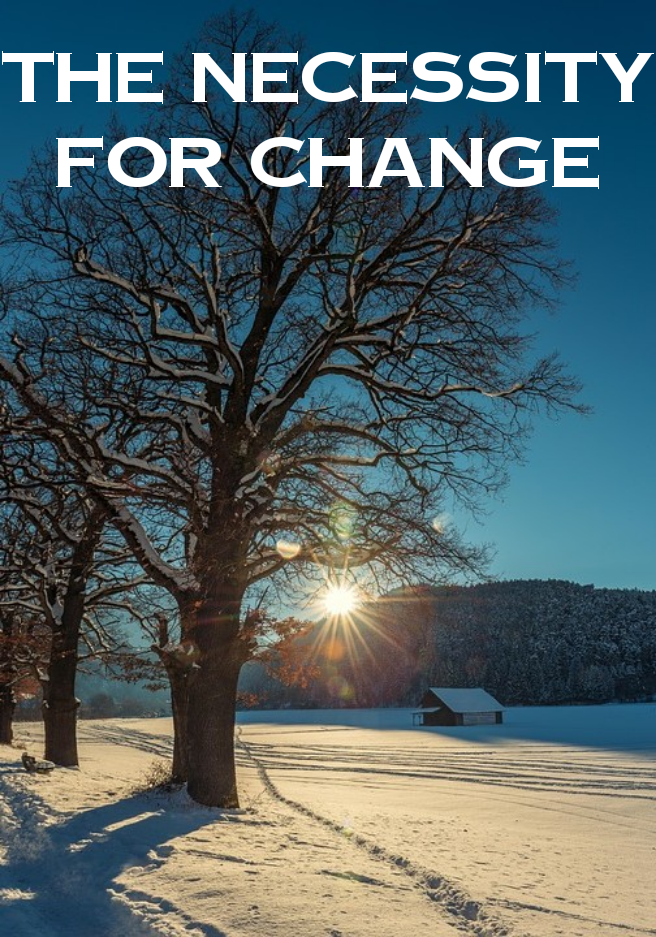
The Necessity For Change
The Necessity For Change

Change is the law of life. Stagnation is death. Carlyle said, “Today is not yesterday; we ourselves change; how can our Works and Thoughts if they are always to be the fittest, continue always the same? Change indeed is painful, yet needful.” That is the great lesson we learn from history. And yet man does not really learn the lesson. He dislikes change and likes to cling to the old order and to oppose the new. He is afraid of change. He is nervous lest he finds his security gone, the stability of his life endangered. Change therefore comes, inevitably but not easily, not without opposition; it has to establish itself against the interest of the existing order. In many cases, this is simply the result of a blind fear, a nervous dread of the unknown.
The poet Tennyson, when he said that “the old order changeth yielding place to new,” completed his statement by adding that “one good custom may corrupt the world.” The paradox is significant. A custom, however good, loses its vitality, its inner justification, - the sole reason of its existence, - by becoming unsuited to the changed surroundings and circumstances. Just as flowing water is wholesome, and stagnant water is poisonous, so is it with a custom. Only when it flows through changes it is refreshing and recreative.
The reason for this is obvious. The material world is perpetually changing, its conditions are not and can never be made stationary. Hence human beings also must change in order to remain in harmony with the material world. If this change is resisted, it leads to social disintegration and decay. Decadence in life and in literature is the direct result of this refusal to change in conformity with time.
Change in response to changing material conditions of life is the cause of all progress.
“The world has been harsh and strange;
Something is wrong: there needeth a change.”
If the wrong is to be righted, then the conditions responsible for the wrong must be altered in a suitable manner. Recognition of this gives rise to optimism which is the philosophy of hope and the cause of all progress. Refusal to recognize this is pessimism, a belief that all change is from bad to worse. If we hope that the future will correct the evils of society, we will have the energy to work for that future, the courage to believe that the world moves from beauty to beauty. That is the law of evolution, which Keats poetically expressed in his Hyperion:-
“On our heels, a fresh perfection treads.
A power more strong in beauty, born of us
And fated to excel us.”
And so we must cultivate the spirit of optimism, a feeling of hope in the future that is to come. We must put ourselves in harmony with “the mighty stream of tendency”, the gigantic forces of evolution, which, correctly measured and organized, will make Browning’s hope, that man will be a god, not poetic imagination, but a fact of reality. We must give up the dread of a future that is yet unknown, and the attitude of conservatism. In the light of Tennyson’s affirmation, conservatism is a sin, because it denies the progress that underlies the history of mankind. Let us not deny our superiority in knowledge and power over our ancestors, and let us also not be blind to the fact that our duty lies in smoothing the path of change in human affairs for the benefit of generations unborn. It is not for nothing that the barbarian of yesterday is the god-like being of today; that the blind seeker after truth who blundered ineptly through a hostile world is today the master of his destiny.
“Not in vain the distance beacons; Forward, forward
let us range;
Let the great world spin for ever down the ringing grooves of change.”