Library

 Profile
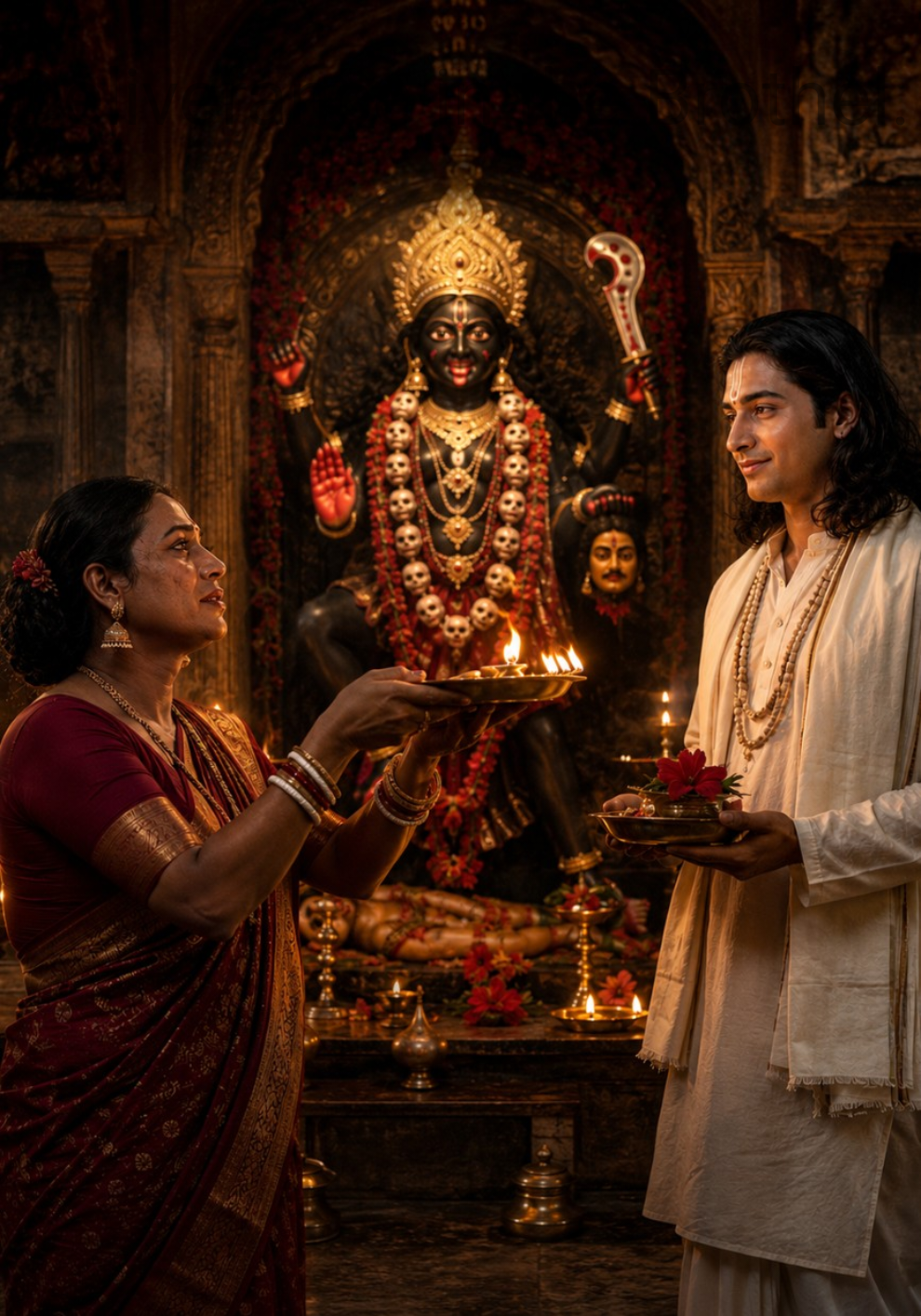
Deliverance in the Brothel.
Deliverance in the Brothel.

In the secluded bower on the banks of the Yamuna, the sweet, divine love-tryst of Radha and Krishna was unfolding. The witnesses to this moment were the distant stars in the night sky, the graceful moon, and the companions standing at the hidden entrance of the bower with beautiful, enchanted smiles. At that very moment, upon the sudden and furious arrival of Ayan Ghosh, Lord Krishna assumed the form of 'Ratanti Kali' to protect the honor of His devotee. In place of the enchanting flute, a scimitar graced His hand; instead of the Vaijayanti garland, His neck was adorned with a necklace of severed heads. The deep darkness of the bower lit up in an instant with the arrival of the Supreme Mother. All the foggy darkness shattered, and minds rejoiced in devotion. The bower resonated with the chants of the Kali hymn:
"Ulkamukhi lalajjihve ghorarabe bhagapriye.
Shmashanavasini prete shabamamsapriye'naghe."
********
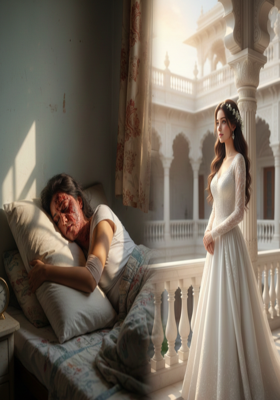
Today, after many years, Uma faced an identical, ethereal dream—as if it were the Maa Kali’s own boundless grace! Beside her lay Laxmi, burning with fever. Uma got up quickly and went to the bathroom to wash her face. Guruma was already furious because Laxmi was unwell, leaving the entire burden of the business on Uma's shoulders. While washing her face, she avoided looking at her wretched reflection in the mirror; she did not like herself. Besides, can those who are cast out by society ever truly love themselves?
At the tender age of sixteen, she was discarded from her own village and homestead like waste. At birth, she was named Unmesh, but oh, the irony of fate! She was born in a male body, but her heart was entirely feminine. Since childhood, she loved wearing her mother's sarees, putting on conch-shell bangles, tying anklets around her feet, and placing a bindi on her forehead. Whenever she went outside, she became an object of ridicule for children her age, and the elders socially boycotted her family. At thirteen, she was expelled from school, and exactly three years later, during her adolescence, the villagers poisoned the village chief's ears—arguing that if Unmesh stayed, the new generation of the village would go to ruin. That was it. With the chief's permission, the villagers surrounded Unmesh's house. They threatened to burn down the house if she didn't leave the village. Forced by circumstances, she left her home with nothing but a picture of Shamshan Kali. From that day on, Maa Kali was her only parent. After joining this profession, she took the name 'Uma'.
She wished to approach Maa Kali in her mortal body and find a place at Her feet. Though that might never happen, she hoped that at least during her final journey to the afterlife, Maa's arati (ritual worship) would be performed. Uma quickly threw on a saree, put on bangles, anklets, and a bindi, and set out for work, because according to Guruma, "Laxmi resides in trade."
********
Today, Uma could not focus on her work; her body felt immensely exhausted. Of course, by begging before people and becoming a burden to them, she had sacrificed her self-respect long ago—now it was just about feeding her stomach.
She got off the train at Patuli station. It was two o'clock in the afternoon. Her life was gasping in the intense heat; her throat was parched with thirst, yet she kept walking. Suddenly, as she walked, she found herself standing before a white marble temple. The temple plaque read 'Siddheshwari Kali Bari'.
From the sanctum sanctorum of the temple, a male voice drifted out in song:
"Whether You are man or woman, I fail to understand.
Unless You reveal it Yourself, how can anyone comprehend?" [Translation of Shyama Sangeet]
That voice poured like honey.
Suddenly the singing stopped, and from within, that same honeyed voice asked, "Why are you standing outside?"
Uma pulled her veil closer and said, "Fie, I am a transgender woman. My presence might defile the place."
"Even if society casts you out, has the Almighty Mother ever pushed you away? Why else would She create you? Come inside, child! We are all children of the Mother."
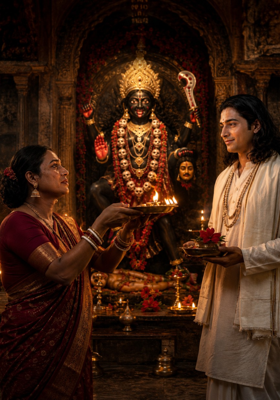
Uma stepped inside. The idol of Mother Dakshinakali stood there, established in Her conscious, divine form.
The man who had been sitting in the sanctum sanctorum now stepped forward to meet Uma. What celestial grace, what otherworldly radiance he possessed! A white turban was neatly wrapped around his head; he wore a white dhoti-kurta, a sandalwood tilak on his forehead, and a tulsi garland around his neck. His hair flowed freely, falling near his shoulders.
He held a plate of holy offering (prasad) in his hand.
Uma whispered faintly, "A Vaishnav!!"
"Does being a Vaishnav mean one cannot serve the Almighty Mother? When Mahaprabhu Chaitanyadev engaged in Mother-worship despite being a Vaishnav, many superstitious people ridiculed him and even tried to persecute him. But Mahaprabhu's devotion was unshakeable. Pleased by his devotion, Maa Chinmayee manifested before those people and, assuming the form of Madanmohan, said—'The very same body that is Krishna is also Kali.' Whichever deity it may be—be it Sri Krishna, Kali, Allah, or Jesus Christ—they all exist for the welfare of the universe. They are inseparable parts of one another."
The priest offered Uma water in a vessel, and she quenched her parched throat. As the water traveled down, Uma felt that it didn't just soothe her chest dried up by the scorching sun, but it washed away years of a persecuted life.
She asked, "Are you the priest here?"
"People say so. However, I am merely a servant of the Almighty Mother, taking refuge at Her feet. Can't you leave this profession?"
Uma replied with a tone of irony, "The very scriptures mention Mohini, Shikhandi, and Brihannala with respect, yet today, due to the machinations of foreigners, we are the ones boycotted. Even though the country is independent, people's mindsets are enslaved by superstition. Who will give us work? People treat us worse than dogs, which is why this profession..."
"Become a servant of Maa Kali just like me, stay here as my companion. The Mother will give you shelter here; that is why She brought you to this place. And the words of men are certainly not the voice of God. If anyone here tries to say anything..."
"I will surely become a servant, but I will travel to this temple from my own residence and perform the Maa's arati. I have a companion there who is burning with a high fever. Please grant me permission to leave..."
"Wait!" saying this, the priest went into the back room of the temple and returned a few moments later, placing a small, ethereal idol of Lord Kali into Uma's hands. Maa Kali was four-armed, but surprisingly, she held an enchanting flute to her lips with two hands, while another hand held a scimitar, and the remaining hand was poised in the blessing mudra. It was an idol of Krishna-Kali.
The priest said, "You reside in a worthy place. The Mother's idol is crafted from that very sacred soil of the brothel. Let the Mother find Her place in that sacred soil today. This idol belongs to you; take it with you."
Uma's eyes overflowed with a torrent of tears. Today, their brothel would be illuminated by the arrival of Maa Kali—the deliverer of the fallen.
The priest then began to sing to himself:
"I have an invitation to the festival of joy in this universe.
Blessed, blessed is this human life."(Translation of Rabindrasangeet)