Library

 Profile
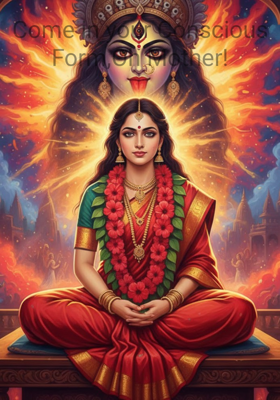
Come in your Conscious Form,Oh Mother!
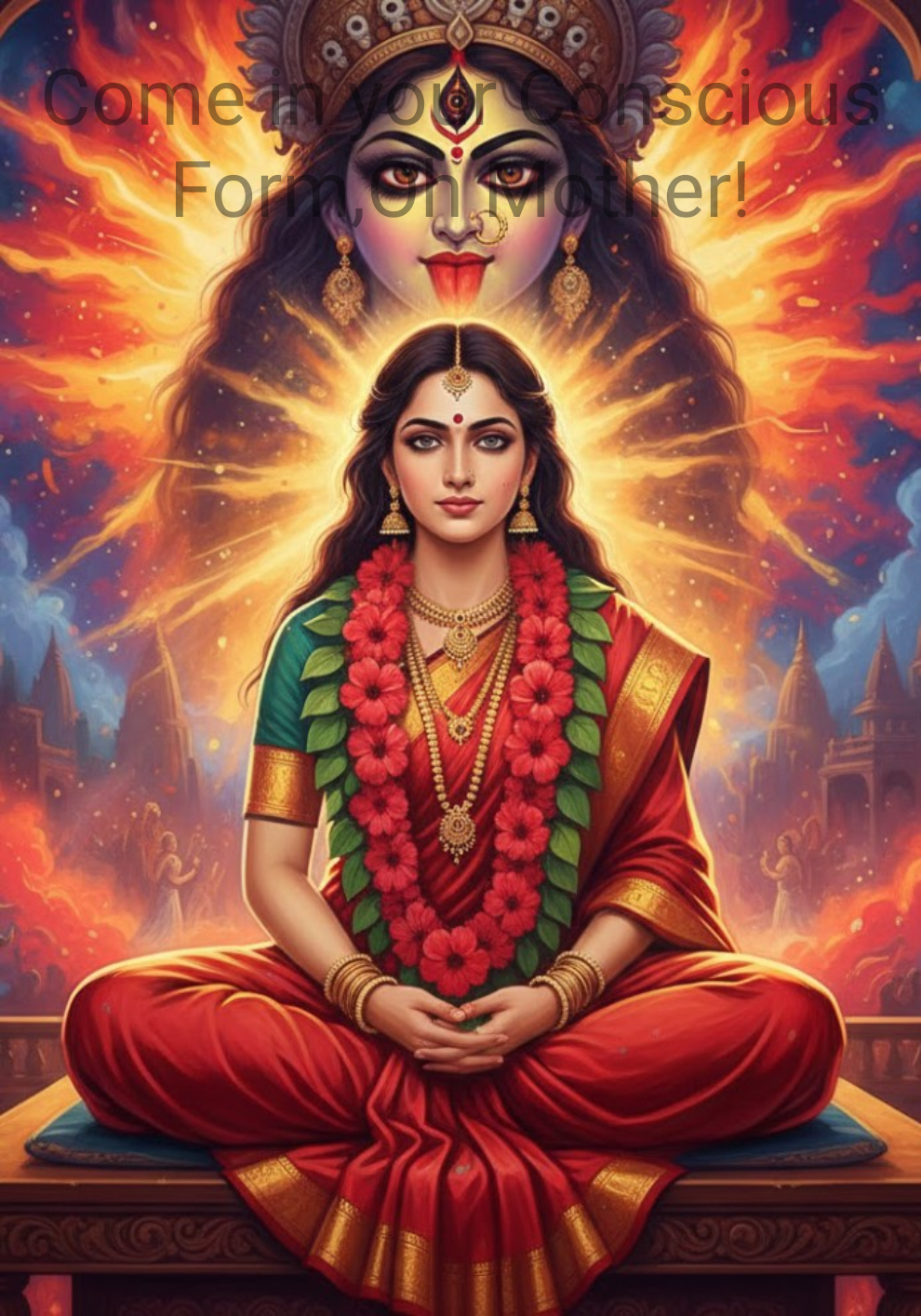
Come in your Conscious Form,Oh Mother!

The Majumdar house stood in the middle of Haripur village. Their ancestors were the landlords, and even after the zamindari system was abolished, the echo of that glory had not faded; hence, the house is still known as the Landlord’s House today.
The current descendants, Chandrashekhar and his wife Nayantara, were revered by all the villagers like deities, and to them, Nayantara was the personification of Annapurna (Goddess of Food). She always stood by them in times of need, whether it was sending someone to the city for critical medical treatment or establishing a free educational institution to provide adequate knowledge to the poor and needy children for establishing their future goals.
However, one deep sorrow festered in Nayantara’s heart: she could not give her husband the joy of fatherhood. Chandrashekhar, though, held no resentment, for he knew that Maa Saradamani herself was childless, yet she was the universal mother, the mother of this world. And his wife, Nayan, though not being progenitrix, shielded and protected every child in the village as her own. Truly, Maa Jagadamba herself had graced their home as a cursed Goddess to redeem herself, becoming his wife—as beautiful as Lakshmi and as virtuous as Saraswati.Nayantara also used to distribute different types of books,encyclopedias bought from city to the village children.
Days passed, and the Kojagari Lakshmi Purnima (full moon associated with Goddess Lakshmi) arrived. The humming of Lakshmi’s Panchali (narrative poem) and Bratakatha (vows and tales) could be heard in every home. But the day after the Puja, various uncanny incidents began to occur in the village. Rumors spread about the arrival of a nocturnal ghoul, causing several children to disappear from their homes. A child would sleep beside their mother at night, only to be found missing in the morning. Many people also heard various abnormal noises during midnight—such as the shrieks of a horse, the faint moaning or unearthly wail of a woman, or the brutal war cry of robbers, 'Haa Re Re Re!' Fortunately, no robbery took place anywhere, and no horse was ever seen. Nayantara’s heart ached at the disappearance of these children, who were like her own. But who was behind this atrocity? Kali Puja was approaching at the Zamindar Bari, where many people would feast joyously. If the children could not be brought back before Diwali, the Mother Goddess would surely be displeased. Which sinful demon's shadow had defiled this village?
A 'ghost terror' took hold of the villagers’ minds. They believed a pestilence had struck the village, the symptom of which were those supernatural noises. Furthermore, the doors of the houses were bolted at night, and a child’s hand could not possibly reach the latch—so how were they disappearing outside the house? This had to be something ghostly.
However, another suspicion began to form in Nayantara's mind: 'If a demon were causing a pestilence in the village, why was it only targeting those innocent children and not attacking other domestic animals? Moreover, the bodies of those children were not found anywhere. Has that demon kidnapped them for some specific ritual and not to devour them?'
Five days passed like this, with four children still missing. Chandrashekhar and the villagers found no trace of them despite an exhaustive search. Nayantara also discreetly visited the homes of the missing children, hoping to find some clue from the families, but she returned disappointed. She only learned that the missing children had all uttered the words 'Maha Das' the day before they vanished. What could 'Maha Das' indicate?
Another doubt was sown in her mind: all the homes of the missing children were located at the far edge of the village (since Haripur was a very large village), and the supernatural noises were only heard in those surrounding areas. But why? Why were those abnormal sounds not heard in the central part of the village? What fate had befallen the missing children?
Two nights passed in intense anxiety and sleeplessness for Nayantara. But today, while contemplating all these questions, she drifted off to sleep, not even noticing.
No sooner had she fallen asleep than her eyes were dazzled by an unearthly red glow that appeared before her. A heavy male voice began to chant the 'Dakshina Kali' Stotra (hymn):
“Bandhukapushpasankashe tripure bhayanashini. Bhagyodayasamutpanne namaste varavandini. Jaya Devijagadhatri Tripuradye Tridevate. Bhaktebhyah varade Devi Mahishaghni namo’stute.”
[Translation of Strotram – "O Divine Mother, whose radiance is like the crimson Bandhuka flower, the one residing in the Three Worlds and destroying all fears, the source from which all good fortune arises—I bow to you. Victory to you, the Sustainer of the entire Universe, the Supreme Goddess of the three realms, the Giver of blessings to all your devotees, and the great Slayer of the Mahishasura demon. I offer you my salutations."]
The voice felt intensely familiar. Just then, the figure of a handsome elderly gentleman appeared—it was her grandfather, Rudranarayan Chattopadhyay. Nayantara instantly felt transported to her sweet sixteen years, sitting on an altar, draped in a red sari, wearing a garland of red hibiscus.
Rudranarayan said tenderly, "My child, my spiritual practice has truly succeeded. You have come as my granddaughter in your concious form . But my child, you now have a great responsibility."
Nayantara asked in an mesmerized voice, "What is it, Grandfather?"
"In Sanatan Dharma, the Divine Power (Devi Shakti) is the energy that people can use for the welfare of society, as Ramakrishna Paramahamsa did playing a pivotal role in framing this society, but some do not hesitate to engage in dark, lower forms of tantric practices, or Dakini, Pishach, or Bhoot-Damar sadhana to show themselves all-powerful in the world. Their sadhana remains incomplete, and in the end, they face Maa Kali's wrath. Such a savage ritual is taking place in Haripur."
"Who, what, and why are they doing this?"
"The 'house enemy Vibhishana,' whom you yourself will find, my child. That brute has engaged in savage practices to conquer the power of the Dasha-Mahavidyas (Ten Great Wisdom Goddesses) to gain power. The offering for this worship of the Mother is the sacrifice of ten children aged five to sixteen. The children will be sacrificed on the auspicious moment of Dipanwita Amavasya (Diwali New Moon). Those children were hypnotized to come here, and the open door latches were all an illusion. You must stop that sacrifice; you must destroy those demons."
"Am I capable?"
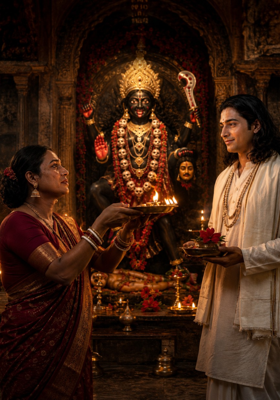
Rudranarayan asked Nayantara to look behind her. She turned and saw the unearthly beautiful idol of Dakshina Kali, but this idol was from the Siddheswari Temple at the village's far edge. He continued, "Just as Kaal controls time, Kali devours even that Kaal also. Do not forget that the unique, destructive form of the Dasha-Mahavidya, 'Tara,' is mentioned in your name's final part. Abandon the form of modesty and take the ferocious form just as Rani Lakshmibai did. You have descended in this worldly form solely to destroy these demon-like men by creating cataclysm on them. You must save your children; awaken the power within you! But yes, you must come to this temple premises alone, half an hour before the Amavasya sets in, to fight them. Take up the sword. 'Yuddhang Dehi' (Declare War)!"
Nayantara awoke. The morning light had not yet broken. But her eyes began to burn with the fierce flame of protest. Today was the sixth day. Chandrashekhar likely had not checked inside the temple; she would have to check it secretly. It was now clear to her what 'Maha Das' truly meant.
..........
A few hours later, the auspicious moment of Dipanwita Amavasya would arrive. Indeed, ten children were missing. But Nayantara had not given up; she had searched in secret. The savage ritual would take place beneath the pedestal of Mother Kali's idol, and her arrival here was precisely to stop it. But the identity of the Kapalik (tantric practitioner) remained unknown.
Nayantara entered the temple with a few strong men and ordered them to move the idol of Mother Kali aside from the pedestal and then leave to bring the villagers there. Just as a lone woman had slain Mahishasura, she alone was enough to destroy those demon-like men. The men obeyed her instructions, and she lifted the pedestal and went inside, holding a torch. It was pitch black inside. It was like a cave chamber. A terribly stale, rotten smell emanated from within, suggesting that savage rituals had taken place here before. Her heart pounded with dread, but she pressed on, refusing to lose hope. There! She could hear the high-pitched chanting of mantras; there! She could see the light of the sacrificial fire. She moved closer and began to hear the faint moaning of children. In the distance, she saw a man wearing a red silk cloth. A sacrifice was burning before him, and nearby lay a blood-stained sacrificial block. But where were the children?
Just then, that man turned around, and Nayantara gasped.
"Truly, the 'house enemy Vibhishana'! If I had known you were that person, I would never have married you! People worshipped you as a deity, and yet you stooped so low just to prove yourself superior? That explains why I saw the Dasha Mahavidya pictures in your display case... but the curtain of your deception will fall soon. Where are the children?"
"I was waiting for you! And since I am a Tantrik, I have acquired some power through black magic. That is why I could perform the hypnosis and those strange noises from a distance. Don't worry, today you will be sacrificed along with those children. Mother wished it, so she sent you here. I have no grudge that you are childless, but you still earned more fame than me in this village by being a mere homemaker of the last lamp of this zamindar lineage, through feeding people and establishing the institution with my money. Still, I never stopped you. How dare you, a barren, insignificant woman to stop me? I will now become the all-powerful! I will achieve immortality! 'Jay Maa Tara'!!" Chandrashekhar laughed hysterically.
"As long as I live, I will not let any harm come to my children. And the Mother Goddess never sanctions atrocious deeds. Tell me where you have kept the children, you devil!"
He laughed the same hysterical laugh and pointed to his right. The fiendish laughter echoed off the cave walls. Following his indication, Nayantara held the torchlight in that direction. In a small niche, she saw the ten missing children. They wore garlands of red hibiscus around their necks and red tikas on their foreheads. The girls wore red saris, and the boys wore black dhoti-panjabis. They were terrified. But Chandrashekhar seemed to vanish like camphor.
Just as Nayantara moved to rescue them, a 'Haa Re Re Re' roar signaled that ten muscular, giant-like men surrounded her, swords in hand. She was terrified by their thin, greedy tongues and bloodshot eyes. One of them pushed her, and she fell down, striking her forehead. Blood trickled down her brow. Their eyes were fixed on Nayantara.
Just then, that familiar voice echoed again—"Abandon the form of modesty, take the ferocious form."
An unearthly power surged within Nayantara. One of the men raised his sword to strike her, but she screamed, kicked him in the leg, and leaped onto another, shouting, "Yuddhang Dehi!" She snatched his sword and began to slaughter the demons, just as Raktadantika (a form of the Mother Goddess) destroyed Raktabij(a demon). Outside, the sound of crashing thunder was heard. Amavasya had begun, and Chandrashekhar could harm them at any moment.
She wasted no time, untied the children, and led them out of the temple one by one. The villagers had already arrived at the edge of the dense jungle near the temple. She had to return the children, her children, to their families.
They ran with torches in hand, and in the distance, the villagers' torchlight was visible. But suddenly, without her noticing, Chandrashekhar struck her back with a dagger from behind. Nayantara could not comprehend it. Before collapsing into the arms of death, she urged the children to cross the jungle quickly without looking back. The children ran as instructed. As Chandrashekhar moved to pursue them, a fierce surge of fire, a roar of defiance, struck him. Simultaneously, a sharp, savage scream was heard from the jungle. The villagers found two dead bodies inside the jungle and felt an aura surround Nayantara.
Though Nayantara embarked on her final journey, she successfully suppressed the wicked and protected the righteous, handing those children back to their families. She was subsequently known to the villagers as the 'Divine Form (Chinmayee Roopa) of Mother Kali.' Her virtues spread far and wide. To the villagers, Nayantara had not died; she had achieved ascension, just as Maa Mahishasuramardini does on the auspicious moment of Bijaya Dashami.