Library

 Profile
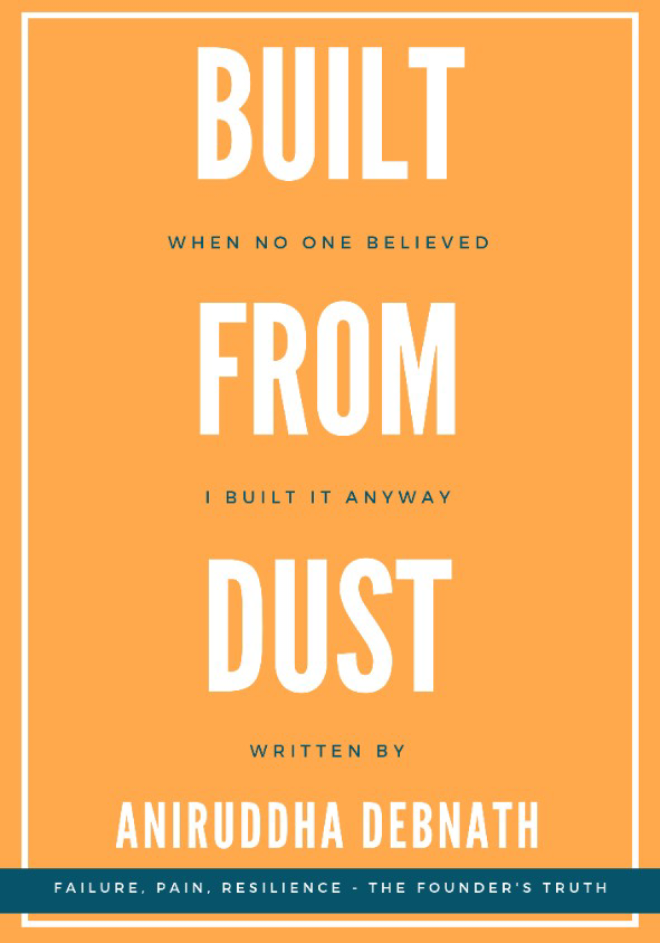
Built From Dust
Built From Dust

Dedication:
To my mother, whose silent prayers carried me through every storm. To my wife, who held my dreams like fragile seeds and helped them bloom. To my invisible friend, who showed up when no one else did. And to those who tried to bury me—thank you for making me unshakable.
Author's Note:
This is Not Self-Care. This is Self-Survival.
I didn’t write this book to inspire. I wrote it to bleed.
You see, startup stories are often wrapped in the glitter of unicorn dreams and Silicon Valley fairy tales. But this one is born from sweat, superstition, and silence. It’s a journey not through investor pitch decks but through power cuts, black magic, and emotional warfare.
This book is not a roadmap. It’s a survival manual. Not every founder has access to mentorship or capital. Some of us build from scratch—literally, from the dust. We are not anomalies. We are the future of India rising from its tier-2 and tier-3 corners.
So if you ever felt unseen, unheard, or underestimated—this is your book too.
Let them read it. Let them feel it. Let them know: we are not the exception, we are the revolution.
—SayFounder
Prologue: The Fire Before the Ashes
Before there was GooLeads, before SayFounder had a mic, before the world noticed my scars and strategies—there was 10karma.
It was 2019.
I wasn’t dreaming of IPOs or pitch decks. I was just a small-town soul with a big question: "Why isn’t tradition evolving with technology?"
So I did what nobody around me dared to: I brought pandits online.
Yes, my first startup was an online priest aggregator—the first of its kind in West Bengal. At a time when no one even thought you could book a pandit like a cab, I built a platform where rituals met algorithms, and sacred services could be scheduled with a click. 10karma wasn’t just an idea; it was my devotion, my rebellion, my first leap into entrepreneurship.
I was incubated at Webel-Bandhan-BCC&I in Kolkata. I still remember walking into that facility—not with swagger, but with shaking hands. In 2022, I was recognized by ABP Network's Indian Emerging 100, and later that year, DPIIT acknowledged my startup. I even registered my first private limited company: Dashkarma Services Pvt. Ltd.
It felt like I had made it.
And then... COVID.
What I built depended on movement. On pandits reaching homes. On rituals being held. But when lockdowns came, so did cancellations. Not just of pujas, but of dreams. The screen that once showed bookings now showed nothing. Silence echoed in my inbox.
I tried to pivot. I tried to breathe. But 10karma, my first baby, was gone before it could even walk.
That was the first time I felt what failure tastes like.
But I didn’t bury myself with it. I buried my ego instead.
Because what broke me also revealed something deeper: the gaps in India’s rural startup ecosystem. The lack of mentorship. The absence of digital trust. The loneliness of building from zero in places where people still ask, “Startup? Ye kya hota hai?”
And from those gaps, I gave birth to two things:
- GooLeads – a growth partner for small-town founders and struggling businesses.
- SayFounder – a raw, honest, unfiltered voice for every founder who never fit the typical startup image.
So if you're holding this book thinking it’s just about how I built GooLeads, you’re mistaken.
This is about why I rebuilt myself after my first startup died.
This is not just a comeback story.
It’s a continuation of a fire that never truly went out.
📖 Chapter 1: Built from Dust:
I wasn’t born in Silicon Valley.
There were no pitch decks in my schoolbag. No hackathons in my neighborhood. Just the faint smell of red soil after rain, the chirping of birds in mango orchards, and the distant whistle of local trains that carried other people’s ambitions past my small town — Chakdaha.
This is not a village, not quite a city. It’s a place stuck in transit, just like I was.
A place where startups were bedtime stories, and founders — mythical creatures you only heard about on TV.
But one dusty afternoon, sitting in a broken plastic chair inside a sweaty cyber café, I Googled "how to start a digital business."
That’s how it began.
🌐 A Life in Loading Screens:
Our internet wasn’t Wi-Fi. It was "wait-fi."
The cyber café had four computers, all secondhand. Most had screens with greenish hues and keys that stuck with chewing gum. The man running it charged ₹15 per hour. And even that felt expensive on days when I skipped a meal.
I’d bring a small notebook with hand-written ideas. Business names. Campaign taglines. Even client pitch notes — all drafted by candlelight the night before. I’d enter the café with eyes full of fire but leave with a pocket full of buffering.
There was a day I downloaded a startup guide PDF.
The power cut off at 87%.
The café closed early that day.
But I came back the next morning. Downloaded it again.
This time, it worked.
📚 The Missing English
I wasn’t fluent in English. And in the world of business, that makes you invisible.
There were moments I translated entire proposals on Google Translate before sending them. I watched hundreds of YouTube videos — sometimes not understanding half the words, but absorbing the intent.
I didn’t have a mentor. But the internet became mine.
Seth Godin, Neil Patel, Raj Shamani, Ankur Warikoo — all became my silent teachers.
One day, I recorded my first client call — not to impress them, but to learn from my own broken grammar.
I wasn’t ashamed. Because broken grammar was still better than broken dreams.
🧱 The Mockery
Some laughed when I said I wanted to build a digital marketing startup from here.
“Chakdaha se Google compete karega?”
“Website banayega? Electricity to pehle la!”
They chuckled, sipped their tea, and went back to small talk.
I stayed quiet. Not because I agreed — but because I was busy building.
They mocked the idea. I mocked the limitation.
Where they saw a rural dead-end, I saw fertile soil.
✊🏻 Pain. Pressure. Purpose
What drove me wasn't a business plan.
It was pain — the pain of not fitting in.
It was pressure — of seeing my friends move to cities while I stayed behind.
And it was purpose — knowing that if I succeed from here, thousands will know they can too.
So GooLeads wasn’t just my venture. It was my rebellion.
My declaration that location isn’t destiny.
🧱 "Built from Dust" Isn’t a Metaphor:
I used to write on a table that had termite holes.
Design campaigns under a leaky tin roof during monsoon.
Pitch to clients while background sounds of temple bells and auto horns crept into my calls.
This wasn’t poetic.
This was real.
This was building from dust — literally.
But dust has one magic: it sticks.
And every grain became a part of the foundation I was silently creating.
🔥 Today, I Stand
Not because I had capital.
Not because I had connections.
But because I had the will to try.
From Chakdaha’s silent corners to national startup directories, from cyber cafés to Google Sheets with real clients — the journey didn’t happen overnight.
It happened over every night I stayed awake, dreaming with open eyes.
💬 Final Lines (Chapter Closer):
People ask me today:
“How did you start GooLeads?”
I smile and say:
“I didn’t start it. I built it — from dust.”
Chapter 2: SayFounder – The Voice They Couldn’t Silence
There’s a strange sound to silence—it rings louder when it’s forced upon you.
After the shutdown of my first startup, 10karma, the noise in my world wasn’t of city traffic or boardroom debates. It was of whispers. It was the sound of closed doors, the pause in conversations when I entered the room. It was the strange rituals thrown in my path—not just figuratively, but literally. Strings tied. Ash scattered. Symbols left at my doorstep. A silent war no startup founder ever plans for.
I remember one evening when my mother, worried and trembling, pointed out the bizarre marks on our verandah. “Someone has been doing something,” she said, her voice heavy with rural fear. Not business rivals. Belief rivals. People who couldn’t handle the idea that a young man from Chakdaha was dreaming loudly. People who believed that silencing me wasn’t just strategic—it was spiritual.
But I wasn’t raised to surrender.
I was raised to survive.
The Beginning of a Voice
SayFounder didn’t start as a brand.
It started as a whisper in my own head.
I remember staring at my cracked phone screen, watching videos of successful founders telling polished stories. But where were the ones like me? Where were the stories from small towns? From rented rooms with leaking ceilings? From founders who battled rituals, rumors, and real rejection?
That’s when the fire lit again.
If no one would tell my story, I’d tell it myself. And not just mine—every founder’s untold story who ever felt invisible, mocked, or manipulated.
That’s how SayFounder was born—not in a studio, but in a room with fading paint, on a second-hand mic, with the desperation of survival and the courage of truth.
Mic Check, Soul Check
The first podcast wasn’t perfect. My accent was raw. My confidence cracked between words. But it was mine. Every episode became therapy. Every guest became a reflection. And every listen reminded me—I’m not alone.
SayFounder wasn’t about glamour.
It was about grit.
I didn’t want a fanbase. I wanted a founder base—a safe haven where startup warriors, especially from tier-2 and tier-3 cities, could feel heard, not judged. Where our broken English, broken systems, and broken dreams could still build something whole.
In SayFounder, I wasn’t trying to impress. I was trying to express.
From Silence to Signal
As SayFounder slowly found its way into the digital space, I started getting messages:
- “Bhai, I thought I was the only one going through this.”
- “Your podcast saved me from quitting.”
- “I never thought someone from my kind of background could speak up like this.”
This wasn’t a platform anymore.
This was a mirror.
And mirrors don’t lie. They reflect pain. Passion. Possibility.
A Revolution in the Rural
There are revolutions that start with protests. Mine started with a podcast.
Not with followers, but with founders. Not with trends, but with truths. And not with ego, but with empathy.
SayFounder became the soundtrack of the silent.
The anthem for the underestimated.
And a living proof that your voice, no matter how rural, how rough, how raw—matters.
SayFounder is not my project.
It’s my protest.
It’s my poetry.
It’s my purpose.
Because when they tried to drown me in silence,
I didn’t fight with fists.
I fought with voice.
And guess what?
My voice echoed.
Chapter 3: Fear Was the Co-Founder I Never Chose
Most startup stories begin with passion.
Mine began with panic.
While other founders were brainstorming MVPs and hunting investors, I was counting pills for anxiety. While they showcased pitch decks, I hid panic attacks behind WhatsApp replies. Fear wasn’t an emotion—it was my environment.
And in many ways, it became my first co-founder.
It joined me in every decision. It shadowed every step. It whispered when I had to speak. It tightened my chest before every client call. It sat with me in dark rooms when the electricity failed—not just literally, but emotionally.
The Startup Nightmares No One Talks About
There’s a lie we’ve all been sold:
That building a startup is about 10X growth, investor smiles, and coffee-fueled brainstorming sessions.
But in tier-2 India, it's about:
- Fear of judgment from the same neighbors who once asked if you’d ever get a "real job."
- Fear of failure, because there’s no second chance when your savings are already borrowed.
- Fear of superstition, when some believe your ambition is unnatural or cursed.
- Fear of being watched, when rivals start following your every move not to learn, but to crush.
- Fear of mental collapse, when you’re handling tech issues, cash flow, social shame, and insomnia alone.
These are not motivational poster moments.
These are the night sweats. The shaky breaths. The silent screams.
When I Couldn’t Sleep…
There were nights I stared at the ceiling, eyes wide open, body exhausted but soul electrified by fear. Sometimes, the fear was real—like missed deadlines, broken trust, or police complaints triggered by competitors. Sometimes, it was imagined—but it didn’t matter. It felt real.
I remember writing journal entries like:
“If I break, who will fix me?” “Should I stop? Or should I scream louder?” “Maybe this is the end. Or maybe it’s the start of the actual beginning.”
Those were the thoughts of a founder with no cushion, no privilege, and no therapy sessions scheduled. I didn’t need motivation. I needed mental survival.
Learning to Co-Exist with Fear
I didn’t defeat fear. I did something harder:
I partnered with it.
I made fear my morning reminder.
It told me, “You're stepping into something big, that’s why I’m here.”
I stopped treating fear as a warning.
I started seeing it as a witness.
I journaled it. I walked with it. I sometimes cried because of it.
But I kept building with it sitting right next to me.
And over time, fear lost its grip.
It went from a monster to a mirror.
The Day I Stopped Apologizing for My Mind
One day, I posted a brutally honest message on SayFounder:
“Today I didn’t work. I had an anxiety breakdown. But I’m still a founder.”
That post got more engagement than any success post ever did.
That’s when I knew:
Vulnerability is power in the startup world.
Not weakness.
We’re not robots with unicorn targets.
We’re humans carrying decades of generational fear, systemic hurdles, and personal baggage.
And yet we build.
We create.
We rise.
A New Definition of Founder
A founder is not someone who raises funds.
It’s someone who raises themselves from breakdowns no one ever saw.
A founder is not someone who scales a product.
It’s someone who scales belief—especially when belief dies daily.
A founder is not someone who conquers markets.
It’s someone who conquers the fear of being laughed at, left out, and let down.
So yes—fear was my first co-founder.
But it also became my fuel.
And now, it no longer leads.
It follows.
Chapter 4: The Quiet Comeback
They say when a phoenix rises, the world watches in awe.
But what if the world doesn’t even know you burned?
My comeback didn’t trend on LinkedIn.
It wasn’t viral.
No VC sent a "congrats" message.
There was no media coverage.
There was just me. Alone. Rising quietly.
After 10karma Fell, I Fell Too
When 10karma was forced to shut during COVID, it wasn’t just a company that died — it was the hope I carried in my lungs for years.
I had done something bold — bringing priests online in Bengal before anyone thought of it.
From incubation at Webel-Bandhan-BCC&I to national recognition from ABP Network and DPIIT — the startup had momentum, purpose, and soul.
But it wasn’t fully digital.
It needed homes.
And during a pandemic, homes were closed.
Just like my startup.
And just like that, my identity cracked.
I stopped picking calls.
I stopped believing in “tomorrow.”
Every time someone said, “Jo hota hai achhe ke liye hota hai,” — I wanted to scream.
Because this didn’t feel achha.
But Comebacks Don't Ask for Permission
A year later, I didn't announce a comeback.
I simply started waking up earlier.
Reading more.
Learning Meta Ads. Automating CRMs. Studying funnel optimization.
Building, not broadcasting.
I created GooLeads. Quietly. Strategically.
It wasn't just a new startup.
It was my healing.
I wanted to fix what 10karma couldn’t:
- A fully remote setup.
- Scalable services.
- No physical dependencies.
- More B2B than B2C.
- A model built for survival, not just success.
Why I Chose Silence Over Revenge
People who mocked me during the 10karma shutdown?
I didn’t confront them.
I outlived their judgment.
People who ghosted me during my low phase?
I didn’t ask why.
I just became someone they’d want back — and couldn’t afford anymore.
People who copied my model and claimed credit?
I let them run.
Because I was preparing to fly.
The First Time a Client Came Back
One night, a previous client who once said, “I don’t think your model is practical,” messaged again.
“Hey, I saw GooLeads. Are you available for a 3-month retainer?”
I didn’t feel victorious.
I felt… validated.
Comebacks don’t need claps.
They need clarity.
They need systems, stamina, and silence.
How the Quiet Changed Me
In the quiet, I found:
- Resilience, not rage
- Planning, not proving
- Process, not panic
- Boundaries, not burnout
I stopped selling to everyone.
I started qualifying clients.
I stopped showing up everywhere.
I focused on showing upward.
The Comeback Rulebook I Now Live By
- Don’t explain to people who never listened.
- Don’t fix narratives. Fix systems.
- Don’t run faster. Walk sharper.
- Don’t try to prove anyone wrong. Just prove yourself right.
- Don’t crave stage lights. Build your spotlight.
And Most Importantly...
The quiet comeback taught me:
🔥 You don’t need noise to be noticed.
Just keep showing up.
Keep solving problems.
Keep growing in places where no one claps.
Because someday, the world will turn around and say:
“Wait… when did he return?”
And you’ll smile…
Because you never left.
You were just rebuilding in silence.
Chapter 5: SwaNidhi – My Inner Wealth, My Outer War
When you build something from the soil — not metaphorically, but literally — you realize success isn’t measured in profits first. It’s measured in survival. In how long you can keep walking when your legs are shaking. In how many times you get up after being mentally paralyzed by fear, doubt, and exhaustion.
And for that, I needed a reserve.
Not a bank account.
Not a credit line.
Something deeper.
Something invisible, but invaluable.
I called it SwaNidhi — my inner wealth.
A Fund Made of Feelings
In the startup ecosystem, people talk a lot about external funding — seed round, angel investment, Series A. But what about the emotional and psychological funding that helps a founder survive the in-between?
SwaNidhi was never about rupees or dollars. It was about:
- A quiet lassi break during a 45°C summer instead of another chai-fuelled rant.
- A 15-minute journal entry where I poured my mind instead of pitching it.
- Gratitude notes to myself on days I didn't feel like getting up.
- A voice note I sent to my future self saying, “It’s hard right now, but you’ve seen worse.”
- A folder of rejections that I renamed as “Lessons Issued”.
In this rural entrepreneurship battlefield, I had no financial fallback. But I had emotional foresight. I knew burnout wasn’t optional — it was guaranteed. The question was: Would I crash, or would I conserve?
SwaNidhi made sure I had something to fall back on — myself.
The Unseen War
There were wars no one saw:
- The war of trust — when every new partner might be another saboteur.
- The war of self-worth — when no one claps for your effort, and you're unsure whether you’re a fool or a visionary.
- The war of comparison — when you see founders in Delhi or Bangalore raising crores while you're figuring out how to get your electricity back during a storm.
I was not just running a startup. I was defending my mental capital every single day.
And to do that, I had to budget my energy.
I divided my emotional reserves like a monthly expenditure:
- 25% for core operations — client handling, delivery, project innovation.
- 15% for defense — shielding my team and my mind from toxic surroundings.
- 20% for inspiration — reading, listening to others who came from nothing.
- 10% for gratitude — giving back, without expecting return.
- 30% for me — the most important, most neglected stakeholder.
Not Self-Care. Self-Strategy.
They say “Self-care is important.” I disagree.
Self-strategy is necessary.
Self-care is a bubble bath.
Self-strategy is knowing when to disconnect from people who drain you, even if they’re close.
Self-care is a journal.
Self-strategy is using that journal to track emotional triggers like a CEO tracks cash flow.
My SwaNidhi was both my balance sheet and my battle cry.
Rural Founder, Urban Fire
Tier-2 and Tier-3 founders have a different kind of pain. We don't get media attention. We don’t have coworking spaces that smell like cappuccino and code. We have power cuts, passive mockery, and parents asking, “Beta, naukri kyun nahi karte?”
So I built my soul capital.
I stored compliments like investments. I absorbed pain like reinvested profit. I documented failure like quarterly reports. I learned from betrayal like market research.
And this SwaNidhi — this system of inner wealth — carried me through the nights when nothing else worked.
Now I Teach This
Today, at GooLeads, I tell every young founder:
Before you raise funds, raise yourself.
Before you pitch, plan your peace.
Before you scale outward, stabilize inward.
Because one day the money might not show up. The clients might ghost you. The partners might cheat.
But if your SwaNidhi is strong, you will rise anyway.
Chapter 6: Founder’s Bloodline
They say entrepreneurship runs in the blood.
But mine? It didn’t.
No family business legacy. No uncle in the Chamber of Commerce. No cousin at Google or Amazon. Just a middle-class surname and a thousand-question stare every time I said, "Main startup chalata hoon."
If I have a bloodline today, I carved it out — drop by drop.
Birth of a Different Kind
When I started, I didn’t know I was birthing something.
Not just a company.
Not just an idea.
But a new version of myself — one that wouldn’t fit into what society expected.
This rebirth came with labor pains no one prepared me for:
- Friends disappearing the moment I stopped being "fun" and started being "focused."
- Family members whispering if I had gone mad leaving a conventional career path.
- Former classmates mocking me, posting vacation pictures while I posted pitch decks.
I was bleeding attention, relationships, and time. But I kept going.
Missed Calls, Missed Moments
While others counted their revenue milestones, I counted:
- Birthdays missed because I was chasing an urgent deliverable.
- Anniversaries forgotten, buried under Excel sheets.
- Dinner invitations declined, because I had no money and no mind-space.
My wife once said, “You’re here, but not really.”
She wasn’t wrong.
But she stayed. Quietly. Lovingly. Even when I couldn’t show up emotionally.
Even Maa... she never asked much, but I knew she wished for one thing — to see me happy, truly.
But I had traded that happiness for purpose.
For the founder’s bloodline.
The Unseen Inheritance
You don’t inherit this bloodline.
You build it — every time you:
- Choose a late night call with a struggling intern over Netflix.
- Sacrifice rest to meet an unrealistic deadline because your reputation’s on the line.
- Cancel every plan, just because one small client finally said yes.
Every wound — emotional, spiritual, physical — becomes the DNA of your founder identity.
What I Lost. What I Gained.
I lost comfort.
But I gained clarity.
I lost friends.
But I found a tribe — those rare few who believed in the messy, unfinished me.
I lost time.
But I gained time freedom. No 9 to 5, but a 24/7 on my terms.
And somewhere along the line, I gained something priceless:
A cause bigger than me.
I wasn’t just building a company.
I was building a path — for every small-town, underestimated, underdog founder who’s told to "be realistic."
A Note to My Bloodline
One day, my future kid — or maybe a kid who reads this book — will ask:
"Was it worth it?"
And I’ll say:
"No one gave me this legacy. But I left one for you. You won’t have to bleed the same way I did. But remember: if you do... it will only make you more alive."
Absolutely, dost. Let’s dive into it.
Here begins Chapter 7: Blacklist to Breakthrough, written with the fire you’ve carried through your darkest hours.
Chapter 7: Blacklist to Breakthrough
There’s a special kind of silence that follows betrayal.
No emails. No callbacks. No replies to messages that once started with “Bhai, tu hi sambhal le.” I remember that silence well. It wasn’t just a pause in communication. It was a verdict passed in hushed meetings and manipulated WhatsApp groups. I had been unofficially… blacklisted.
Not by a legal system. Not in writing. But through whispers. Through deals I was excluded from. Through vendors who started avoiding my calls. And the worst of all—collaborators who once called me “partner” now pretended I didn’t exist.
Why?
Because I chose to speak.
Because I didn’t bend.
Because I wanted to build something clean in a place where mud was currency.
At first, I thought it was a phase. Maybe I overreacted. Maybe it would pass.
But when even chai stalls started offering me distant stares, I knew — something deeper had shifted.
My startup name wasn’t just left out — it was erased.
Platforms that once featured me, now denied even knowing me.
I wasn’t the rebel. I was suddenly the risk.
But I didn’t fight them.
I fought with strategy.
The Breakthrough Was Never Loud
While they tightened their circles, I expanded my systems.
While they spread rumors, I built processes. Quietly.
I stopped chasing validation and started refining value.
Every morning, before sunrise, I wrote down what my ideal client looked like — and I realized most of them weren’t even in the same circle that blacklisted me. That gave me peace. That gave me focus.
I began training myself. Automating where I could. Learning to pitch better. Learning to sell without shouting.
And most importantly — I stopped waiting to be invited.
I Found Allies in Unlikely Places
Strangers who found my work online, not through a reference.
A founder from another state who said, “I’ve heard about GooLeads. You guys do honest work.”
A client from abroad who said, “Your proposal was so clear, I didn’t even need to negotiate.”
Each one was like a small flame in a very dark forest.
And guess what? Some of the people who once blacklisted me?
They came back. Quietly. With new numbers. With fresh smiles.
They thought I wouldn’t recognize the pattern. But I had already moved on.
The Blacklist Was My Branding
Today, I say it proudly:
“If standing for transparency made me the outcast, then blacklist me again.”
Because it’s that exclusion that forced me to create inclusion for others like me.
Through SayFounder. Through open systems. Through startups that are less about hierarchy and more about humanity.
I stopped trying to fix broken networks.
I built my own ecosystem instead.
In the startup world, everyone loves the word “disruption.”
But they never talk about the personal cost of disrupting local monopolies and silent syndicates.
I paid that price. With my name. With isolation.
But I also earned something far more powerful — self-worth.
And once you know your value,
no discount of rejection can make you cheaper again.
Chapter 8: The Founder’s Testament
If this journey were a courtroom, I have already testified.
Not with lawyers or legal notices.
But through every late night I didn’t quit.
Through every pitch I gave without stammering, even when fear sat beside me like a co-founder.
Through every new day I woke up and still believed in what I was building — even when no one else did.
This chapter isn’t a conclusion.
It’s my Testament — the declaration that I was here, I built this, and I refuse to be forgotten.
To the System That Ignored Me
You didn’t see me when I registered my first domain using borrowed money.
You didn’t notice when I sat outside internet cafés refreshing funding pages while others sat in boardrooms.
You didn’t care when I pitched in broken English, sweating bullets, trying to explain a dream that didn’t fit your glossary.
But I was still building.
Still listening.
Still growing.
And now, I don’t need your stage.
I built my own.
To the People Who Hurt Me
You taught me something no webinar could:
The cost of trusting the wrong people.
You burned bridges I had once considered home.
You made me question my sanity, my goodness, my very right to exist as a founder.
You sent shadows, whispered lies, and tried to replace my identity with ridicule.
But you also gave me something more powerful:
Clarity.
Clarity about what matters. Who matters. And most importantly — who I truly am.
To the Founders Still Hiding
I see you.
The one in a small town, borrowing Wi-Fi, translating words from English to confidence.
The one skipping meals to save for GST filings.
The one crying silently after every failed client call but still logging in the next morning.
This chapter is for you.
This book is for you.
You’re not alone.
You’re not “too small.”
You’re not delusional for dreaming in an area code that doesn’t trend on Twitter.
You’re just early.
And that’s what makes you powerful.
To Myself
I forgive you.
For the compromises. The breakdowns. The moments you thought you weren’t enough.
You were always enough.
I’m proud of you — not for surviving, but for building something in the middle of the storm.
For speaking when silence was safer.
For loving your mission when no one loved you back.
And if no one ever gives you an award again, remember this:
You turned pain into platform.
You turned exile into ecosystem.
You turned fear into fire.
And you never stopped.
The Testament Isn’t About Me. It’s About Us.
Because I’m not a startup “success story.”
I’m a startup soul story.
One that started in the dust.
Fell. Bled. Cried.
But rose again. Louder. Clearer. Stronger.
This isn’t the end.
It’s a beginning — not just for me.
But for every founder who dares to rise from where others say “you don’t belong.”
So let this be my oath:
I will build. I will speak. I will stay true. Even if I stand alone.
Because the revolution won’t always be televised.
But it will be written.
And you’re reading it now.
✨ Bonus Section: Echoes of the Journey
For every founder who reads not just with eyes, but with heart.
📌 1. Resources for Founders (Especially Tier-2 Dreamers)
Startup India Essentials
- DPIIT Registration Portal: startupindia.gov.in
- Benefits of DPIIT Recognition (tax, IP, funding, visibility)
Tools That Kept Me Alive
- Project Management: Notion, Trello
- Design & Branding: Canva, Looka
- Business Email & CRM: Zoho Suite
- Virtual Office: myHQ / Awfis
- Compliance Help: LegalWiz, Vakilsearch, Neusource
- Website Hosting: Hostinger, WordPress, DotPe
- Community: LinkedIn, Indie Hackers, SayFounder Circle
My Personal Startup Toolkit
(Real tools I used with low budget & limited team)
- Budgeting: Google Sheets, Axio
- Marketing: Meta Ads Manager, WhatsApp Broadcast, AdKrity
- Scheduling: Calendly, Setmore
- Payments: Razorpay, Cashfree
- AI Help: ChatGPT 😄
💌 2. Letters I Needed to Write
👉 To My Mother
For every moment you smiled through pain, just so I could chase mine. You are my root, my anchor, my courage. Your silent tears watered my vision. This book is yours first.
👉 To My Wife
You held me, not just as a man, but as a dreamer at war. In your belief, I rebuilt mine. Your silence roared louder than applause. Thank you for being my peace in chaos.
👉 To My Invisible Friend(s)
👉 To My Younger Self
You didn’t know what was ahead. And that’s okay. Just know — it’s not your broken English or your small town that defines you. It’s the fire in your refusal. Keep walking. You’ll build.
🧭 3. The SayFounder Manifesto
We are not influencers.
We are builders.
We are not polished stories.
We are scars stitched into startups.
We don’t fake hustle.
We survive it.
We rise from regions no one mapped.
And we create paths where no VC dared to look.We are SayFounder.
And our stories won’t be silenced.
You can download the full Manifesto template at: SayFounder.in/manifesto
🔔 4. Join the SayFounder Circle
A raw, real platform for Tier-2/Tier-3 founders.
- 🎙️ Podcast: Real stories from real founders
- 📚 Resources: Free startup checklists and mental health tools
- 🫂 Community: No filters. No gatekeeping. Just voices that matter.
Join: SayFounder.in
DM me on YouTube: @sayfounder
🙏 5. Acknowledgment
To my team — visible and invisible.
To those who left — your absence built my self-worth.
To the red soil of Chakdaha — you gave me more power than Silicon Valley ever could.
To the sleepless nights, unpaid bills, and lonely festivals — you shaped me.
To you, the reader — if you made it till here, you are already rewriting your own chapter.
And to myself — thank you for not giving up.
✍️ 6. For You, Founder
A blank space to write your own vow to yourself.
I, the founder of my own path,
choose to build even when it’s hard,
to believe even when it’s lonely,
and to never forget why I started.
Signed, _____________
Date: ______________