Library

 Profile
Poetry: Searching
Poetry: Searching

Where are you
I search you
every moment
every corner.
.
Hey listen
he is my own colour
did you see him ?
.
Once upon a time
he was my own colour
today lost seven colour ocean.
.
I sure
he change and change...
become light and lighten
but I search him
did you searching him ?
[ N. B :-
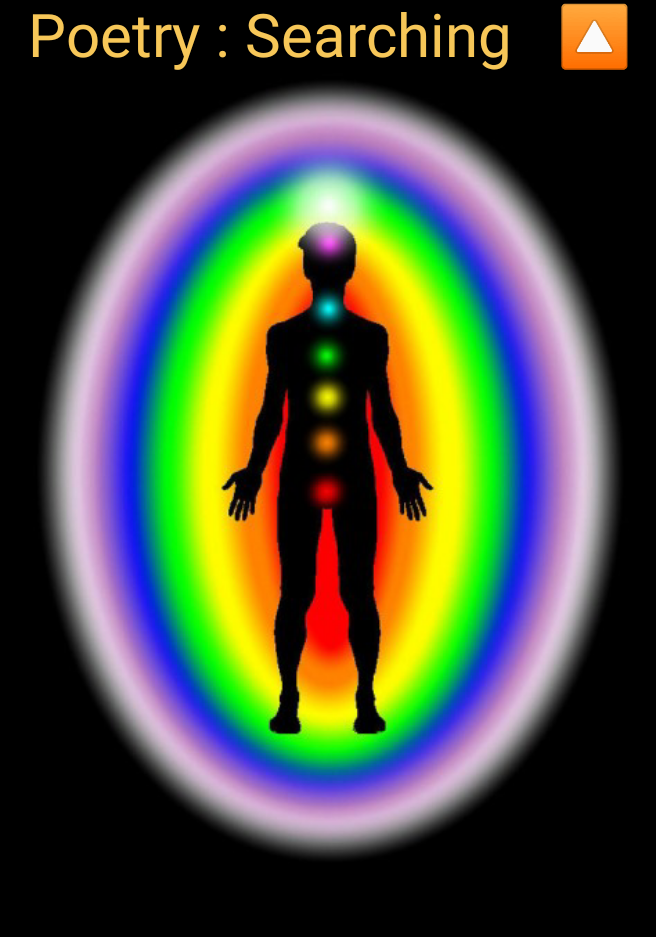
💚 Seven colours of Aura :
Aura , the existence of auras as the energy around every creature of this world. So we must aware of aura & respect from heart. The aura is a field of subtle , luminous radiation surrounding a person that changes in color, sizes & shape relation to our mood. When the aura is great then human is stronger or more powerful. It is said that children can see auras easily. The child can unknowingly add the aura colors to his drawings. The colors of aura can be realized only by fews. Obviously few people can also feel vibes coming from auras.
Indian religions such as Hinduism and Buddhism have discovered auras since time was immemorial, connecting them to chakras and kundalini.
In Latin and Ancient Greek, aura means wind, breeze or breath.
Charles Webster Leadbeater was the first person to address auras in that context. He was a priest in the Church of England.
In his book Man Visible and Invisible published in 1902, he illustrated a man’s aura in various stages. In 1910, Leadbeater introduced the modern conception of auras by incorporating the Tantric notion of Chakras in his book The Inner Life.
In 1977, American esotericist Christopher Hills published the book Nuclear Evolution: The Rainbow Body, which presented a modified version of Leadbeater's occult anatomy.
The book The Third Eye, written by Cyril Henry Hoskin under the pseudonym Lobsang Rampa, claims that Tibetan monks opened the spiritual third eye using trepanation in order to accelerate the development of clairvoyance and allow them to see the aura. It also includes body gazing techniques purported to help achieve aura visualization. The book is by some considered to be a hoax.
Auras has seven colors. Each color is believed to have alternate importance :-
Red – fearless and passionate
Pink – Deeply sensitive and gentle in nature
Orange – creative and full of emotion
Yellow – Confident and happy with high self-esteem
Green – Natural born self-healers who are drawn to nature and animals
Blue – Caring, nurturing, and protective
White – Spiritually motivated, positive, and uplifting