Library

 Profile
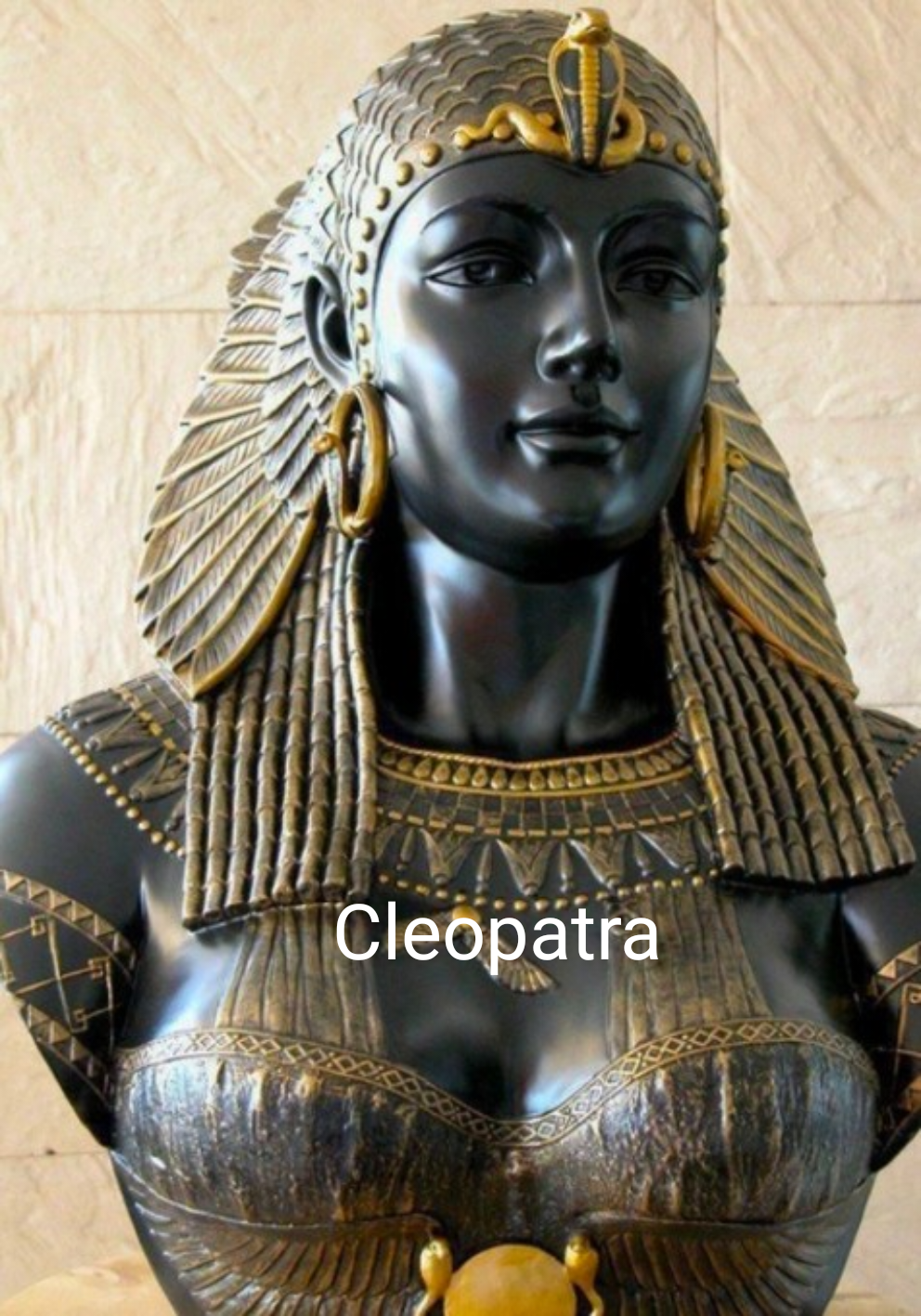
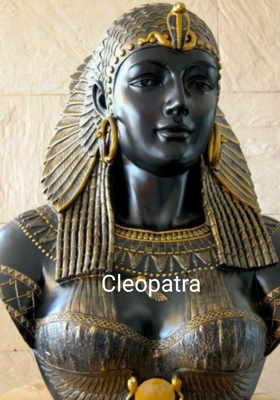
Cleopatra
Cleopatra

The heat of Alexandria in August was a physical weight, pressing down on the limestone terraces of the Lochias promontory like a warm, damp wool blanket. Inside the private chambers of the royal mausoleum, however, the air was thick with the scent of burning frankincense, crushed myrrh, and the metallic tang of old blood.
Cleopatra VII Philopator, the last active ruler of the Ptolemaic Kingdom of Egypt, stood before a tall mirror of polished bronze. She was thirty-nine years old, and for the first time in her life, she looked every day of it. The sharp, aquiline profile that had once stared down the Roman Senate from golden tetradrachms was now hollowed by grief and sleeplessness. Dark shadows bruised the skin beneath her large, expressive eyes—eyes that the Roman poets had called bewitching, though she knew her true magic had always lived in her voice and her mind.
"Leave the kohl, Iras," Cleopatra said softly, her Greek crisp and measured despite the tremor in her hands. "Today is not a day for seduction. Today is a day for majesty."
Iras, her faithful attendant since childhood, bowed her head, blinking back tears as she set down the ivory jar. Charmion, her other lifelong confidante, stepped forward with the heavy, pleated linen of the ceremonial robe of Isis—the goddess whose living incarnation Cleopatra had claimed to be for nearly two decades.
Outside the heavy bronze-plated doors, the city that Alexander the Great had founded three centuries ago belonged to another man. Gaius Julius Caesar Octavianus—Octavian, the adopted son of her first great Roman ally, the cold-blooded boy who had outmaneuvered Mark Antony at Actium and chased them both to the edge of the sea—held Alexandria in an iron grip.
Antony was already dead. Two days ago, deceived by a false rumour of Cleopatra’s suicide, the great Roman general had fallen on his own sword. They had hoisted his bleeding, broken body up through the upper window of this very tomb using ropes and pulleys, because Cleopatra had barred the lower doors against Octavian’s soldiers. He had died in her arms, stained with his own blood, asking her not to weep for his fallen fortunes, but to remember the days when he was the greatest man in the world.
Cleopatra closed her eyes, feeling the phantom warmth of his heavy hand against her cheek. She had loved Julius Caesar with the fierce, calculating ambition of a young queen fighting for survival. She had loved Mark Antony with the desperate, intoxicating passion of a woman who believed she could build an eastern empire to rival Rome itself. Now, both titans were ashes, and she was trapped in a stone box with two serving women and a basket of figs.
"The Roman guard is outside, Your Majesty," Charmion whispered, fastening the golden asp diadem onto Cleopatra’s dark, braided hair. "Proculeius and Epaphroditus. They say Octavian awaits your word."
Cleopatra looked at her reflection. The diadem gleamed against her brow. She was Macedonian Greek by blood, descended from Ptolemy Soter, one of Alexander’s fiercest generals. Yet she had been the first of her dynasty to learn the native Egyptian tongue—along with eight others, from Aramaic to Latin and Ethiopian. She had ruled not as a foreign conqueror, but as a Pharaoh. She had rebuilt temples, stabilized a bankrupt treasury, and kept the Roman eagle from swallowing Egypt whole for twenty-two years.
She would not walk through the streets of Rome in golden chains. She would not let the Roman mob jeer at the mother of Caesarion, the queen who had once held their empire in the palm of her hand, as she was dragged behind Octavian’s triumphal chariot.
"Bring the scribe," Cleopatra commanded, her voice ringing with the old authority that had once silenced quarrelsome ministers in the Brucheion palace. "And bring the basket."
Three days earlier, before the gates of Alexandria had fallen, Cleopatra had sat in the great library of the palace, surrounded by scrolls of papyrus and the quiet rustle of history. Even then, with Octavian’s legions marching across the Pelusium frontier, her mind had been a restless engine of strategy.
She had summoned her oldest surviving advisor, Olympos, a Greek physician whose family had served the Ptolemies since the days of her grandfather.
"Tell me honestly, Olympos," she had said, tracing the edge of a silver inkstand. "If the negotiations with Octavian fail—if he refuses to leave Egypt to my children—what are my options?"
Olympos, a man whose beard was as white as the papyrus before him, had looked around the empty hall before leaning in. "A queen always keeps a door open, Majesty. Even when the walls are closing in."
"I have tested the poisons on the condemned prisoners in the dungeons," Cleopatra murmured, her tone clinical, detached. She had spent months studying toxicology, recording every reaction with the precision of a scholar. "The viper’s venom is swift, yet it leaves the limbs twisted and discolored. The hemlock brings a cold paralysis, slow and agonizing. Nightshade clouds the mind with madness before the heart stops."
"There is a blend," Olympos said quietly. "A distillation of Egyptian opium, mixed with the crushed seeds of wolfsbane and a drop of the sacred cobra’s essence. It does not burn the throat. It brings a heavy, dreamless sleep within minutes. The skin remains smooth, as if the sleeper were merely resting."
Cleopatra had nodded slowly. "And the asp?"
"A symbol, Majesty. A Pharaoh’s death. To be bitten by the uraeus, the sacred serpent of Ra, is to be claimed directly by the gods. It turns a defeat into an apotheosis."
She had looked at him then, a faint, sharp smile touching the corners of her mouth. "Let Rome believe what it wishes, Olympos. History is written by the victors, yes—but legend belongs to those who know how to stage their final act."
Now, standing in the cool gloom of the mausoleum, that final act had arrived.
Octavian had visited her the day before. He had come expecting to find a broken, weeping woman, perhaps hoping she would try to seduce him as she had seduced Caesar and Antony. Instead, he had found Cleopatra lying on a simple pallet, dressed in a plain mourning tunic, her hair disheveled, her voice trembling with calculated vulnerability.
She had fallen at his feet, pleading for her life, handing him an inventory of the royal treasures—only to let her treasurer, Seleucus, "betray" her by revealing she had held back several priceless jewels. Cleopatra had feigned outrage, striking Seleucus across the face before turning back to Octavian with tears in her eyes.
"Forgive me, Caesar," she had sobbed, playing the desperate mother. "I did not keep those trinkets for myself. I kept them to offer as gifts to your sister Octavia and your wife Livia, so that they might plead with you to show mercy to my children."
Octavian had left satisfied, convinced that Cleopatra was clinging desperately to life and could be kept alive long enough to march in his Roman triumph. He had ordered his freedman, Epaphroditus, to watch her closely, ensuring she had no weapons, no ropes, no vials of poison.
He had underestimated her. Everyone always did.
A peasant from the countryside had arrived at the mausoleum gates that morning, carrying a woven basket covered with fresh green fig leaves. Epaphroditus’s guards had stopped him, lifting the leaves to inspect the plump, purple figs beneath. Seeing nothing suspicious, they had laughed at the rustic’s devotion to his fallen queen and waved him through.
Now, the basket rested on a low cedar table beside Cleopatra’s golden couch.
"Write, Theodotus," Cleopatra told her Greek scribe, who sat cross-legged near the window, his reed pen poised over a fresh sheet of papyrus. "Address it to Gaius Julius Caesar Octavianus."
Theodotus dipped his pen into the black ink, waiting.
"I, Cleopatra, Queen of Egypt, ask of you one final grace," she dictated, her voice steady and resonant. "As you have conquered my kingdom and claimed my crown, deny me not the right to share my grave with Mark Antony. Let no man separate in death those whom fate and love united in life."
She paused, watching the scribe’s hand move across the sheet. When he finished, she took the royal signet ring from her finger—the engraving of the eagle and the thunderbolt—and pressed it firmly into the warm wax seal at the bottom of the scroll.
"Send this to Octavian immediately," she told Epaphroditus, who stood just inside the doorway, his hand resting on the pommel of his short Roman sword. "Tell him it is urgent. Tell him it concerns the surrender of the remaining royal archives."
Epaphroditus hesitated, glancing around the room. He saw two women adjusting the folds of the Queen’s ceremonial gown, a basket of fruit, and a scroll. There was no dagger, no brazier of coals, no vial of dark liquid in sight. Eager to please his master with news of the Queen’s complete submission, the Roman bowed stiffly, took the scroll, and stepped out into the blinding sunlight, pulling the heavy bronze door shut behind him.
The metallic clang echoed through the chamber like the tolling of a temple bell.
Silence settled over the mausoleum, broken only by the distant, muffled roar of the Mediterranean waves crashing against the seawall below.
Cleopatra turned toward the cedar table. Iras and Charmion stood beside her, their faces pale but resolute. Neither woman had asked to be spared. In the royal court of Alexandria, loyalty was not a convenience; it was a sacred oath.
"You have served me well," Cleopatra said, reaching out to touch Charmion’s cheek, then Iras’s. "Better than any general, better than any minister. When the poets speak of Egypt’s last queen, they will speak of you as well."
"We follow our goddess," Iras murmured, kneeling beside the couch.
Cleopatra lifted the lid of the fig basket. Beneath the top layer of sweet, dark fruit lay a small, coiled Egyptian cobra, sluggish in the cool shade of the leaves, and beside it, nestled in a hollow carved into a thick wooden comb, a slender glass phial filled with amber liquid.
She looked at the serpent for a long moment. Its hooded head rose slightly, flicking a forked tongue at the scent of frankincense. To the Egyptians, the cobra was Wadjet, the fierce protector of the Pharaoh, the fiery eye of the sun god Ra.
Slowly, deliberately, Cleopatra uncorked the hollow comb and poured the amber liquid into a golden goblet of wine. She raised the cup toward the alabaster urn that held Antony’s ashes on the altar across the room.
"To the East," she whispered. "To what might have been."
She drank the wine in a single, smooth draught. It tasted faintly of bitter almonds and sweet honey. She set the goblet down, then reached into the basket and lifted the cold, muscular body of the cobra, pressing its head gently against the soft skin of her left forearm.
A sharp, twin prick of pain—like the bite of a thorn—flared in her arm, followed instantly by a spreading wave of warmth.
She placed the serpent back into the basket and lay down upon the golden couch, arranging the pleated linen of her Isis robe so that it fell in graceful, unbroken folds over her legs. Iras and Charmion followed, each taking a small dose from the remaining phial before sinking onto the cushions at her feet.
The warmth in Cleopatra’s arm rose toward her chest, heavy and soothing, washing away the crushing weight of the past year. The voices of the Roman guards outside faded into the rhythm of the sea. In the gathering dusk of her vision, she was no longer in a locked tomb in a conquered city.
She was nineteen again, unrolling a carpet at the feet of Julius Caesar, watching the astonishment widen the eyes of the master of Rome. She was twenty-eight, sailing up the Cydnus River on a barge with a gilded stern and purple sails, dressed as Aphrodite, while Mark Antony waited on the shore, already lost to her before she had spoken a single word. She was the mother of four royal children, the scholar of the Great Library, the woman who had forced the greatest empire on earth to hold its breath.
Her breathing slowed, deep and effortless. The golden diadem caught a single shaft of late afternoon sunlight slanting through the high narrow window, gleaming like a star against her brow.
Twenty minutes later, the bronze doors burst open.
Octavian’s guards rushed into the chamber, swords drawn, followed closely by Proculeius and Epaphroditus, who held the broken seal of Cleopatra’s letter in his trembling hand. Octavian had read her plea to be buried with Antony and had realized, too late, that the scroll was not a surrender—it was a farewell.
The soldiers halted abruptly at the foot of the dais.
There was no blood on the marble floor. There was no struggle, no sign of agony. Cleopatra lay motionless upon the golden couch, crowned and robed in the full regalia of a Pharaoh, her face serene and unmarred, as if she had simply drifted into an afternoon slumber.
Iras lay dead at her feet. Charmion, barely clinging to life, swayed slightly as she reached up with trembling fingers to straighten the golden asp diadem that had slipped slightly askew on her mistress’s brow.
"Was this well done, Charmion?" one of the Roman officers barked in shock and anger.
Charmion turned her fading eyes toward the Roman, a faint, triumphant smile touching her lips before she collapsed beside her queen.
"Extremely well done," she whispered. "And fitting for a descendant of so many kings."
When Octavian entered the mausoleum an hour later, he stood for a long time in silence, gazing down at the still form of the woman who had defied him to the very end. He had conquered her fleet, taken her treasury, and annexed her ancient kingdom to feed the granaries of Rome. Yet as he looked at the serene, crowned figure before him, the future Emperor Augustus knew that in the final, decisive battle, Cleopatra had beaten him.
True to her last request, he ordered that she be buried with royal honors beside Mark Antony—leaving their resting place to vanish into the shifting sands and rising waters of Alexandria, forever beyond the reach of Rome.