Library

 Profile
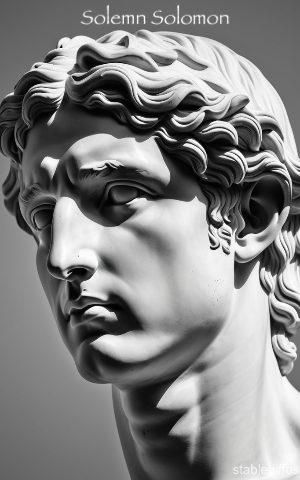
Solemn Solomon
Solemn Solomon

Here he stood, feeling not as he should. His men cheered, but Solomon thought only of how his enemy jeered before he severed his pate with pure hate. "Mark my words, you'll be dead in my stead if you chop off my head. So says Han Dulla, horseman of Hill Tara." He wished to call it drivel, such talk of death (and revival), but there were doubts in his mind: this was undeniable.
A man such as Han never lied, even as he died. They were similar in that aspect, both having a level of honor and respect that none could object. But then how would the horseman rise from his demise? A spell of some sort, one that threatened King Charles's court? Or perhaps his will would cause him to live on, sword drawn till dusk turned dawn: a specter riding upon oblivion.
Solomon shook his head; how could the dead make the living fall in their stead? Had he gone crazy or simply hazy from how busy he'd been tracking Han Dulla, the man fighting for Hill Tara? The dead could not rise as a deadly surprise. Such a thing would never happen under God's eyes.
The Irish heathen had met his demise, his last words a compromise on his honor, telling such lies.
Times like these made Solomon get on his knees, proud to be a part of British society where his deity responded to his piety entirely. Had Han and his Irish fellows merely converted to Christianity, this wouldn't have been their destiny. Such a pity.
"Prithee, general, tell me. What comes next for thee?" One of Solomon's men spoke, seeing the lack of hope disappearing from his brown oak eyes.
"I will be returning home, where me and my wife will make marry and be happy at her successful delivery," Solomon said, forgetting to be solemn at the words of the dead.
"Aye. I suppose we'll have to trust that other guy, Blanche, till Big Cross."
"If he guides you well, he can have all the recognition among the swells. I merely wished to do my duty: to do the heathens due cruelty." He fully believed in the cause, for it was his others' cause, and that was cause enough for him to be grim towards those who wished not to join in on their religion. Truly, he was a pigeon; flying with the flock, without a single balk at any talk and mockery of others' beliefs and griefs towards them.
"This is the start of mayhem," a voice in his head claimed, but he'd never be ashamed to carry this legacy (again).