Library

 Profile
The Reunion
The Reunion

Wilhelm had come to India for a fifteen-day tour with me in the late-summer season. I wished to show him the Great Himalayas which is my personal favourite attraction of this glorious country. Wilhelm, being from Germany, would find the temperature in these lofty fold mountains to be quite similar to his homeland.
Our plan was this—that Wilhelm would fly to Delhi and start on a train journey to Kathgodam in the Terai regions of Uttarakhand where I would join him. He told me that the little time that he had spent in Delhi felt like "being roasted in those tandoors". I symphatized with him and our first major face-to-face conversation was about Global Warming. That being over, we hopped on an Uttarakhand Government-owned bus that would take us to the town of Chaukori near Patal Bhuvaneshwar in the Pithoragarh District. The scenery, as always, was absolutely enchanting. From the tropical deciduous vegetation of the lower Shiwalik Hills, there was a transition to Evergreen Coniferous forests. The dominant conifers were Chir Pines and Wilhelm had never seen more beautiful pines than them. Their needles are of a shiny greyish-green colour and this looks absolutely wonderful. The sky was a brilliant blue without even a sign of a cloud.
We were hungry by the time we reached the city of Almora where we had a lunch at a wayside Dhaba—Local Kumaoni food. It was a hurried lunch as the bus driver was anxious to reach his destination before sundown. He was the shepherd and we were the sheep. More altitude was gained after travelling in a river valley for some time. At around 5 p.m., we reached Chaukori where we had made arrangements in advance at a hotel. The snow-capped peaks that were supposed to be seen in the north, north-east and north-west were veiled by dark snow clouds, thereby yielding no view. There was, however, a splendid late-afternoon view of the surrounding oak and pine forests.
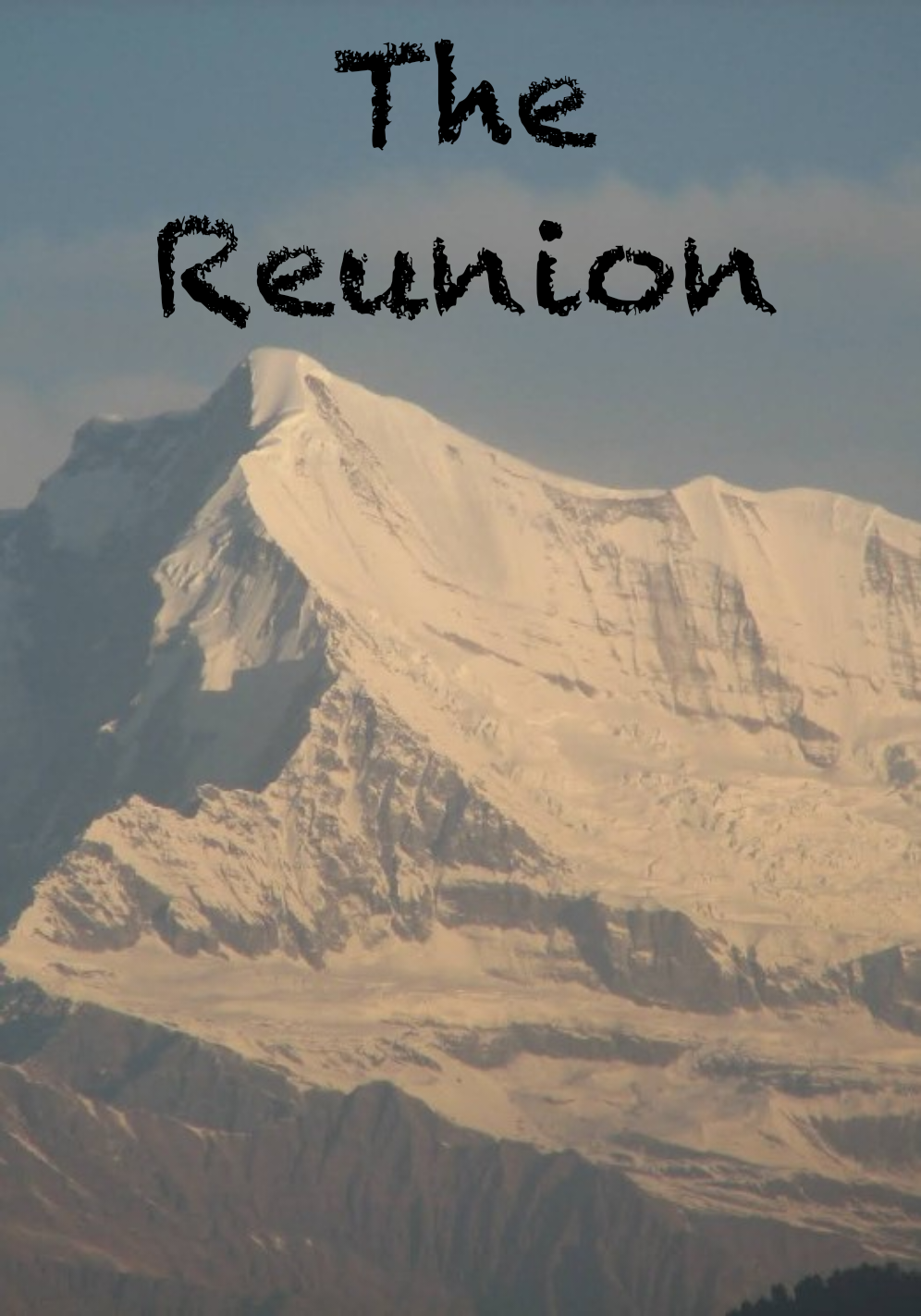
The next morning, both if us were up at 5 a.m. and we were not disappointed because there were no more clouds concealing the snow-capped Himadri peaks. We were unbelievably close to these peaks—Nanda Ghunti, Trishul, Mrighthuni, Maiktoli, Nanda Devi, Sunanda Devi, Nanda Khat, Nanda Kot, Rajrambha, Panchachulli, Adi Kailash, Chota Kedar and more—in order from left to right. The rising Sun illuminated these peaks from the top to the bottom in hues of pink, vermillion and then golden and the entire Himalayan countryside seemed to wake up from its slumber. It was Magic—the Magic of Nature which had induced me to fall in love with Nature the first time I had seen it and had the same effect on my friend.
We revelled this episode of Nature for over an hour before having breakfast. Then, we hopped on another bus that would take us to the town of Munsiyari. This journey was not as pleasant as the previous one—the road practically non-existent in some parts but the natural beauty made up for it with waterfalls, more forests and, occassionally the snow-capped Nanda Devi Range peeking out. It was shortly after 1 p.m. that we reached Munsiyari and went to have lunch at the homestay that had been pre-booked. We stayed at Munsiyari for a couple of days, revelling at the natural essence of the place and the way of life of the people there when an encounter with a Tibetan boy and his grandparents changed a few things.
The grandmother, Dorjee, had been a victim of oppression under them who invaded Tibet and took away the freedom of the Tibetan people. Her son and daughter-in-law, that is, the child's parents had been taken away from them shortly after the birth of the child's brother and this had left the old couple to fend for themselves and their child. The family had, for a long time, been trading with Kumaoni traders and, with their help, the grandparents made the difficult journey across the high-altitude passes in the Himalayas and entered The Land of the Buddha. It was thanks to the Kumaonis that they had sustained themselves and the child, now a teenager, had received education. Their only grief was that they had tried hard to know the whereabouts of the boy's parents but had failed. The grandfather, Pema, said with tears in his eyes, "We were happy and free in our homeland then suddenly those soldiers came and took my children away. We do not know whether they are living or been killed whether they are in India or Tibet." The boy's name was Tashi and I felt very sad for him.
It was then that Wilhelm and I, moved by the condition of this family, decided to forget about our own material pleasures and find out the wherabouts of Tashi's parents. We began enquiries at several places—Wilhelm used his contacts to get in touch with a Tibetan lama who had settled in Germany and, was, in turn, put into direct conference with leaders of the Central Tibetan Administration, the Tibetan Government-in-exile. They were asked by us to find out if Tsering Thondup and Drolma Thondup were residing anywhere in India. Our stay in Munsiyari had been extended and we waited fervently for any news. Finally, about a day after the enquiry, the reply came that they were residing in Bylakuppe, Karnataka having escaped from Tibet a few years prior with their younger son. As to this younger son, he turned out to be the reincarnation of an important lama which was specifically the reason who they had been arrested by the PRC Government. By sheer luck, they had managed to escape. Coincidentally, it happened so that they were also looking for Grandfather Pema and Grandmother Dorjee. Their contacts were forwaded to us and we made it possible for the eldwerly couple to directly connect with their long-lost family members over phone, which they did with tears of joy in their eyes. They thanked us immensely and said that they had no words fit enough to express their gratitude to us. We kept them company until a small group came from Bylakuppe, among them came Tashi's parents and his lama brother. The reunion was heartwarming and I shall always cherish the smiles on their faces as long as I live. The party gave us silk scarves as a mark of respect and gratitude, even conveying the warm thanks and gratitude of H.H. The Dalai Lama who had been informed of our efforts. It had been a week in Munsiyari and we took our leave, happy that we could be of service to those in need. As for the family, they decided to settle in Munsiyari with the Kumaonis, the only exception being the younger son who had to return to Bylakuppe for his monastic education.
"All's well that ends well!", remarked Wilhelm on our journey to Kausani, the next place we had to visit. I could not agree more and prayed to the Buddha for the end of suffering of all beings in this world.