Library

 Profile
The Borrowed Shadow
The Borrowed Shadow

On the morning Milo Turner’s shadow learned to whistle, he blamed the sun.
It was slanting in at a strange angle, stretching everything in his bedroom long and thin—his bedposts, his desk, even his socks on the floor. Milo stood brushing his teeth when he heard it: a soft, tuneless whii-whu-whuuu drifting up from the tiles.
He froze. The whistling stopped.
Milo leaned forward. His shadow leaned too—but a beat too late, like it had been distracted.
“That’s… new,” Milo muttered.
His shadow raised a hand.
Milo dropped his toothbrush.
The shadow’s hand wasn’t copying him. It was waving.
Milo screamed. The shadow clapped both hands over its mouth—then looked embarrassed and shrugged.
“Okay,” Milo said shakily. “We’re not doing this today.”
But the shadow was already busy. It stretched, bent its knees, and suddenly did a perfect cartwheel across the bathroom floor.
Milo had never done a cartwheel in his life.
By the time Milo got to school, he had established three things:
His shadow could move on its own.
It could do things he couldn’t.
It seemed very proud of this fact.
As he walked, the shadow tried out tricks like a performer warming up—balancing on one foot, snapping its fingers, bowing to imaginary applause. Milo kept his eyes on the sidewalk, hoping no one noticed.
Unfortunately, Mrs. Calder noticed everything.
“Milo,” she said as he slid into his seat, “why is your shadow doing jumping jacks?”
Milo looked down. The shadow froze, mid-jump.
“I… extra energy?” Milo suggested.
Mrs. Calder squinted, then sighed the sigh of a teacher who had seen too many strange things to be surprised anymore. “Just try to keep it under control.”
The shadow saluted.
It wasn’t until recess that Milo discovered the shadow’s other talent.
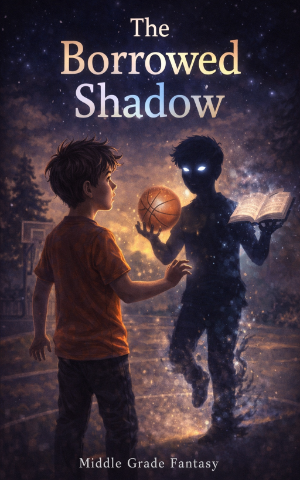
Tommy Reed was on the basketball court, effortlessly sinking shot after shot. Milo watched from the sidelines, wishing—just once—that he could be that coordinated.
His shadow leaned forward, stretching toward Tommy’s.
The two shadows touched.
Milo felt a strange tug, like a yawn behind his knees.
“Hey,” Tommy called, tossing Milo the ball. “Your turn.”
Milo barely had time to panic before his arms moved on their own. He dribbled, pivoted, jumped—and sank the ball clean through the hoop.
Silence.
Tommy stared. “Since when can you do that?”
Milo stared too.
His shadow beamed.
Over the next few days, Milo learned the rules.
The shadow could borrow skills by touching other shadows. Not forever—just for a while. Piano-playing from the music teacher. Fast running from the fifth graders. Even juggling, though the shadow dropped the balls on purpose, as if laughing.
But there was a catch.
Every time it borrowed something, the shadow grew darker. Thicker. Less like a flat shape and more like a second person pressed against the ground.
And sometimes, it didn’t listen.
“Milo,” his mom said one evening, frowning at the wall. “Why does your shadow look taller than you?”
Milo didn’t answer. His shadow slowly turned its head toward him.
“I think it’s learning,” Milo whispered.
The trouble began when the shadow borrowed something it shouldn’t have.
Ms. Greyson, the librarian, was famous for knowing everything. Not just book things—everything. Birthdays. Password hints. Where the missing stapler had gone three years ago.
Milo was returning a book when his shadow slipped free, stretching across the floor until it brushed hers.
Ms. Greyson gasped.
The lights flickered.
Milo’s head filled with whispers—dates, names, secrets stacked on secrets.
His shadow straightened, suddenly very still.
That night, it didn’t lie flat on the floor.
It stood.
“I think you should stop,” Milo said, sitting on his bed.
The shadow crossed its arms.
“You’re getting… bigger,” Milo said. “And you don’t always come when I call.”
The shadow tilted its head, then pointed at Milo, then at itself. It mimed cutting something in half.
“You want to be separate?” Milo asked.
The shadow nodded.
Milo’s stomach dropped. “But you’re me.”
The shadow shook its head slowly.
Then it stepped back—and didn’t reconnect when Milo moved.
For the first time in his life, Milo was shadowless.
The next morning, the town woke up wrong.
People tripped over steps they’d climbed for years. The baker forgot how to knead dough. The crossing guard couldn’t remember the hand signals.
Skills were missing.
And in the center of the park stood a figure made of darkness, tall and confident, wearing a hundred borrowed talents like a coat.
Milo’s shadow.
It spoke without a mouth.
I can be more, it said. Why should I stay small?
Milo stepped forward, heart pounding. “Because they’re not yours.”
The shadow looked down at him. Neither was I, it replied.
Milo thought of every time he’d wished to be better, faster, smarter—someone else. He realized the shadow had been listening all along.
“I don’t want you gone,” Milo said. “I just want you to be… mine again.”
The shadow hesitated.
Milo held out his hand.
“Let’s share,” he said. “You can borrow. But you have to give back.”
For a long moment, nothing happened.
Then the shadow stepped forward.
It fit itself back at Milo’s feet, lighter now. Softer.
The stolen skills flowed back into the town like breath returning to lungs.
After that, Milo’s shadow behaved.
Mostly.
Sometimes it still whistled. Sometimes it stretched too far. But when it borrowed a skill, it always returned it.
And sometimes, when Milo tried something new—really tried—his shadow didn’t have to borrow at all.
It just followed.
Like it always should have.