Library

 Profile
The Hourglass Homework
The Hourglass Homework

By the time the final bell rang, Mira Patel’s notebook looked like a battlefield—crossed-out fractions, ink blots, and one big red circle around Try again. She sighed and packed her bag slowly, already dreading the walk home.
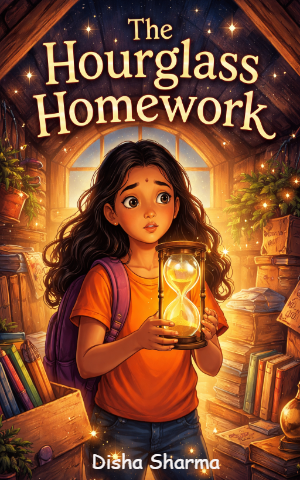
At the bottom of her backpack, wrapped in a faded handkerchief, was the hourglass.
It wasn’t ordinary. The sand shimmered like crushed stars, and the glass felt warm, even on cold days. Mira had found it last winter in her grandmother’s attic, tucked inside a shoebox labeled School Things. Grandma had smiled oddly when Mira showed it to her and said only, “Be careful what you wish to redo.”
Mira had learned how it worked by accident.
The first time, she’d flipped it after bombing a spelling test. The sand fell, the world hummed, and suddenly—she was back at her desk, test blank, teacher smiling, the words lined up neatly in her head. She aced it.
But later that day, when her best friend Riya asked about the mango ice cream they’d shared last summer, Mira had stared blankly. The memory was gone, like a page torn from a book.
Redo a mistake. Lose a memory.
Tonight, the hourglass felt heavier than usual.
Mira spread her math homework across the kitchen table. Long division with remainders. She tried once, twice, three times. The answers wobbled. Her stomach tightened.
“I can’t fail again,” she whispered.
Her fingers brushed the hourglass.
Flip.
The sand began to fall.
The hum returned, soft and deep, like a distant train. The numbers rearranged themselves in her mind. Her pencil flew. When the sand settled, the page was perfect.
Mira smiled—then froze.
Something was missing.
She looked around the kitchen. The yellow clock. The chipped mug. Her mom’s humming from the other room. Everything seemed normal… except she couldn’t remember the tune her mom always hummed while cooking.
A small thing, she told herself. It was fine.
Over the next week, Mira flipped the hourglass again and again.
For a science quiz. For a messy art project. For a forgotten library book. Each time, her work improved. Each time, something slipped away.
She forgot the name of her first pet.
Then the smell of rain on hot pavement.
Then the way Grandma’s laugh bubbled up before she told a joke.
The losses stacked quietly, like dust.
One afternoon, Riya waved from across the playground. “Race you to the gate!”
Mira hesitated. She knew this girl was important. She knew they were friends. But the inside jokes, the shared secrets, the reason Riya’s smile felt familiar—those were gone.
“Uh… sure,” Mira said.
Riya slowed. “Are you okay?”
“I think so,” Mira replied, unsure.
That night, Mira finally opened the shoebox again. Beneath the hourglass lay a folded note, written in her grandmother’s careful handwriting.
Magic makes life easier, it read, but learning makes it yours.
Mira’s throat tightened.
She remembered Grandma teaching her how to knead dough, guiding her hands patiently, letting her mess up again and again. Those memories—were they still there?
She tried to picture Grandma’s face.
It flickered.
Panicked, Mira clutched the hourglass. “No more,” she said aloud. “I won’t flip you again.”
But the biggest test of the year loomed ahead—the Math Marathon. Three pages. One hour. No redos.
The night before, Mira sat at her desk, staring at the hourglass. The sand glowed brighter than ever, pulsing like a heartbeat.
Just once more, a voice whispered. You’ll remember enough.
She picked it up.
Then she noticed something new: a thin crack along the glass.
A warning.
Mira set the hourglass down and opened her notebook instead. She worked slowly, checking each step. When she got stuck, she didn’t reach for magic. She reached for patience. For scratch paper. For breathing through the confusion.
It was hard. Her head ached. She made mistakes—and fixed them the long way.
The next day, during the Math Marathon, Mira’s hands shook. The problems were tough. She skipped some and returned later. She erased. She rewrote. She finished just as the bell rang.
She walked out feeling… light. Unsure, but proud.
The results came a week later.
She hadn’t topped the class.
But she’d passed.
That evening, Mira climbed into the attic with the shoebox. She held the hourglass one last time.
“I don’t hate you,” she said softly. “You helped me. But you cost too much.”
She placed it back in the box and closed the lid.
As she stood, a warm breeze drifted through the attic window, carrying the scent of mangoes and summer rain.
Mira gasped.
The memories didn’t rush back all at once. They returned gently, like shy birds—her pet’s name, Grandma’s laugh, and Riya’s jokes.
Not all of them came back.
But enough did.
Downstairs, her mom hummed a familiar tune.
Mira smiled and joined in, singing the parts she remembered—and learning the rest again, one note at a time.
In the days that followed, Mira noticed small changes in herself. She no longer rushed through her homework just to be done. She paused. She reread questions. When confusion crept in, she didn’t panic—it felt familiar now, like an old classmate she knew how to sit beside without fear.
One evening, Riya came over with a stack of books and two chocolate bars. They studied together, laughing over wrong answers and celebrating tiny victories. Mira realized something important then: struggling didn’t feel lonely anymore. It felt shared.
Up in the attic, the shoebox stayed closed. Dust gathered on it, soft and quiet. Mira didn’t feel tempted. The hourglass had taught her its final lesson—not by flipping, but by staying still.
At school, her grades didn’t suddenly soar, but her confidence did. Teachers noticed her questions were sharper and her explanations clearer. She wasn’t just fixing mistakes anymore—she was understanding them.
One night, as Mira drifted to sleep, she thought about time. How it moved forward no matter what. How moments, even imperfect ones, shaped who she was becoming.
Mistakes, she realized, weren’t cracks in her life.
They were the lines that helped the light get in.
And this time, she didn’t wish to turn anything back.