Library

 Profile
Tiger's Fall
Tiger's Fall

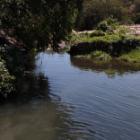
It was a scorching day in October 2015. We were driving in our bright yellow Nano, and the new army checkpoint at Vaduvakkal bridge didn't pay much attention to us. We slowed down to take in the beautiful scene: a lone fisherman stood in the shallow water, casting his net. He balanced on the burnt remains of the bridge that once connected both sides of the serene waterway.
There, a stone plaque caught our eye. It said, "Waduwakkal (sic) causeway is important. It connects Mullaithivu and Pudukuduiruppu. Terrorists (sic) destroyed part of it during a humanitarian operation. This prevented the advancing (sic) army from reaching Pudukuduiruppu. The place marks the end of a 14 km long terrorist ditch cum bund, which separated the No Fire Zone (NFZ) from the rest of the area. The ruthless terrorists (sic) were determined to keep innocent civilians in the NFZ..."
Despite the odd grammar, this plaque was the only sign that we were at the very spot where, on May 16, 2009, thousands of Sri Lankan Tamil civilians faced a rain of death. They were trapped in the waterway on the final day of a harsh war against the Tigers, led by their tough leader, Prabhakaran. The memories of that day hung heavy in the air as we stood there, marking the beginning of a story deeply etched in history.
In addition to the haunting documentary "Killing Fields" by the UK's Channel 4, there existed an extensive archive of photographs and videos that documented the frantic exodus of the terrified civilians. They made their way cautiously across the bund, forming a single-file line, comprised of men, women, and children, both non-combatants and belligerents in civilian attire. Their meager possessions were balanced precariously on their heads as they traversed the same waterway toward the so-called No Fire Zone.
Amid this chaos, many desperately tapped out text messages on their phones. The LTTE's second-tier leadership reached out to contacts across the globe, from Tamil politicians in Chennai, India, to United Nations (UN) officials in New York and former UN peace negotiators in Oslo. Their singular objective was to negotiate a safe passage out of the war-torn zone.
Back in early April, the LTTE militia had forcibly turned thousands of civilians into human shields. However, in response to the Sri Lanka Army's calls, broadcasted through megaphones, urging them to surrender, many paid a heavy price. When they obeyed, they were caught in a brutal crossfire, some drowned in the knee-deep waters, their lifeless bodies trapped among the unforgiving rocks below. Their possessions, bags, and clothing were strewn across the azure waters, and the white foam became tainted with their blood.
For those who survived the relentless shelling, their ordeal was far from over. They suffered in countless ways, bearing the scars of a thousand deaths after the battle. Many were subjected to brutal beatings, horrific acts of rape, abductions, and summary executions in acts of vengeance that plunged them deeper into the abyss of suffering.
"The Vaduvakkal Death Trap," read the ominous headline. "Over 40,000 dead," the UN Report of the Secretary-General's Panel of Experts on Accountability in Sri Lanka revealed. Tens of thousands had perished in the relentless onslaught from January to May 2009, many of them fading into anonymity in the carnage of those final days, as the chilling document known as the Darusman Report conveyed. Unofficial accounts whispered of a toll reaching 100,000, while official figures later downsized the tragedy to a mere 15,000. Somewhere in the murky depths between those numbers lay the haunting truth.
My companion on that sweltering October day was Ramkumar, a young journalist from the Tamil newspaper Virakesari. He cautioned me against openly taking photographs, even though other tourists had slowed their vehicles in front of us, clicking away to capture war memories. We were navigating the brand-new, narrow bridge that reconnected both sides of the infamous waterway, and it had been six long years since the tragic events had unfolded. Yet, the man's concern about drawing undue attention remained, revealing the lasting scars etched into the hearts of the people.
Ever since the dramatic setback in the Wanni, as the war reached its climax in April 2009, the LTTE had forcefully relocated the Tamil populace from their homes, moving thousands into makeshift dwellings. They were placed in tented cities in and around the insurgents' bunkers in Mullaithivu, all in the hope of deterring the relentless advance of the Sri Lanka Army.
As the army closed in, senior LTTE members, who had come to terms with their inability to win the war, actively sought surrender. From May 10 to May 16, these senior leaders had conveyed to the trapped civilians in the camps that they were free to go wherever they wished, leaving once tightly controlled checkpoints unmanned.
Simultaneously, in a parallel effort to safeguard the innocent civilians, UN peace negotiator Solheim had proposed to the Rajapaksa government that the international community, especially the US and India, were willing to provide safe escort for those civilians and LTTE cadres who desired to surrender and seek refuge in the safe zones.
The plan had been set in motion—a ship destined for the north, carrying UN officials and international representatives on board. Their mission: to conduct a thorough census, capturing photographs and documenting the Tamils. The aim was to disarm them, transport them to Colombo, and eventually release them.
Solheim, the UN peace negotiator, and the LTTE middleman known as KP were scheduled to meet in Oslo to iron out the details on that fateful 16th of May. Little did the thousands waiting in the Wanni know that their hopes were about to be shattered. At the eleventh hour, Prabhakaran, the unyielding leader of the Tigers, called off the meeting. The suggestion had fallen on deaf ears. President Rajapaksa, who happened to be visiting Jordan at the time, had different plans. He aimed to secure the surrender of the top LTTE leadership, with little intention of allowing hundreds of thousands of LTTE sympathizers to roam free.
KP would later reveal to the media that the LTTE leadership was holding out for a conditional surrender. They wanted to lay down their arms to a third party, not the Sri Lankan government, in exchange for a ceasefire and the initiation of negotiations for a political solution.
However, neither the international community nor Colombo was willing to entertain such ideas. Prabhakaran himself had other clandestine plans. He reached out to Delhi through an intermediary to negotiate a separate escape route. When the mass exodus commenced on the morning of May 16, Prabhakaran, or someone similarly ill-advised, decided to dispatch two suicide bombers. Tragically, this reckless action led to the needless deaths of hundreds in a fierce do-or-die battle, as recounted by a journalist embedded with the Sri Lanka Army.
For those who sought to surrender, the Sri Lanka Army's suspicion only deepened. They were subjected to a degrading process, forced to strip down, shed their outer clothing, abandon their possessions, and then approach the water's edge clutching white flags. But it was all a charade, a cruel masquerade.
To the army, every Tamil who had lived under the shadow of the LTTE was a potential threat, viewed as a hidden sympathizer of the Tigers. Men, women, and children who had any connection, no matter how tenuous, to Tiger cadres were considered legitimate targets. The world looked on in silence as the Tamils from the Wanni, who had publicly surrendered, vanished without a trace. The order was clear: "Take no prisoners." This was the day of the White Flag massacre, a day that would be forever remembered in infamy. There were no records, no paperwork, no documentation of those who had been detained.
The deeply disturbing videos aired by Channel 4 and the photographs published in various media outlets around the world bore witness to the horrors that unfolded. Young boys and girls barely into their teens, women, and men were herded behind the nearest truck. Some were subjected to unspeakable acts of brutality, and all met their end in cold blood. Their last hours were marked by unimaginable terror, etched in the fear on their faces. This was the price they paid simply for being of Tamil origin or for living unwillingly under the oppressive rule of the LTTE.
One particular video, capturing the harrowing final moments of the Tamil television presenter Isaipriya, served as a chilling epitome of the mindless brutality that swept over those hapless innocents in their dying moments. Struggling to stand, her legs trembling, she clearly pleaded for her life after enduring unspeakable horrors. The soldiers, allegedly mistaking her for Prabhakaran's daughter, Dwaraka, callously dragged her away, accompanied by a naked man. The footage was broadcast on Tamil television stations worldwide, and the fate of this beloved young woman, who suffered the torment of gang rape and a brutal end, symbolized the senseless bloodlust that consumed the Sri Lanka Army as they extinguished the last glimmer of hope for the Tamils.
According to the Sydney Morning Herald, that was the day the war came to an end. In the aftermath, some of those who had surrendered were discovered lifeless, their bodies scattered in the days that followed. However, a significant number remained unaccounted for, and it is widely believed that none of those who had chosen to surrender managed to escape with their lives intact.
In the relentless propaganda battle waged by both sides, and as part of a concerted effort to conceal the killing of non-combatants, which UN aid agencies would later starkly label as genocide, the Sri Lankan media had circulated reports. These reports claimed that in the days leading up to the final battle, civilians who had attempted to flee LTTE camps had been ruthlessly killed, with their lifeless bodies displayed as a macabre deterrent to others considering escape.
Sri Lankan authorities contended that the photographs depicting the victims were of individuals killed by the LTTE. They argued that they were unfairly accused of the White Flag massacre by LTTE remnants who were testifying before the UN Human Rights Commission in Geneva.
Amid the chaos of bloody surrenders and vanishing hope, only a select few of his close aides were privy to the whereabouts of the elusive LTTE leader, Prabhakaran. However, as the Sri Lanka Army continued to eliminate the last vestiges of opposition, clearing the dense mangroves and the lagoons held by the militia, the hunt for Prabhakaran, the man whom the Tamils had once blindly relied on for guidance to safety, intensified.
The Sri Lanka Army's elite special forces meticulously tracked his movements, and in a cruel turn of fate, they succeeded in drawing out and killing his older son, Charles Antony, who was just twenty-four. If the son was so close, it begged the question: Could the father be far behind?
After several false alarms during clearing operations, Prabhakaran's lifeless body was discovered a day later on May 17. His remains lay in the flat marshes of the Nanthikadal lagoon, just across the bridge. Beside him, a handful of dead bodyguards shared his tragic fate. One side of his head had been obliterated, and his forehead was pierced with bullets. His lifeless body lay soiled and blackened, a scrap of black cloth covering his genitalia.
Nanthikadal marked the final reckoning, a stark contrast to the fabled Dunkirk that the Tamil diaspora had envisioned it to be. Unlike Vaduvakkal, he had no escape route to the sea. But fervent LTTE supporters refused to accept that Prabhakaran had met his end under a hail of Sri Lanka Army bullets in these marshes on the day his body was discovered. Adding to the intrigue was the fact that the army's chief, General Fonseka, waited an additional forty-eight hours before officially announcing his death.
The general and the Rajapaksa government seemed determined to confirm Prabhakaran's demise beyond a shadow of a doubt. It wasn't until two individuals— the elusive LTTE official spokesperson Dhaya Master, who had managed to escape and been apprehended while fleeing with civilians, and former LTTE Eastern Commander Col Karuna, who identified Prabhakaran through his identity tag, 001, and a birthmark on his thigh—positively identified Prabhakaran's lifeless body that the official announcement was made.
Nonetheless, conspiracy theories persisted among the Tamil diaspora. Some contended that Prabhakaran had been captured late on the night of May 16 as he struggled through the marshes in an attempt to reach his submarine yard along the coast. The turn-off to Puthukkudiyiruppu led to his escape route, where his Sea Tiger naval chief, Commander Soosai, had constructed a massive semi-submersible vehicle. This contraption could be launched from a specially built 70-foot-deep water shipyard. It was meant to be his path to freedom. Prabhakaran had no intention of surrendering or getting caught; he even wore his cyanide capsule around his neck and was accompanied by only a handful of LTTE bodyguards.
The rusting, twisted, 30-foot submarine that lay in the submarine yard was now nothing more than a hollow shell. It was armored and divided into distinct sections: a forward section, a storage space for cargo, an engine room, and a living area. It appeared far from seaworthy, but six years earlier, it might have been in better condition. Further down the road, in what had become a veritable war museum to the LTTE, one that drew visitors from all corners, there were four mini-subs and several boats that the Sea Tigers had utilized for gun and drug smuggling. Any one of them could have been Prabhakaran's potential ticket to freedom—if he could have reached them.
However, hemmed in by the sea, cornered in a lagoon, and confronted by an advancing army that was within grasp of victory, Prabhakaran, once the master of surprise, now had no tactical advantage left. His only conceivable path was through the mangroves, where the Sri Lanka Army lay in ambush, waiting for him to make a fatal move. He stood no chance.
Since April 2009, numerous divisions of the Sri Lanka Army had pushed deep into Mullaithivu, including the relentless Special Forces. They systematically cleared the entire northern and north-eastern coastline, eliminating every last LTTE stronghold, bunker by bunker, berm by berm. It was a three-pronged effort to close in on Prabhakaran.
On April 19, Brigadier Prasanna De Silva, who led the 55 Division, had decimated almost the entire top echelon of LTTE commanders in Pudumathalan. By April 21, he had successfully cleared the A9 highway, sweeping from the west coast into Mannar. In the final stages of the battle, Maj. Gen. Prasanna De Silva, who was later promoted after the LTTE's destruction, took charge of the key routes alongside Maj. Gen. Chargie Gallage of the 59 Division and Maj. Gen. Shavendra Silva of the 58 Division.
The LTTE, which had once held dominion over 15,000 square kilometers of land in the north and east, had been reduced to a mere sliver of territory—just 42 square kilometers of marsh and mangrove. Prabhakaran, devoid of a strategy for a counter-attack or a plan to fight his way out, found himself trapped in the tiny expanse at Mullivayikal with no viable escape plan. The army only had to wait for him to reveal himself.
Sitting in the vastness of the Indian Ocean, with the knowledge of the Sri Lankan naval forces, lay the formidable Indian Navy. It worked in concert with the US Navy, employing GPS and other tracking devices to monitor Prabhakaran's every move. Utilizing its impressive resources, the Indian Navy played a crucial role in directing the three-pronged assault by Sri Lankan forces. This offensive would ultimately force Prabhakaran and the small group of men who had remained loyal to him into the marshy lagoon just inland. There, in the unforgiving terrain, there would be no escape.
The Sri Lanka Army unleashed an unrelenting onslaught of firepower over the next seventy hours. When the inferno of battle finally subsided, Prabhakaran's fate remained shrouded in mystery.
Even today, among many Tamils, the conflicting accounts of the LTTE supremo's final moments fuel the belief that Prabhakaran had surrendered and was subsequently executed, with his lifeless body placed in the marshes at Nanthikadal. However, the notion of their revered 'Annai' giving up so easily seemed inconceivable. There were no signs that he had put up a fight. Tamil websites preserved images of his body, revealing that he had been found devoid of clothing, with only a part of his head blown off, as though he had been shot at close range, possibly from just a few feet away. Adding an intriguing layer to the mystery was the official photograph circulated by the armed forces, which depicted him fully clothed.
The enigma surrounding Prabhakaran's final hours mirrored the enigma of his tumultuous life.
The central question that lingered was: Why would Prabhakaran believe that India, the US, the UK, the EU, and Norway would facilitate his surrender, even if it were unconditional, and offer him safe passage?
Perhaps, in his lack of exposure to the world's changing dynamics and without the counsel of the sophisticated LTTE ideologue Balasingham, who had passed away in 2006, Prabhakaran was unaware that the leadership in these countries had lost faith in him. He had repeatedly rejected peace deals and, ultimately, the Ceasefire Agreement brokered by the international community in 2002. The global landscape had transformed since the events of 9/11, and tolerance for his brand of terror had reached an all-time low. The US had transitioned from being a sympathetic supporter of the Tamil cause to a critic, as the Tamil diaspora failed to win over the Obama administration. The notion of a formal India-brokered safe passage was nothing more than a fantasy, particularly as the government that regained power in India that very week was led by Sonia Gandhi, the widow of the only foreign leader he had assassinated in 1991.
Strangely, KP, who had been estranged from the LTTE leader since 2003 but had, under suspicious circumstances, reconciled with his boss as the LTTE's military fortunes dwindled, emerged as his main interlocutor.
Placing faith in AIADMK leader Jayalalitha as the one who could find a solution reflected equally flawed judgment. Whether it was an electoral tactic or an homage to her mentor M.G. Ramachandran's friendship with Prabhakaran, she had openly declared her support for Eelam—and then suffered a stunning defeat in the Tamil Nadu parliamentary elections.
The lingering question will always be this: Was Prabhakaran under the misguided impression that India, perhaps in tandem with Norway, would step in and offer him a sanctuary, overlooking his tumultuous past? Or did LTTE sympathizers and the RAW operatives they interacted with grossly miscalculate the boundaries of such an arrangement? Was Delhi ever truly onboard?
Fonseka Provocation
The spark that ignited the decisive offensive to annihilate the Tigers was Prabhakaran's ill-advised attempt to assassinate Sri Lanka Army Chief Lt Gen. Fonseka on April 25, 2006.
This marked Prabhakaran's formal rejection of the 2002 Ceasefire Agreement, an accord he had previously brokered with Sri Lankan Prime Minister Wickremesinghe under the counsel of the LTTE's political adviser, Balasingham, who was later sidelined by the Tiger leader.
At the time, Sri Lankan intellectuals and critics had roundly condemned the move, viewing it as Ranil's gravest blunder. They argued that it effectively legitimized a terrorist organization on the brink of declaring a separate state. Yet, with the benefit of hindsight, some have come to recognize that it may have been Ranil's strategic stroke of genius. In fact, it could have marked the beginning of the end for the Tiger organization.
Here's why: As Tigers roamed freely for the first time, venturing into the carefree, joyous domain of the Sinhala-dominated south and even foreign nations like Indonesia to participate in peace negotiations, figures like Col Karuna Amman, the LTTE's eastern commander responsible for Batticaloa and Amparai, tasted the pleasures of life. The shackles of travel restrictions within the island were lifted, and the unyielding grip of the militant Prabhakaran on Tamil hearts and minds began to loosen as LTTE leaders exchanged their hitherto harsh, grim existence in the jungles for the bustling cities of the south.
The peace talks in Phuket, Thailand, in 2002, to which Prabhakaran had dispatched Karuna, were a revelation for the LTTE commander. They sowed the seeds of his eventual defection from the Tiger ranks in 2004. It was in Thailand that Karuna allegedly had his epiphany—recognizing that the conflict could only be resolved through political means.
Karuna reportedly learned what every peace negotiator had discovered: Prabhakaran had never genuinely intended to negotiate lasting peace. This had been evident when he verbally promised Rajiv Gandhi in 1987, President Premadasa in 1989 (whom he assassinated four years later), President Chandrika Kumaratunga in 1999 (whom he failed to assassinate), and finally, Prime Minister Wickremesinghe, with whom peace talks culminated in a temporary cessation of hostilities and the formal Ceasefire Agreement in 2002. Yet, Prabhakaran's continued provocations made it clear that he had no intention of upholding his end of the bargain.
The defection of Karuna, whether motivated by a loss of faith in a military solution or a newfound appreciation for the good life, would exact a heavy toll on the Tigers. It signified the loss of their crucial eastern wing, from which the LTTE chief had recruited the human pawns he deployed against the Sri Lanka Army.
Karuna's pivotal role in divulging Tiger secrets and aiding in the unraveling of the LTTE war machine would prove instrumental in the militants' downfall. He openly acknowledged this in a February 2009 interview with the Washington Post, shortly after being rewarded with a government ministry under the Rajapaksa administration. "All the world knows that without me, they couldn't have won the war," he stated. Karuna claimed to possess intimate knowledge of all the LTTE hideouts and tactics, emphasizing that, without his manpower, the Tigers were left without an army. "They lost their grip," he declared.
Karuna's public grievance originated from the fact that it was his soldiers from the east who were deployed when the LTTE went to war. The upper echelons of the LTTE leadership consisted of northern Tamils who protected their own interests while sacrificing his fellow easterners. The breaking point arrived in 2004 when he was purportedly ordered to supply an additional 1,000 fighters after already forcibly recruiting a battalion of child soldiers. In response, he announced his departure from the LTTE.
In a misguided move, unlike Mahattaya, the crucial Prabhakaran aide who was reportedly planning to oust him under Indian intelligence guidance and was subsequently executed by the unforgiving chief, Karuna was never targeted. Colombo ensured his security in a safe house, making sure he remained untouchable.
In line with Prabhakaran's characteristic double-speak—offering peace while waging war—the Tiger leader compounded his error of judgment by attempting to eliminate the hardliner Gen. Fonseka. The April 2006 attack, which wounded the army chief, involved an LTTE suicide bomber—a pregnant woman—who detonated herself at the army headquarters in Colombo just as Fonseka was leaving the building.
Several months later, when Gen. Fonseka returned to active duty, armed with the support of the international community that worked to proscribe the terror organization in thirty-three countries (India had already banned the LTTE in 1992, a year after Rajiv Gandhi's assassination), he was resolute in seeking revenge. The demise of the LTTE appeared all but certain.
Their fate was sealed with the failed assassination attempt against Gotabaya Rajapaksa on December 1, 2006.
The Sri Lanka Army, receiving training and equipment from Israel, India, and the United States, achieved a significant victory by capturing Mavil Aru in the crucial east in July 2006, followed by Sampur in September.
With the unwavering support of President Mahinda Rajapaksa and his brother Gotabaya, a former military officer, the Sri Lanka Army, led by Gen. Fonseka, took full control of the Eastern Province from the LTTE for the first time in fourteen years.
In January 2007, a key town in the Batticaloa district fell into government hands. Six months later, Major General Gallage successfully wrested control of Thoppigala, a long-held LTTE stronghold. In both Sampur and Mavil Aru, the LTTE found itself drawn into a conventional battle, a grave mistake on Prabhakaran's part. He had transitioned from the guerrilla warfare tactics of the past to conventional strategies used by traditional armies, over which he had no mastery.
Prabhakaran committed another critical error when he engaged in a full-scale war against the Sri Lankan state, which had previously shown a willingness to make concessions for his people. This decision cost him the sympathy of the international community that had once supported peace efforts.
Between 2007 and 2009, as the Sri Lanka Army steadily closed in on the LTTE, with President Rajapaksa's determination to confront the LTTE in the east, the Tigers suffered a blow with Karuna's defection. This severed their supply chain for ammunition, weaponry, and military personnel. The LTTE was unprepared for a large-scale offensive, stripped of its eyes and ears and its access to intelligence, money, and arms, as Col Karuna shifted his allegiance from Prabhakaran to Gotabaya Rajapaksa.
The Sri Lanka Air Force (SLAF) had, in the meantime, transformed into a battle-ready force, trained by Indian and Israeli experts. In November 2007, the SLAF targeted a bunker located just a few kilometers from the LTTE's capital, Kilinochchi, eliminating S.P. Thamilchelvan, the leader of the LTTE's political wing, who had been engaged in lengthy satellite phone conversations at the so-called Peace Secretariat in Kilinochchi. The SLAF's newly acquired Israeli fighter aircraft dropped a US bomb, proving that Kilinochchi was no longer safe. Gotabaya Rajapaksa reportedly initiated this move.
On three fronts, the LTTE began losing control, including the A9 arterial road from Jaffna, Pooneryn, Elephant Pass, and finally, the administrative capital, Kilinochchi. Journalists who arrived to witness the fallen capital described deserted offices at the Peace Secretariat, offering a wealth of information on LTTE contacts and sources of overseas funding, with the exception of the untouched water tank, symbolizing the LTTE's scorched earth policy.
Kilinochchi was hastily abandoned by the LTTE, forcing approximately 300,000 people, including cadres, their families, and local laborers, to retreat deeper into the Wanni until they were cornered in Mullaithivu, a small strip of land measuring 42 square kilometers in the northeast corner of the island.
The ruthless separatist war that the LTTE had waged against the Sri Lankan government came to a bloody end on a desolate beach in Mullaithivu in May 2009 after over a quarter of a century. The man who had held onto the dream of a separate Tamil state, Eelam, was finally captured. Prabhakaran's military might turn out to be nothing more than a myth. Trapped amidst his own lies and the false narratives perpetuated by the Tamil diaspora, he believed he still held value for the international community. However, with no army, territory, or capital, and with a faction within his own organization ready to trade him in for their own freedom, Prabhakaran had no cards left to play.
The six-month delay, from the fall of Kilinochchi in January 2009 to Prabhakaran's baffling efforts to escape from Mullaithivu, remains unclear. Did he hope to conceal himself among his cadres and exploit President Rajapaksa's and Defence Secretary Gotabaya's assurances of a safe surrender to make his own escape? Or was he under the impression that, in the war's final moments, he would be airlifted out of Mullivayikal to safety by the Indian Navy, only to be betrayed by Delhi, working in conjunction with Colombo and Washington?
Did India have the last laugh, or is the true story hidden somewhere in between, with Indian intelligence agents who had ties to the Tigers attempting to secure Prabhakaran and his family's safety and facilitate safe passage for non-combatants but failing due to Colombo's resolute determination to end the Tamil insurgency for good? As a senior intelligence official once told me: "We stopped trying once we heard about the killing of Balachandran, VP's fourteen-year-old son. There was no turning back after that.