Library

 Profile
Application Under Process
Application Under Process

He was never the kind of student teachers paused for.
They called his name, marked attendance, moved on. His marks were average—good enough to pass, never good enough to be remembered. In classrooms, nobody predicted his future. At home, however, it had already been settled.
“Engineering,” his father said one evening, eyes fixed on the television.
The word was spoken like a safety measure. He nodded. He had learned early that nodding shortened conversations.
Engineering, in his house, was not interest—it was insurance. It was the answer his parents wanted ready before relatives asked their questions. What is your son doing now? was a question that frightened them more than unemployment itself.
He chose Different.
There was no rebellion. No raised voices. He stood in a queue, filled out a form, and waited. When the admission letter arrived, his mother read it twice, as if the word Humanities might rearrange itself.
“What will you do after this?” she asked.
“I’ll study,” he said.
She waited for more. There was nothing else he could offer.
From then on, time inside the house grew louder.
Until eighteen, people were patient. “He’s still young,” relatives said, generously. His parents repeated the sentence often, as if it could delay something. But age moved quietly, counting itself through birthdays.
At twenty-one, concern entered conversations.
At twenty-three, advice replaced encouragement.
At twenty-five, questions stopped reaching him directly.
Silence began to speak instead.
He completed his degree. Then his master’s. His days were —reading, writing, rewriting sentences that refused to settle. His nights stretched long in libraries where even clocks seemed tired.
Yet at home, nothing changed.
“You are always studying,” his uncle said once, watching him close a book. “But what are you actually doing?”
The question followed him back to his room. He tried answering it silently and returned to his reading.
Outside, urgency ruled.
Coaching centres glowed late into the night. Banners promised certainty—Guaranteed Selection, One Attempt Success. Hundreds climbed narrow staircases every morning, carrying bags heavier than their confidence. Inside, rows of aspirants bent over the same books, memorising answers someone else had decided were important.
He passed them every day.
Sometimes he paused to watch. Faces tight with focus, fear disguised as discipline. Everyone running, no one sure where the finish line really was.
He read newspapers instead. Numbers rose steadily—applications, cut-offs, unemployment rates. Lakhs competing for hundreds of posts. Age limits shrinking quietly every year.
He did not panic. That unsettled people.
“Don’t you feel scared?” a friend asked him once.
He didn’t know how to explain that fear had become too common to be useful. What troubled him was the sameness. Everyone chasing the same future, repeating the same answers, hoping to be selected out of a crowd that looked exactly like them.
He began to wonder if the problem was not failure, but design.
At home, concern softened into pleading.
“Why don’t you try coaching?” his father asked one night, careful with his tone. “Just to be safe.”
Safe. The word hovered between them.
He understood it—monthly salary, visible respect, a life that didn’t need explanation. His parents had lived long enough to know that uncertainty aged people faster than work.
But something resisted inside him. Not rebellion. Not confidence. Just refusal to interrupt a thought midway.
He wanted continuity.
He wanted to move directly into a PhD. Not because it promised success, but because stopping felt dishonest. His questions were still alive. Coaching demanded speed. Research demanded patience.
“You can do research later,” his mother said. “First settle.”
He looked at her hands—hands that had worked all her life without ever being called a career. He did not argue. Arguments needed a shared language, and they no longer had one.
Displacement, he realized, did not always require movement.
He had not left home. He slept in the same room, ate the same food. Yet his life no longer matched the rhythm around him. He lived in years; the world counted months. He valued process; society demanded results.
Among friends, conversations changed. Those with jobs spoke of targets and deadlines. Those without spoke of attempts, ranks, failures. Everyone spoke in numbers.
Unemployment had become moral. Being without a job was no longer a condition—it was a suspicion. Even exhaustion from trying was mistaken for laziness.
Competition did not unite the unemployed. It sharpened them against each other. Each aspirant learned to see another not as company, but as reduction.
He wondered how long a society could keep running like this without asking itself why everyone was tired.
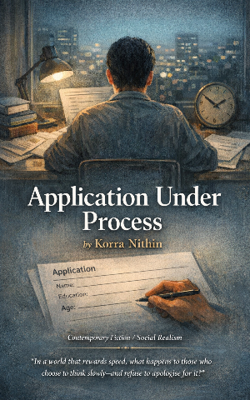
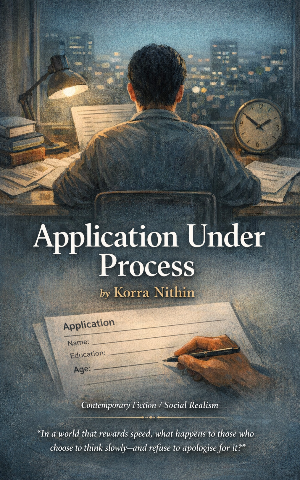
One night, he sat filling out a PhD application.
Name. Address. Qualifications.
Then—Age.
He stopped.
The number felt heavier than his degrees. He knew how it would be read—not as time lived, but as time wasted.
He wrote it anyway.
When he reached Research Proposal, something loosened. He wrote slowly, without fear of deadlines. His questions were not about quick answers, but about why some lives were always asked to hurry, and others allowed to unfold.
He finished near midnight.
Outside, coaching centres were still lit. Somewhere, thousands were revising. Somewhere, parents were worrying. Tomorrow’s headlines were already waiting.
Nothing had changed.
Except that one boy—average, invisible, out of sync—had chosen not to race.
Whether he would be selected, he did not know.
But for the first time, his life felt aligned with its own pace.
And in a world obsessed with early arrivals, In a world that rewards speed, what happens to those who choose to think slowly—and refuse to apologise for it…?