Library

 Profile
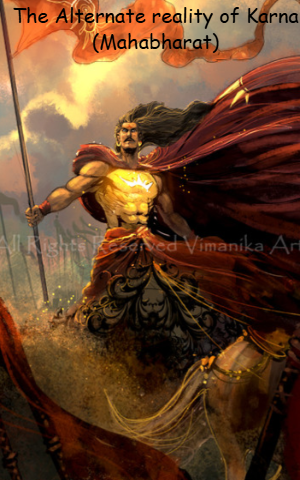
The Alternate reality of Karna (Mahabharat)
The Alternate reality of Karna (Mahabharat)

Karna was wide awake on his bed, trying to get some sleep but failing to do so as he observed the stillness outside and the hint of sunrise as a new day at war began. He felt he should be getting some rest before the battle but he did not have to worry about that now as, the command of battle was in the hand of Bishma who had forbidden him from participating, due to his non-Kshatriya origin.
Again the world only sees those things that are outside his control, again it refuses to see him for his skill but looks down upon him as low birth, his mind raged. Whenever he thinks of it his anger rises and his body starts shaking from this indignation. How hard he had tried to reason the benefits of his participation in the war, but Bhisma was adamant about him not participating. But it was not this fact that prevented the sleep in his eyes but the thing that happened to him a few mornings ago, he reminisced.
It was after he had given away his armor and earrings to Arjun’s father Indra Dev.
The memory of that fateful encounter with Kunti haunted Karna as he lay alone. Her words still echoed in his mind, each syllable a sharp reminder of his destiny, his misfortune.
He remembered the first time he saw her approaching him by the Ganga, her figure outlined by the golden light of the setting sun. At first, he thought she was another noblewoman seeking his aid—perhaps for alms or justice. But when she spoke, her voice trembling with unspoken truths, he sensed this meeting was different.
“I am Kunti,” she had said, her eyes moist and her hands trembling. “I am your mother.”
The words had struck him like an arrow. He had laughed then, a bitter sound filled with disbelief. “My mother?” he had scoffed. “You mean to tell me, after all these years of ridicule and shame, that I am not a Suta-putra but the son of a queen? Where were you, Kunti, when I was spat upon, when I was denied respect? Where was this so-called mother when I needed her most?”
Her face had crumpled, but she held her ground, her voice breaking. “I was a coward, Karna. I made a terrible mistake. I abandoned you out of fear, but not a day has passed when I haven’t regretted my decision. You are my firstborn, my greatest pride, and I am here now, begging you to return to your true family.”
He had stared at her, his heart torn between longing and anger. "You come to me now, on the eve of battle, to remind me of a birthright I was never allowed to claim? You expect me to abandon Duryodhana, the only man who treated me with honor, for brothers who mocked me all my life?”
Kunti had fallen to her knees then, her tears mingling with the dust. “I cannot undo the past, my son, but I can offer you a future. Stand with the Pandavas, Karna. Reclaim your rightful place. Let the world see you for who you truly are.”
He had looked away, the pain of her words searing through him. For years, he had dreamed of learning the truth about his lineage, but now that it was here, it felt like a cruel jest. After a long silence, he spoke, his voice steady but heavy with sorrow. “You gave me life, Kunti, but Radha and Adhiratha gave me love. Duryodhana gave me respect. My loyalty lies with them.”
Her sobs had pierced the air, but he had continued. “I promise you this: you will always have five sons. I will not harm Yudhishthira, Bhima, Nakula, or Sahadeva. But Arjuna… Arjuna is mine to fight. I cannot spare him.”
She had left after that, her shoulders hunched with defeat. Karna had watched her go, a storm of emotions raging within him. Even now, as he prepared for the inevitable war, he felt the weight of that revelation pressing on his soul.
“Fate,” he murmured to himself, “is a cruel master.”
The first day of the great war at Kurukshetra was drenched in warriors' blood, and cries of soldiers echoed through the vast plains. Karna, forbidden to participate in the war as long as Bhishma was the commander of the Kaurava forces, kept himself in the shadows, observing the devastation with a heavy heart. The faces of his true brothers-the Pandavas-haunted his thoughts, yet loyalty to Duryodhana had led him to this stage.
As the sun set on the first day, Karna began to feel apprehensive. Duryodhana was filled with confidence, speaking of his army's triumphs; but Karna could not share his expressions of joy He could not ignore the voice of his conscience, which questioned his role in this war. “Am I standing with dharma or merely with pride?” he wondered.
That night, as Karna stood alone under the starry sky, Krishna appeared before him. The divine charioteer’s face was calm, his eyes filled with understanding.
“Karna,” Krishna began, “you have always been a man of honor, but today, your honor binds you to adharma. The brothers you oppose are your own blood. The Pandavas need you, and dharma calls upon you to choose the righteous path.”
Karna’s heart ached. “Krishna, I have lived my life as Radheya, a son of a charioteer. My loyalty to Duryodhana is unshakable. How can I forsake him now, who stood by me through all that happened?
Krishna placed a comforting hand on Karna's shoulder. "True loyalty is when you guide your friend to righteousness, not enabling him in destruction. All these things will come together because of Duryodhana's ambition. All these will be ruined; and you can alter this war's course. This fight should be for dharma, not for egos."
Karna wrestled with emotions, but Krishna's words planted a seed of determination in his heart. Next morning, when the early rays of dawn broke up on the second day at Kurukshetra, Karna made a decision.
Karna entered the Pandava camp in the first rays of early dawn on the second day of the Kurukshetra war. The decision to defect had not come easily; it was a battle that raged in his soul as fiercely as the one outside. Karna had spent the night in anguish, haunted by Krishna's words. Memories of his life flashed through his mind: the cruel taunts of his peers, the shame of his unknown lineage, and the gratitude he felt toward Duryodhana for lifting him from obscurity. Yet, Krishna's revelation of his true parentage planted a seed of doubt that grew into an unshakable resolve by morning.
The warriors murmured at the sight of Karna entering their camp. Murmurs spread like wildfire. Arjuna, ever alert, instinctively reached for his bow, his expression a mixture of surprise and suspicion. Bhima scowled, his hands balling into fists, his muscles taut as if preparing for a fight. Only Krishna remained calm, his serene smile unchanging, as though he had foreseen this moment.
Karna stopped at the threshold of the tent, raising his hands in the gesture of peace.
"I come not as a foe," he began, steady but charged with emotion. "I come as a brother who has wronged you, seeking to make amends."
Yudhishthira moved forward. His face betrayed confusion mixed with hope.
"Karna, why have you come here? You stand with Duryodhana. What has changed?"
Karna took a deep breath, his hands trembling slightly. "Last night, Krishna revealed to me a truth I had long been denied: that I am the son of Kunti, your elder brother. My life has been a journey of pride and misfortune, and I have stood against you out of loyalty to Duryodhana, the man who gave me dignity when the world mocked me. But now, I see that loyalty to adharma is no loyalty at all. I cannot fight against my own blood, against the path of righteousness."
Arjuna stepped forward, his eyes narrowing with suspicion. "And we are to trust you now? After all these years of enmity? After standing by Duryodhana as he schemed and wronged us?"
Karna met Arjuna's gaze, pain evident in his eyes. "I have no excuse for my actions, Arjuna. But I swear upon my honor as a Kshatriya that I stand with you now. Not as a rival, but as your brother. Let my actions on the battlefield prove my intentions."
Krishna raised a hand to silence Arjuna. "Karna speaks the truth, Arjuna. His heart has been torn, but he has chosen the path of dharma. We must welcome him, for his strength and his conviction will be a boon to our cause."
Yudhishthira turned to Karna, his expression softening as tears welled in his eyes. "Brother," he said, his voice breaking, "if what Krishna says is true, then it is we who owe you an apology. You have suffered because of circumstances beyond your control, and yet you have chosen to stand with dharma. That is the mark of a noble soul."
Karna bowed his head, his voice heavy with emotion. "I ask for nothing but the chance to fight by your side, to protect what is just. Let me atone for my mistakes."
Bhima, though reluctant, finally spoke, his tone gruff but sincere. "If Krishna and Yudhishthira accept you, then so shall I. But know this: I will hold you to your word, Karna. Betray us, and you will face my wrath."
Arjuna remained silent for a moment longer, his mind wrestling with years of enmity and newfound truths. Finally, he nodded curtly. "Let the battlefield decide your intentions. Fight with honor, and I will accept you as my brother."
Kunti, who had been silently watching from the shadows, stepped forward. Her eyes were filled with tears as she approached Karna. She placed a trembling hand on his shoulder. "My son," she whispered, her voice choked with emotion, "you have made the choice of a true Kshatriya. No mother could be prouder."
Overwhelmed, Karna knelt before her, his head bowed. "Mother, I have wronged you as well. Forgive me."
Kunti embraced him, her tears falling freely. "There is nothing to forgive, my child. You have found your path, and that is all a mother could ask for."
With that, the bond between Karna and the Pandavas was sealed. The warriors of the Pandava camp, though still wary, began to accept his presence. Karna, now free of the burden of secrecy and guilt, felt a weight lifted from his soul.
As the sun climbed higher, the Pandavas and their newfound ally prepared to face the challenges ahead. Karna stood among his brothers, ready to fight not for personal glory, but for dharma, for justice, and for the family he had finally found.
Karna's defection shocked the Kauravas. The sting of betrayal hurt Duryodhana, but his rage only made him more resolute to destroy the Pandavas. Meanwhile, Karna brought new life to the forces of the Pandavas. His unmatched skill and strategic brilliance became a significant asset.
On the battlefield, Karna fought alongside Arjuna, and the two brothers unleashed a storm of arrows that decimated the Kaurava ranks. Bhishma and Drona, bound by their loyalty to Hastinapur, fought valiantly but could not suppress the newfound strength of the Pandavas.
As the war continued, Karna's sense of purpose deepened. He found peace in fighting for dharma, knowing he was on the right path. But destiny had already written his fate.
As the 17th day of the Kurukshetra war unfolded, chaos engulfed the battlefield. Blood-soaked warriors clashed with ferocity, and the cries of the wounded echoed like sad songs. Among them, Karna, now a Pandava ally, fought valiantly. The sun bore down on him as if reflecting the fire in his soul, and his every move was a testament to his unmatched skill and unyielding resolve.
But fate had decreed otherwise.
Ashwathama, fueled by rage and grief over his father Dronacharya’s death, saw Karna as a prime target. The encounter was brutal. The two warriors unleashed their arsenal, their celestial weapons illuminating the battlefield like streaks of lightning.
During the battle, Karna’s chariot wheel, cursed by a brahmin he had wronged, sank into the earth. His knowledge as imparted by Pashurama left him at this important injunction.
In the midst of this, Karna was struck down by a volley of arrows from Ashwatthama, who saw Karna’s death as revenge for his perceived betrayal of the Kauravas. Lying there, the cacophony of battle fading into a distant hum, his mind turned inward.
He felt the warmth of the blood seeping from his body, yet his thoughts were cold, calm. Is this what liberation feels like? he wondered, gazing at the sky painted with hues of crimson and gold.
Memories came rushing like a flood. The humiliation at the archery tournament, the taunts of his birth, and the unbreakable bond he had shared with Duryodhana. He had fought so hard for dignity, for a place in a world that had shunned him. Yet, here he was, dying not as a friend of Duryodhana but as a brother to the Pandavas.
“I chose this path,” he whispered, his voice barely audible over the din. “Not for glory... but for dharma.”
His heart ached for his mother, Kunti. Her revelation had changed his life. Though the bond had been brief, the warmth of her acceptance lingered, soothing his turbulent soul. Mother, I hope I have redeemed myself in your eyes. I hope you can grieve for me without shame.
The faces of his brothers flashed before him—Yudhishthira’s serene wisdom, Bhima’s fierce loyalty, Nakula and Sahadeva’s quiet resolve, and finally, Arjuna’s unrelenting spirit. With them, he had found not just allies, but family. He had fought beside them with every ounce of his strength, his arrows a shield for their cause.
A pang of regret pierced his heart. Will they forgive me for the years I stood against them? Will they remember me for the brother I became in the end, not the rival I once was?
He thought of Krishna, whose divine insight had guided him toward this path. “You knew this would happen,” Karna murmured with a faint smile, a tear slipping from the corner of his eye. “You always knew. And still, you gave me a choice. Thank you, for letting me choose righteousness over pride.”
He raised his eyes to the sky, where the sun was setting. His rays softened, as if bidding him goodbye. No fear, no bitterness, but only an extreme feeling of release. This is the end of my struggle, he thought. Maybe I'll find peace in a world where I am no longer chained by fate's ropes.
With one last breath, Karna closed his eyes and whispered a silent prayer to his lips:
May my soul find its place among the stars, where dharma and peace reign eternal.
And so, the great warrior Karna, son of the sun god, with immense valour and unyielding spirit inside him, accepted this with honour. His death was not just a termination of a life but a conclusion of a soul that had longed for justice, love, and belonging