Library

 Profile
Kidnapped 4
Kidnapped 4

Kidnapped 4
The mist hadn’t lifted when Meena shook Rounak awake. Not with her hands—with her boot, nudging his ribs through the yellow frock.
“Up,” she said. “Shanta Ma will reach the shrine by noon. We move now.”
Rounak sat up, shivering. The jungle was cold, damp, indifferent. His throat was raw from yesterday’s screaming. His thighs were scraped from the bark. His pride? That had been left behind in Kavita’s arms somewhere between the stream and the banyan tree.
Kavita was already rolling the thin blanket. She glanced at him, then at her sister. “He can’t walk today, Didi. Look at his feet. City feet. One more mile and he’ll bleed.”
Meena clicked her tongue. “So what? Want me to call a taxi?”
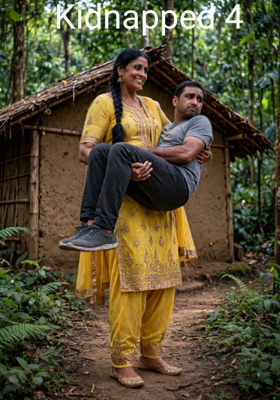
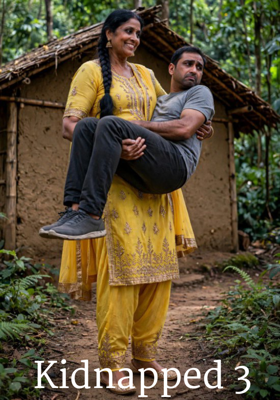
“No,” Kavita said, and her eyes did that thing—mischief, yes, but something else. Pity? No. Ownership. “I’ll carry him.”
Before Rounak could form the word ‘no’, Kavita was crouching. “Arms around my neck, babu. Now.”
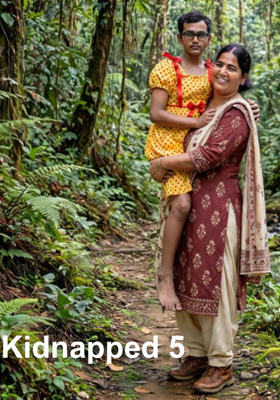
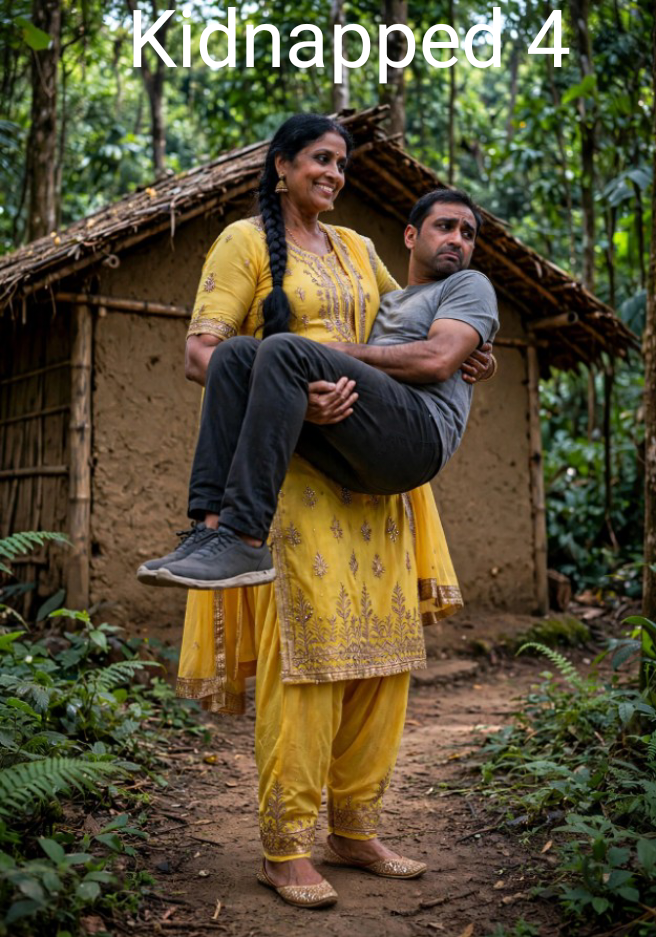
He obeyed. He’d learned. His short legs didn’t even reach her waist. She hooked one arm under his knees, the other across his back, and stood in one smooth breath. 5'11", 85 kilos, lifting 5'3", 63 kilos like he was the schoolbag she mocked him for being.
“You’re shaking,” she murmured, not unkindly, into his hair. “Cold or scared?”
He didn’t answer. His face pressed into her neck because there was nowhere else to go. She smelled of sweat, smoke, and the wild tulsi that grew near the shrine. Not perfume. Not city. Real.
Meena took point, pistol tucked into her waistband, eyes scanning. “Keep him quiet,” she told Kavita. “If he whimpers, gag him.”
Kavita didn’t gag him. She shifted him higher, settling his weight. “You hear that, Rounak ji? Didi thinks you’re a liability. Are you?”
He shook his head against her skin. “No. Please. Don’t drop me.”
They walked. The jungle thinned. The sun climbed. Kavita’s arms never wavered, but after an hour she muttered, “Didi. Switch.”
Meena didn’t argue. She stopped, turned, held out her arms. “Give.”
And that was how Rounak was passed—like a child between mothers, like a sack between workers—from Kavita’s cradle to Meena’s shoulder. Meena didn’t cradle. Meena hauled. Fireman’s carry, his stomach on her hard shoulder, head dangling, frock riding up, the world upside down and bouncing.
“Comfortable?” Meena asked the trees, not him.
He bit his lip until it bled. “Don’t cry. Don’t cry. Toys don’t cry.”
By midday they reached a dry riverbed. Meena dumped him unceremoniously on the sand. He landed on his hip, gasped. Kavita was there instantly, hauling him upright by the front of the frock.
“Easy, Didi,” she said, but she was talking to Meena, not comforting him. “If we break him, Ma will skin us.”
Meena squatted, her face level with his. For the first time since the burqa came off, Rounak saw her without the sneer. Tired. Young. 30 years old and carrying a gun and a man.
“Why did you pretend?” she asked, quiet. “Why let villagers think you were big?”
Rounak opened his mouth. A lie sat there. A truth sat deeper. He chose the truth because Kavita’s arm was still around his waist, and he was too tired to be anyone but small.
“Because…” His voice cracked. “Because when I’m 5'3", no one listens. When I wear shiny glasses, they do.”
Meena stared. Then she snorted. Not a laugh. A sound. “So you lied to feel tall.”
Kavita, behind him, burst out laughing. “And now you’re in a frock to feel small! Life is funny, na, babu?”
Meena stood. “We move when the sun dips. You—” she nudged Rounak with her foot, not hard, but not gentle—“you stay put. Or I’ll let Kavita hang you from the next tree.”
Kavita sat beside him, cross-legged, and pulled him sideways into her lap before he could protest. His head landed on her thigh. Her hand came down, heavy, warm, resting on his chest to keep him there.
“Rest,” she told him, like he was feverish. “Ma will be here soon. Then the real fun starts.”
Rounak closed his eyes. Not from fear. From exhaustion. The last thing he felt was Kavita’s fingers, absently straightening the wrinkled yellow frock over his knees. Not mocking. Tidying. Like he was, in fact, her doll.
And for one broken second, it didn’t feel like humiliation.
It felt like being held.
Then the twig snapped in the treeline, Meena’s pistol came up, and the moment shattered.
The sun was a white coin above the banyan leaves when the first stone skittered down the ravine path. Meena’s head snapped up. Pistol out. Kavita’s arm went around Rounak instantly—not a cradle, not a tease. A cage. Holding him against her side, one broad palm flat on his chest, feeling his heart go dhak-dhak-dhak like a trapped bird.
“Ma,” Meena breathed.
And Shanta Devi stepped into the clearing.
She hadn’t run. 50 years old, 5'10", 90 kilos of sari and sweat and command. She never ran. The jungle parted for her. In one hand, a cloth bundle. In the other, a stick, thick as Rounak’s wrist. Her eyes found her daughters first. Then the bundle on Kavita’s hip—yellow frock, red flowers, 5'3" of city man, bare feet, dusty, trembling.
“Report,” she said. One word. The birds stopped. Meena holstered the pistol.
“No trail. No police. Boys called. Company is stalling. They want proof of life.”
“Proof,” Shanta Devi repeated. She looked at Rounak. Not at his frock. Not at his size. At his eyes. He couldn’t hold her gaze. He dropped it, stared at the dirt, and that’s when he realized—he was more ashamed of her than of her daughters. Because Shanta Devi didn’t laugh. Shanta Devi weighed.
“Get down,” she told Kavita. Not Rounak. Kavita.
Kavita obeyed. Slowly. She set Rounak on his feet but didn’t let go. One hand stayed on his shoulder. 25 years old holding 35 years old like he was 5.
Shanta Devi stepped close. Her shadow covered him whole. He smelled her—soap, cheap, same brand he sold. The irony nearly made him laugh. Nearly.
“You,” she said. “Assistant Manager.”
Rounak flinched. She knew. Of course she knew.
“You lied to us. You made us believe you were worth crores. Now the boys think the same. Company thinks the same. Police will think the same. All because you wore shiny glasses.”
She wasn’t shouting. Shanta Devi didn’t need to. Each word was a stone.
“Ma,” Kavita started, defensive, “he—”
“Quiet.” Shanta didn’t look at her. “I’m talking to him.”
Rounak’s mouth was dry. Sandpaper. The stream was ten steps away. Meena and Kavita had given him water all day, in their palms, in their moods. He’d never asked. He’d taken.
Now Shanta Devi was here. Command, not cruelty. Maybe.
His voice came out smaller than he was. “...Paani.”
The word hung in the air. Water.
Meena blinked. Kavita’s fingers tightened on his shoulder. Shanta Devi’s expression didn’t change, but something behind her eyes did. A calculation.
“Who are you asking?” she said.
Rounak swallowed. His throat clicked. He looked up—past the 5'10" wall of her—and at Kavita. The one who’d carried him all morning. The one who’d whispered ‘rest’ last night. The one who’d caught him from the tree.
“Kavita… didi,” he said. The ‘didi’ slipped out. He didn’t plan it. It just... fit. “...paani de do. Water, some water please.”
Silence. Then Kavita’s breath hitched. Meena’s eyebrows went up.
Shanta Devi studied him for three seconds. Three years, it felt like. Then she nodded once, at Kavita. “Give him water.”
Kavita moved like she’d been unchained. She scooped him up—not cradle, not shoulder. Hip. Like a mother with a toddler, one arm under his thighs, his legs dangling on either side of her waist, his arms instinctively going around her neck to hold on. She walked to the steel pot, bent, poured water into a steel glass with her free hand, and held it to his lips.
“Slow,” she said. Not teasing. Not mocking. Instruction. “You’ll choke.”
He drank. The water was warm, metallic. It was the best thing he’d tasted in his life. Halfway through, his eyes watered. Not from the water. From the ask. From the given.
When he finished, Kavita didn’t put him down. She turned, still holding him on her hip, and faced her mother.
“He asked,” Kavita said. Simple. Like it mattered.
Shanta Devi watched her 25-year-old daughter holding a 35-year-old man like a baby. She watched his small hands fisted in the back of Kavita’s kurta. She watched the yellow frock bunched up, his bare knees knocking against Kavita’s side.
“He asked,” Shanta Devi repeated. “Good. Means he’s not dead yet.”
She turned to Meena. “Boys will call again tonight. They want video. Proof of life. We’ll give them proof.”
Meena frowned. “How? If police trace—”
“They won’t,” Shanta said. “Because the proof won’t be a man tied to a chair. It will be a man… alive.”
She looked at Rounak. Really looked. “Can you walk, Assistant Manager?”
He shook his head before he could stop himself. Honest. No. Feet cut. Legs shaking. Terrified.
Shanta Devi nodded as if he’d passed a test. “Then you’ll be carried. But not like a sack. Not like a joke.”
She looked at Kavita. “Take him to the stream. Wash his feet. Properly. The ransom is for a living man, not a cripple. And if the company sees him broken, they’ll pay less.”
Kavita’s grip on Rounak tightened. Not cruel. Claiming. “Ji, Ma.”
Shanta Devi started to turn away, then stopped. She reached into her bundle, pulled out something, and tossed it at Rounak. He flinched, but Kavita caught it one-handed.
A pair of hawai chappals. Size 7. Worn. Men’s.
“Your shoes were left on the boat,” Shanta said. “These were my husband’s. He was 5'4". They should fit.”
Rounak stared at them. The boys took his shoes. His wallet. His phone. His name. And this woman… kept a dead man’s chappals. For what? For who?
“Thank… thank you,” he whispered.
Shanta Devi’s face didn’t soften. But it didn’t harden either. “Don’t thank me yet. You’re still ransom. But ransom can be kept clean.”
She walked away, toward the shrine, to plan. To command.
Meena exhaled. “Well. Ma’s in a mood.” She looked at Kavita, at Rounak on her hip. “You heard her. Stream. Wash him.”
Kavita started walking. Rounak bounced with each step, his cheek against her shoulder. His voice was tiny. “Kavita… didi?”
“Hm?”
“Why… why did you catch me? From the tree?”
Kavita didn’t stop walking. Didn’t look at him. But her arm around his thighs tightened, just a fraction.
“Because if I didn’t,” she said, to the path, to the trees, to the jungle that wanted to eat him, “you’d be dead. And I didn’t carry you this far to let you die.”
Not ‘ha ha small man’. Not ‘my doll’.
I won’t let the jungle eat you.
Rounak closed his eyes. The frock was still humiliation. The arms were still a cage. But for the first time since the burqa came off, the cage felt like it was keeping something out, not just keeping him in.
And far behind, Shanta Devi sat on the shrine steps, dialing a number on a battered Nokia. The boys. The company. The ransom.
The Nokia was older than Rounak. No not exactly that…just saying. Shanta Devi held it like it was a grenade with the pin pulled. One wrong word, one traced signal, and the jungle would be full of khaki and guns.
“Boys,” she said into the phone. Her voice was stone. “7 PM. I’ll send video. You send it to company. No faces. No location. Only him. Alive.”
She cut the call. Looked at Meena. “Battery low. We get one take.”
Meena nodded. “I’ll set it.”
Kavita was still on the shrine steps, Rounak on her hip. He’d gone quiet after the water. After the chappals. After calling her didi. The yellow frock was dusty, the red flowers faded. His legs, too short, dangled like a child’s. His arms, too tired, stayed around her neck. Not clinging. Holding. Because if he let go, he’d fall.
Shanta Devi walked to them. Each step was a decision. She stopped in front of Kavita. In front of him.
“Put him down.”
Kavita hesitated. One second. Shanta Devi’s eyebrow went up. Kavita set him on his feet. Fast. Her hand stayed on his back. He swayed. The chappals were big. Her husband’s. The thought made his stomach turn.
Shanta Devi looked him up and down. Frock. Chappals. Hair wild. Eyes red. Small.
“Good,” she said. “You look broken. Company pays more for broken.”
Rounak flinched. Meena was propping the Nokia on a pile of stones, angle up, catching the last light.
“Script,” Meena said. “You say: ‘My name is Rounak. I’m Assistant Manager. I’m alive. Tell my company to pay. I’m hurt. I’m scared.’ Then you cough. Look weak.”
“I… I can’t,” Rounak whispered.
Shanta Devi stepped in. Not a slap. Not a kick. She lifted him. Both hands under his armpits, straight up, like he was three years old being plucked from danger. 90 kilos lifting 63 like nothing. His feet left the ground. His face came level with hers.
“You can,” she said, quiet. “Because if you don’t, my daughters will carry your corpse to the river. And I’ll still get money. Dead or alive, Rounak. But alive pays better. For you. For me.”
She set him down. Not dropped. Placed. That was worse. Careful.
Kavita’s breath caught. Meena’s finger hovered over ‘record’.
Rounak looked at the camera. Black dot. Small. Judging. He thought of his mother. His old father. His shiny glasses on the boat. His lie.
He thought of Kavita’s arm around him when he fell from the tree. I won’t let the jungle eat you.
He looked at Shanta Devi. “Can I… sit?”
She considered. “No. Standing shows you’re alive. Not dying.”
His legs shook.
Kavita moved. Fast. Before anyone could speak, she was behind him. One knee on the ground, the other up. She pulled him back, between her legs, his back to her chest, her arms coming around his waist. Sitting, using her as a chair. His head tucked under her chin. Her chin on his head.
“Now he’s standing,” Kavita said, voice hard, to her mother. To the world. “My legs are standing. He’s breathing. That’s enough.”
Shanta Devi stared. For the first time since the burqa came off, her mouth opened, then closed. She looked at her 25-year-old daughter holding a 35-year-old man like a baby in a warzone.
“Record,” she told Meena.
The red light blinked.
Rounak spoke. Voice small. True. “My name… is Rounak. I’m… Assistant Manager. I’m… alive. Please… tell my company…” He stopped. Looked up. Not at the camera. At Kavita. At didi. “...tell them I’m being treated… okay.”
Kavita’s arms tightened. Warning. Don’t.
He swallowed. “Tell them… to pay. I… I want to go home.”
A cough. Real. His ribs hurt from crying. From being carried.
“Cut,” Shanta Devi said.
Meena stopped recording. Silence. Only jungle.
Shanta Devi took the phone. Played it back. Rounak’s voice, tiny. Kavita’s arms, huge around him. Yellow frock. Red flowers. Shanta Devi’s face showed nothing.
“Send it,” she told Meena. “To the boys. Now.”
Meena went to the edge of the clearing for signal.
Kavita didn’t let go of Rounak. He didn’t ask her to. His body had given up. He was slumped, dead weight, in her lap now, her legs folded under her. Her kurta was wet from his sweat. From his tears he wouldn’t admit.
Shanta Devi squatted in front of them. Her knees cracked. 50 years. She was tired too.
“Why?” she asked Rounak. Not unkind. Asking. “Why did you say ‘okay’?”
Rounak couldn’t look at her. He looked at Kavita’s hand. On his stomach. Holding him together.
“Because…” His whisper was only for them. Not the camera. Not the company. “...she gave me water. When I asked.”
Shanta Devi was still for a long time. Then she stood. “Feed him. Both of you. He’ll need strength. If company says no, we walk further into the jungle. If they say yes, we walk to the road. Either way, we walk.”
She left. To think. To command.
Meena came back. “Sent.”
Kavita didn’t move. Rounak was asleep. Or pretending. 35 years old, in a frock, passed out on a 25-year-old’s lap after telling the truth to a camera.
Meena sat beside them. Looked at her sister. At him.
“He called you didi,” Meena said, soft.
Kavita didn’t answer. She just shifted, pulled Rounak higher, so his face was hidden in her neck. So no one could see him. So he could see nothing.
“Ma’s right,” Meena said after a while. “He’s ransom. But…”
“But?” Kavita’s voice was straw.
“But he’s also… light,” Meena finished. “Easy to carry. Hard to drop.”
The jungle got dark. The Nokia was off. The company was watching a video of a broken man in a yellow frock, held by arms that wouldn’t let him fall.
And the ransom?
That was Shanta Devi’s war now.
Rounak’s war was just... staying awake. In Kavita’s arms.