Library

 Profile
Kidnapped 3
Kidnapped 3

Raunak woke with a start as the first rays of sunlight slid through the thatched roof. His wrists ached from the rope, his back sore from the hard cot. When he turned his head, he saw Meena crouching near the fire, blowing gently on a bundle of straw to light it. Kavita was already outside, washing her face in the stream that trickled past the hut.
“Wake up, city babu,” Meena said without looking at him. “We have to fetch water before it gets hot.”
“I… I can help,” he said, his voice dry.
Kavita stepped inside, water dripping from her hair. “Help? You can’t even walk two steps without tripping over your own feet.”
She untied his wrists and tossed the yellow frock toward him.
“Wear this. The saree’s being washed.”
Raunak hesitated, staring at the bright fabric. “Please… don’t make me—”
Kavita cut him off. “You want to stay naked? Then fine. The monkeys will have fun watching.”
He lowered his eyes and slipped into the frock, which hung loosely at the shoulders but barely covered his knees. Kavita grinned, circling him like a mischievous schoolgirl. “Perfect. Just like a doll.”
“Enough teasing,” Meena said, but she was smiling too. “Get him ready. We’re going to the stream.”
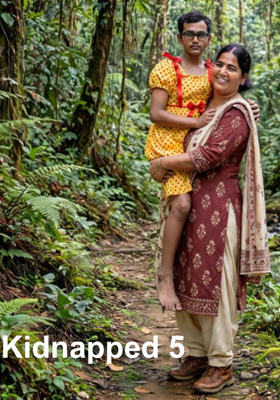
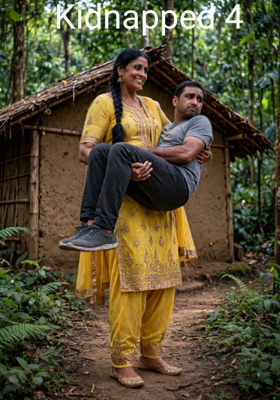
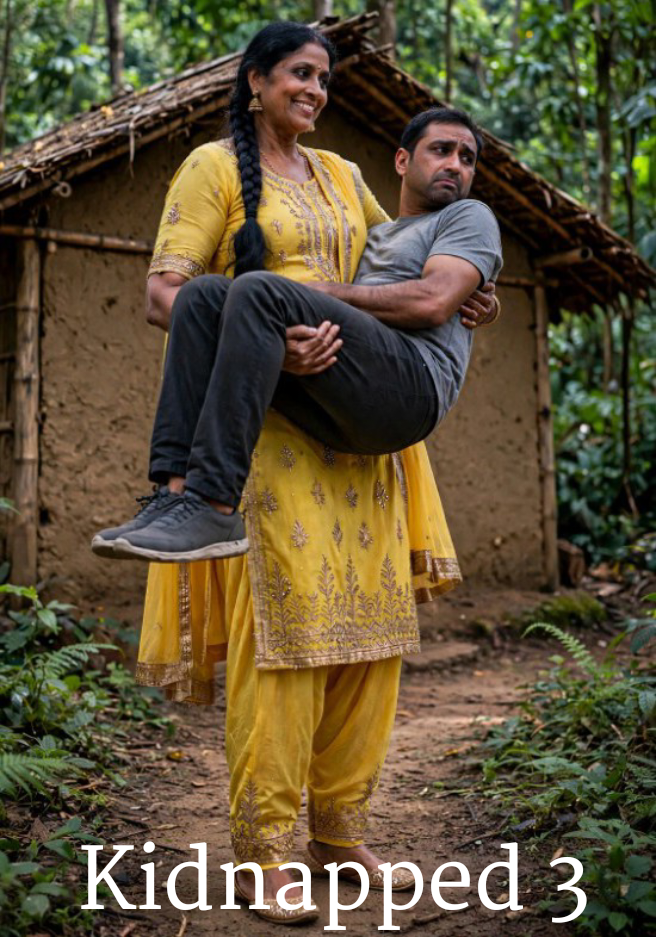
Before he could protest, Kavita crouched, slid one arm around his thighs and the other behind his back, and lifted him up in a clean swoop. He gasped, instinctively clutching her shoulders.
“Stop wriggling!” she said, walking out of the hut with him held across her chest. “You’ll make me drop you.”
The forest was waking up — birds calling, leaves whispering, the faint scent of damp earth. Kavita carried him down the narrow path as though he weighed nothing. When they reached the stream, she set him down on a smooth rock.
“Sit there. Don’t try running. You’ll get lost before you reach ten steps.”
Meena filled two metal pots and glanced at him. “He’s harmless now,” she said. “Look at him — barefoot, scared, and dressed like a little girl.”
Kavita chuckled. “Still trying to act proud though. See that face?”
Raunak stayed silent, his head lowered, hands trembling slightly.
They made him wash his face and drink water, then lifted him again for the walk back. This time, Meena carried him piggyback. Her strong shoulders swayed steadily as she climbed uphill. He could feel the rhythm of her breathing, the steady warmth of her back through the fabric of her kurta.
“Hold tight,” she warned. “If you fall, I’m not picking you up twice.”
By the time they reached the hut, the sun was high. They gave him food — rotis and spiced potatoes — and sat watching him eat.
Kavita leaned on her elbow. “You eat like a scared rabbit,” she said, tearing a piece of roti and holding it near his mouth. “Here. Try this bite. It has more salt.”
He hesitated, then took it. The laughter that followed was light, not cruel — yet every sound felt like another reminder of his helplessness.
Later in the day, they worked in turns outside while one stayed inside to keep watch. When the forest began to darken, they lit a lantern and made him sit near the wall.
Meena looked up from rolling the bedding. “No use tying him tight tonight. He knows better than to run.”
Kavita smirked. “If he runs, the owls will guide the leopards to him. Isn’t that right, city babu?”
Raunak didn’t answer. His eyes lingered on the flickering flame, the shadows of their faces on the wall, and he realized with quiet dread — the world beyond that hut was far more dangerous than the one inside.
The next morning began with a loud crash of thunder. Clouds rolled over the jungle canopy, turning the air thick and wet. Meena decided they needed to move deeper into the forest for safety; the ransom call from the boys had failed, and the women didn’t want to risk being discovered near the riverbank hut.
Kavita and her sister packed a few bundles of food and ropes. Raunak sat in the corner, clutching the hem of his yellow frock, watching them nervously.
“We’ll shift before noon,” Meena said. “And you—” she pointed a finger at Raunak “—you’ll walk quietly between us. No drama.”
“I won’t run,” he said quickly. “Please, I’ve told you already…”
Kavita smiled in that infuriatingly calm way. “Good. Then if you behave, maybe you won’t get carried like luggage.”
They started through the forest path, wet leaves brushing their ankles. The rain began again, heavy and sudden, and the mud sucked at their feet. Raunak tried to keep pace but slipped, his bare legs splattered brown. The women moved ahead easily, their height and strength obvious in the way they stepped over roots and rocks without breaking stride.
“Keep up!” Meena shouted over the rain.
“I’m trying!” he gasped, nearly falling again.
Before he could steady himself, Kavita turned, stomped back through the puddles, and in one swift motion hoisted him up sideways—one arm around his waist, the other under his knees. He let out a startled cry as she lifted him clear off the ground.
“Can’t walk? Fine, then I’ll carry you like a sack of rice!” she yelled above the storm.
“Put me down! I can walk—”
“Quiet!” Meena barked. “You’ll draw attention.”
Kavita trudged forward with him clutched against her, rain streaming down both their faces. When the path narrowed near the stream crossing, she set him down on a rock and wiped her brow.
“See? You’re more trouble than a calf,” she muttered, shaking water from her hair.
The stream was wider than before, frothing with the rain. Meena crossed first with the supplies balanced on her head. Then she called back, “Bring him across quickly.”
Kavita crouched in front of Raunak. “Get on my back. Unless you want to be swept away.”
He hesitated only a second before climbing on, arms tight around her shoulders. She rose easily, the muscles in her arms flexing as she waded into the water. The current pulled at her legs, but she kept her footing, stepping carefully from stone to stone.
Raunak could feel her steady breathing, the tension of her back under his hands. For a strange moment, fear and relief mixed inside him—his safety depended entirely on her.
When they reached the other side, she leaned forward sharply, sending him tumbling onto the grass. He sputtered, but she was already laughing.
“Next time, keep your balance, city babu,” she teased. “You’re not made for the wild.”
Later, when the rain eased, they stopped near a large banyan tree to rest. Meena unpacked food while Kavita climbed the roots to check for a dry spot. She glanced down at Raunak, who sat hugging his knees.
“Still scared?” she called.
He looked up, trying to hide his exhaustion. “I just want this to end.”
Kavita dropped lightly to the ground. “Then stop acting like a prisoner. Earn your food. Help us gather firewood.”
He nodded, but as soon as he tried to move, she smirked and said, “Not so fast.” Before he knew it, she’d grabbed him by the waist again, lifting him high just to hear him yelp. She spun him once, then set him on a dry rock.
“See? You can be useful—just stay where I put you.”
Even Meena laughed softly at that. For a fleeting moment, the jungle seemed less threatening, the air less heavy with fear. But Raunak knew this odd rhythm—the teasing, the unexpected bursts of rough kindness—was just temporary.
When Meena announced the plan to shift their camp deeper into the jungle, Shanta Devi had shaken her head.
“You two go ahead first,” she’d said, her voice calm but firm. “The hut still has supplies and the radio. If the boys call again, someone must answer. They’ll want proof that the man is alive.”
She had a practical mind and a commanding presence. It was Shanta Devi who had handled most of the logistics — food storage, keeping the ransom channel open, managing the young men who’d originally abducted Rounak. She wasn’t reckless; she preferred to wait until she was sure no one had traced the location.
“Once I get confirmation that the call went through and the amount is agreed, I’ll follow. I’ll find you near the old forest shrine,” she told them.
So Meena and Kavita had left at dawn with Rounak, while Shanta Devi remained behind in the hut, guarding both their tracks and their secret.
By dusk, the rain had thinned to a steady mist. The three of them had reached the outskirts of an abandoned shrine, its stone pillars mottled with moss, banyan roots snaking over the courtyard like frozen waves. Meena decided they would rest here for the night.
“We’ll light no fire,” she said, scanning the darkening tree line. “Smoke can be seen for miles.”
Kavita dropped her bundle with a sigh and stretched her arms. “At least it’s dry here.” Then, turning to Rounak: “And you — sit down before you faint.”
He obeyed, sinking to the cool ground. His legs trembled; the day’s march had drained him completely. Despite his humiliation, a strange truth gnawed at him — without these women, he wouldn’t have survived half a day in this forest.
As the night fell thicker, the jungle came alive with sound — frogs, crickets, the distant call of jackals. Rounak hugged his knees, startled at every crackle in the dark.
When the wind shifted, Meena whispered, “Footsteps.”
They froze. From somewhere beyond the trees came the low hum of an engine — a jeep perhaps — then the flash of a distant light moving slowly through the mist.
“The search party,” Meena breathed.
Before he could react, Kavita grabbed Rounak’s arm. “Move.”
He stumbled, but she didn’t waste time arguing. She crouched, hooked an arm under his knees, and swept him up as though he weighed nothing. He clutched at her shoulders, too stunned to protest as she carried him behind one of the fallen temple walls.
“Stay still,” she hissed. Her breath was quick but steady; his was ragged.
The light came closer, sweeping over the shrine’s entrance — then passed on. They waited another full minute before anyone dared move.
When it was safe, Kavita set him down gently. His voice shook. “You—you saved me.”
Meena gave a short, quiet laugh. “Don’t flatter yourself, city babu. We saved ourselves. You’d have screamed if we left you behind.”
Still, she ruffled his hair in mock irritation, then handed him a piece of bread. “Eat. You’ll need strength tomorrow.”
He took it silently. The bread was coarse, but it tasted like safety.
Later that night, they decided to rest in turns. Meena took first watch. Kavita spread a thin blanket on the stone floor and motioned to Rounak. “Lie down before you collapse.”
He did. A few minutes later, his body began to shiver — not from cold, but from the exhaustion and tension of the day. Without a word, Kavita reached over, pulled him a little closer, and draped her arm around him like an older sister calming a frightened child.
He froze for a second, embarrassed. But her tone left no space for pride.
“Sleep, Rounak. You’re safe for now. You won’t last out here without us.”
He didn’t argue. The sound of her heartbeat against his ear was steadier than the forest outside.
Hours later, Meena woke them both. “We move before dawn.”
Rounak groaned softly. “Can’t we rest a little—”
“No,” Meena cut him off. “The searchers may return. Kavita, carry him across the ravine; the rocks are slippery.”
Kavita stood, brushed the dirt from her hands, and looked down at him. “You heard her.”
Before he could protest, she stooped and hoisted him piggyback. His arms looped around her neck automatically. She adjusted her grip and started walking, her breath forming small clouds in the chilly air.
From her back, Rounak could see the dark forest stretching endlessly ahead — and, for the first time, he realized how utterly dependent he was on these two women. His pride had long vanished; now, only survival mattered.