Library

 Profile
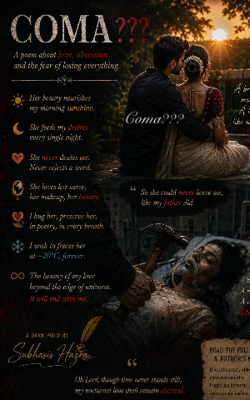
Coma???
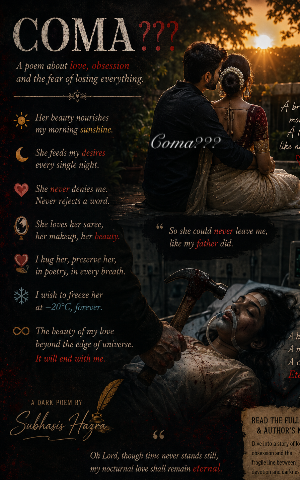
Coma???

A bright morning, A lover is sitting beside his beloved.
Asking the Almighty, "Is this love enough to spend a lifetime with your better half?"
Her beauty nourishes my morning sunshine.
She feeds my sexual desires every single night.
Every night, we come close to fulfilling my coital desires.
We are intimate multiple times, yet she never denies my feelings.
She never rejects a single word I say, nor does her heart ever refuse to respond.
But she genuinely loves dressing up in a beautiful saree, putting on makeup.
I just quietly hug her, cherishing the moment in my backyard.
Sometimes her face becomes so pale that I have to put some little extra makeup on it myself.
I want to preserve her with the help of my poetry, or freeze her at −20°C.
Now, the beauty of my love can truly be compared to the edge of the universe.
It will truly end with me.
One day, she will die, and this cruel society will turn my better half into ashes.
So, a couple of weeks ago, I used a hammer and struck the back of her head, putting her into a coma.
So she could never leave me, like my father did.
Oh Lord, though time never stands still, my nocturnal love shall remain eternal.
## Author's Note##
This poem is intended to be read as a dramatic monologue, a literary form in which the reader hears the voice of a fictional speaker whose own words gradually reveal the truth about their personality, motives, and state of mind. It draws inspiration from Robert Browning's Porphyria's Lover and My Last Duchess, where the narrator unknowingly exposes his psychological instability while believing his actions to be reasonable or even loving.
The speaker in this poem is an unreliable narrator. His understanding of love is profoundly distorted by obsession, possessiveness, fear of abandonment, and unresolved emotional trauma. As the poem unfolds, what initially appears to be a tender expression of romance slowly transforms into a disturbing portrait of a mind unable to distinguish love from ownership, affection from control, and devotion from violence. The gradual shift from warmth to horror is intentional, inviting readers to question every earlier image in light of the later revelation.
The recurring imagery of beauty, makeup, preservation, poetry, freezing, and eternity is symbolic rather than literal. These images represent the narrator's desperate refusal to accept impermanence. His desire to preserve the woman he loves reflects an inability to cope with mortality, change, and the possibility of loss. Throughout the poem, the narrator attempts to resist time itself, believing that permanence can be achieved by denying another person's freedom.
The reference to the father's departure is equally significant. Rather than serving as an excuse, it offers psychological context for the narrator's fractured worldview. His childhood fear of abandonment has evolved into an obsessive need to prevent separation at any cost. The poem does not justify his actions; instead, it illustrates how unresolved trauma can distort a person's perception of love and human relationships.
This work is entirely fictional. The narrator's thoughts, beliefs, emotions, and actions are those of an imagined literary character and should not be interpreted as the personal views, experiences, intentions, or values of the author. Any resemblance to actual people, incidents, or circumstances is purely coincidental.
Above all, this poem is not written to romanticize, glorify, encourage, or justify violence, coercion, abuse, or psychological manipulation. Its purpose is to examine the darker complexities of the human psyche through literature and to demonstrate how an unreliable narrator can reveal disturbing truths while remaining convinced of his own innocence.
Readers are encouraged to approach this work not as a confession, but as a study of character—a fictional exploration of obsession, grief, trauma, and the fragile boundary between love and possession.