Library

 Profile

The Tale of a City
The Tale of a City

2200 CE
It stands abandoned, once the melting point of culture, literature, ballads of love, and a symbol of oneness.
A city founded a thousand years ago, legendary for its ambrosial nectar, refuge to every traveller on the Silk Road, the land of the giving.
This is the first time she has been sent out to see for herself what the world outside her sphere is like…
Every novice gets to visit a place of their choice. Her choice is purely emotional.
After she had made her choice, she spent days in the archives, going through whatever material was available. Her sphere prides itself on having the best archives. There are images, papers, and documentaries, and she had spent days locked up in the archives trying to understand the pulse of the city she would be visiting.
'It's not like what we are used to, though at one time, it was one of the most vibrant regions of the world', the archivist had said. He is an old man, having lived in her sphere for a very long time. She has heard that only those who crossed three hundred would get the privileged archivist position. He mentioned that he had heard firsthand experiences from the first settlers.
He knew she was one of those few special ones who longed to know about where they came from, and had been happy to assist her.
Even though it has been hundreds of years since her family left the city, she still feels connected to her roots.
'It was too late to do anything', her mother had told her, as she remembered what her great-grandparents had lamented.
While her family still reminisced, her teachers were very clear about how they should function.
'This is our world now', her teachers always said, making sure that everyone followed the path laid out by the committee.
Sector 18, where she lives, is a smart purpose-built city, with its gleaming pathways and linear designs. There is a place for everything, and no one has ever seen anything awry. There are laws in place, enforced by the politburo, after having learnt from the mistakes of the generations gone by.
Everyone knows what's expected of them, and everything runs like clockwork. While life is good, there are a few like her who feel a sense of loss. The rest just go on with their lives.
Her days are regimented, so the feeling of dismay is a fleeting one.
She has her life plan chalked out for her as soon as she returns after the foray…
She sets the timer on her device, as instructed by her handler, who is scheduled to return at a designated time. The resources are enough to last those hours. She is aware that even though there is light for a few hours every day, the sun is not visible because of the particulate matter that stays suspended in the atmosphere.
There is a wind blowing, stirring up the dust, and the stark landscape looks more depressing than what has been shown to her in the archives.
There was a time, long ago, when it had looked different, looked colourful, and was inhabited.
'It's so unlike what I imagined', she thinks to herself, as she walks on, following the directions on her tablet.
Her destination is the museum, which, as per the archives, was left intact when the population moved. Each family had been allowed five items each, as a memory of what they had had to leave behind.
In their residential block, those five things are still revered;
a collage of photographs of the abandoned homes through generations, the book with their family tree, which gets updated every time there is a change, a collection of video recordings of her ancestors before they had to leave this land, a bejewelled sword, and a chipped family seal. There is a story of a glorious family, which they reminisce about, but she is not sure how much of it has been altered over the centuries.
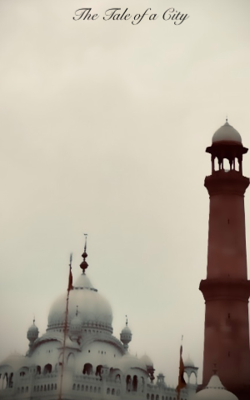
As she turns the corner, she finds herself in front of a palatial structure, which her device confirms is the museum, The Museum of Lost Glory.
The fact box on her device identifies the architecture and the age of the building.
She takes a moment to marvel at the arches and domes, noting the Mughal and Hindu influences that gave birth to the quintessential Sikh architectural style.
With trepidation she pushes open the doors, entering a space that like everything else is covered with layers of dust. It's dark, so she uses her light scatterer to illuminate the space within. What her eyes see leaves her astonished. The room is filled with statues and display cases, the domed ceiling adorned with frescoes, though some seem faded, and the mosaic floor shows the map of the region. Each installation is arranged according to the area it showcases. Time has marred the beauty of the museum, but the history it holds fascinates her like nothing ever before.
Wiping the dust away as she walks from one exhibit to another, she discovers objects, images of which she has seen in the archives. There are miniatures, jewels, manuscripts, and armours. There are guns, cameras, instruments, and maps.
Each display has been labelled, the period it belonged to, and a brief description of its significance.
She pauses next to a large dome in the centre, which, given its size, must have something within. Wiping the dust off the surface, she finds a wedge, which when pushed, slides open the dome, revealing a small amphitheatre. There is a screen with a projector, with a few chairs around.
Unable to find a power source, she links the projector wire to her backpack, and the machine whirs on.
The screen lights up with the title, The Tale Of A City.
'The land of rivers, swaying fields, bursts of colour, blessed by the gods. The land of poets and lovers…', booms the deep voice, as the images on the screen change.
There were drawings, maps, paintings, and photographs, all bringing to life how things had been.
The documentary rolls on as the unknown voice describes how the city was founded.
'…as per records, the settlement was built in the 1570s, on a piece of land given by a benevolent emperor to the learned one. In his thirst for knowledge, the emperor traversed the length and breadth of his empire, engaging with thinkers and philosophers. It's near the rivers Ravi and Beas, tributaries of the mighty Indus, that he came across a new way of life. The leader of this group did not call himself the chief. He told the emperor that his job was only to serve the people, like the three learned ones before him. So impressed was the emperor that he bestowed the most arable land in the region upon this humble man. Following the tenets of those before him, he ensured that every inhabitant of this new settlement fulfilled the role of an honest worker, one who lived in humility and gratitude…'
The documentary goes on to show artists' blueprints of the city, laid out as a grid around a sarovar, a man-made lake, which later would become the spiritual epicentre of the city, with a magnificent temple, open to one and all.
The images show people in vibrant attire, working, dancing, reading, and duelling.
There are images of lush green fields, of boats on the rivers, of writers contemplating as they filled up the scrolls.
There are warriors, artists, farmers, and minstrels.
The painted scenes range from celebrations to sieges, to battles. Some miniatures show hunting scenes. There are also depictions of lovers in gardens and groves.
The documentary goes on further to describe the reign of a loved maharaja, and his decline too.
'…this land was never the same when it was annexed by the colonists. As the century turned, new heroes emerged. A new movement brought together diverse voices, all of which in unison wanted freedom, self-governance, and equality…'
The voice goes on to describe the revolution, the massacre in 1919, the country gathering behind a bespectacled man, who walked the length and breadth to garner support. And freedom was achieved, but the cost was of a magnitude that generations would pay for.
She had felt tears sting her eyes when she saw the footage from 1947, of people crossing the border, sitting hopelessly in camps, and the carnage that had soaked the land in blood.
The reel showed footage of displacement, rebuilding, flags being hoisted, and a man giving his speech as a new era started,
'Long years ago, we made a tryst with destiny. Now the time has come when we shall redeem our pledge-not wholly or in full measure-but very substantially. At the stroke of the midnight hour, when the world sleeps…'.
The city she realises had gone through a lot, its people resilient, but as time had gone by, divided.
The documentary goes on to describe the cataclysmic events of the 1980s, with guns and killings, and destruction. The start of this millennium too had been chaotic. She observes how erratic things were as technology advanced. In her world, other than the politburo, no one can make any decisions. Everything is planned, including technological research, infrastructural changes, and even personal progress.
'No wonder things went out of control', she mutters, as the documentary goes on to show political unrest, environmental degradation, starvation, rioting, and apocalyptic destruction.
The unknown voice goes on, '…this is what we have come to. The world as we know it is uninhabitable. We have killed, not just our own, but also the other species that shared the planet with us. The land is arid, and the crops have failed. Our rivers and seas are dirty, and we don't have enough water to survive. The air is toxic, deadlier than the deadliest killer gas. There is talk that we will have to leave our homes soon. There is a new world being built. Some refuse to leave, and the government is fine with that. After all, we are the ones who understand the term democracy. It's another story how in the name of democracy we have destroyed the world as we know it. I have decided to stay on till my end. They say it could happen very soon because of the toxins. But that's a price we have to pay. It's we who choose. It may not have been me alone, but as a collective, we all need to pay the price. I wish those who are moving away the best. I hope that long after we are gone, someone will remember where they came from and learn from our mistakes.
I am Hukam Singh, the last curator of the Amritsar Museum, from now on called, 'The Museum of Lost Glory'.
She sits transfixed in the chair, absorbing the magnitude of what has happened. The timer beeps, reminding her of her scheduled rendezvous. Her long sigh fogs up her helmet and she immediately presses the defog button. Time is short, so she decides to take the documentary reel with her. There are those in her biosphere who would want to know where they came from.
She walks out of the museum towards the square where she had landed. Her handler stands outside the spacecraft waiting for her.
She quickens her step.
The longer she stays here, the more difficult it will get, physically, and emotionally.